
Your partner says you’ve been short with everyone lately. You’re staying later at work, or at the bar after work, and you can’t remember the last time you slept straight through. You wouldn’t call it sad. It’s more like irritated, wired, and done. If that sounds like you, or like the man you live with in Tampa or Jacksonville, here’s the part nobody tells you: depression in men doesn’t always look like depression. Sometimes it looks like a short fuse.
This guide is educational, not a diagnosis. We’ll walk through the signs of depression in men that tend to get missed, why so many men wait years to bring it up, what the research says about male depression symptoms like anger and heavier drinking, and how a video visit with New Age Psychiatry works for adults anywhere in Florida.
Key Takeaways
- In a national U.S. survey, men reported more anger attacks, substance use, and risk-taking than women.
- When researchers counted those signs alongside the classic ones, men and women met criteria for depression at about the same rate.
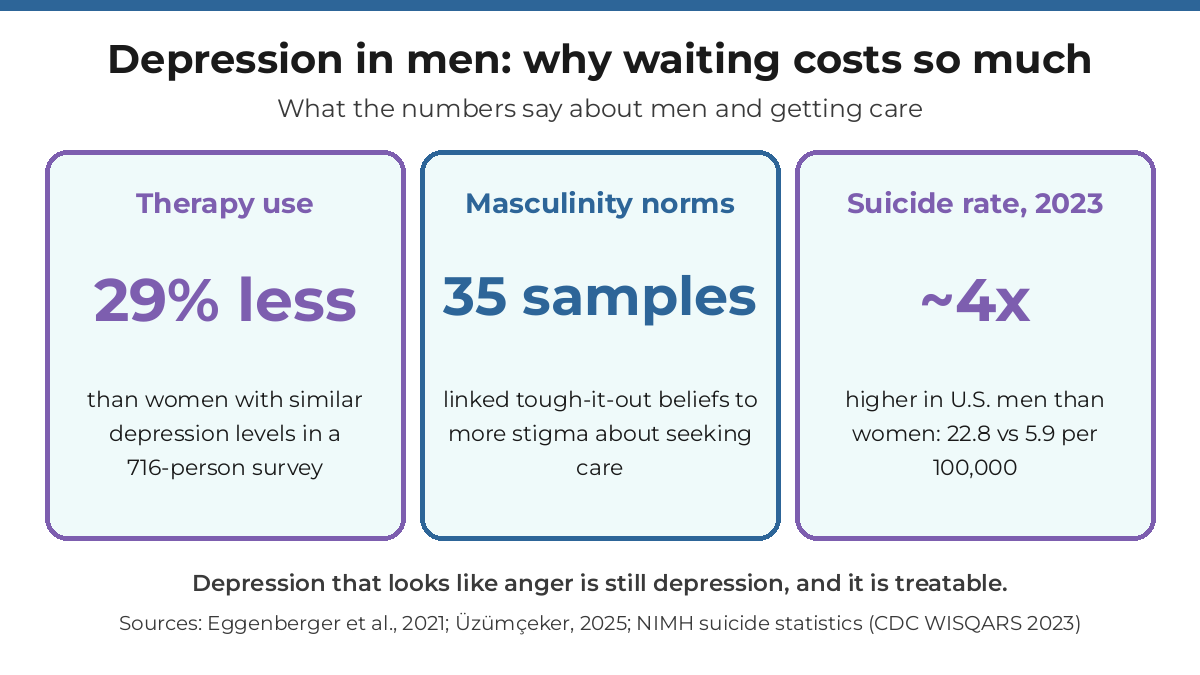
- In one survey, distressed men used therapy 29% less than women with similar depression levels, and men with more anger-type symptoms were even less likely to be in therapy.
- In 2023, the U.S. suicide rate for men was nearly four times the rate for women.
- Psychiatric care by video has held up well against in-person care for mood disorders in randomized trials.
What Depression in Men Can Look Like
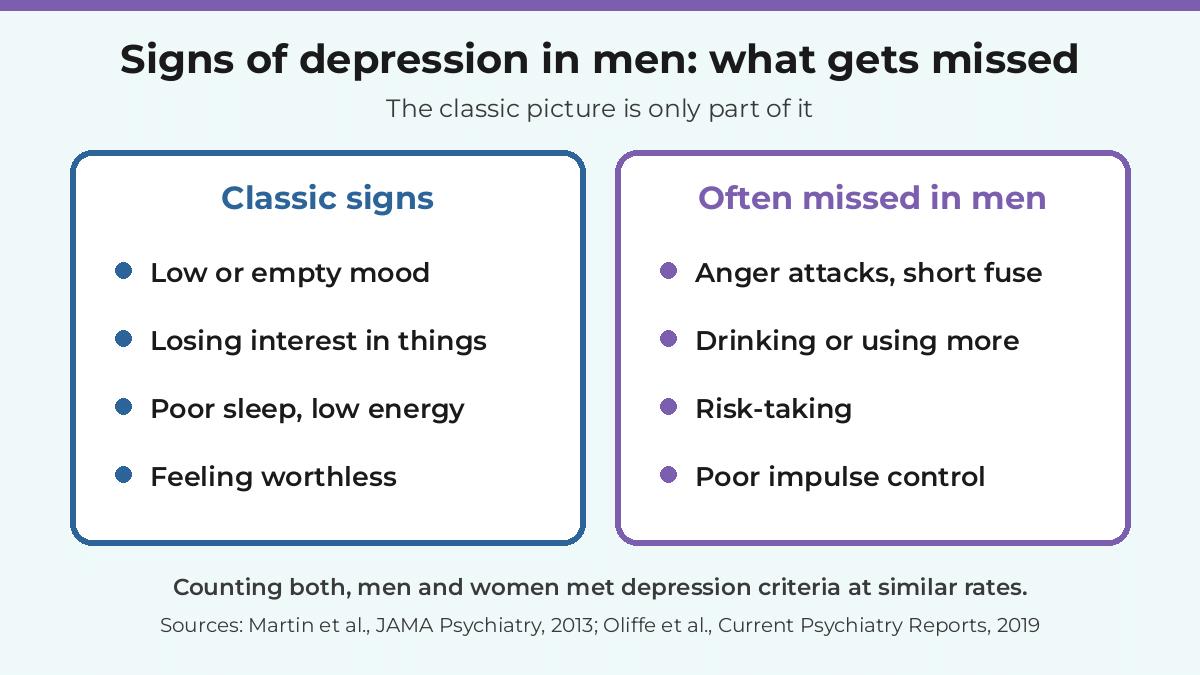
The textbook picture of depression is a person who’s tearful, flat, and stuck in bed. Plenty of men don’t fit that picture. In a large national survey analyzed in JAMA Psychiatry, Martin and colleagues found that men reported higher rates of anger attacks and aggression, substance abuse, and risk-taking than women, and when those symptoms were counted alongside the traditional ones, 30.6% of men and 33.3% of women met criteria for depression, a difference that wasn’t statistically meaningful (PubMed). Put plainly, part of the “women get depressed more” gap may come from what we’ve been looking for.
A review in Current Psychiatry Reports by Oliffe and colleagues came to a similar place. They wrote that substance misuse, risk-taking, and poor impulse control in men point to the need for depression screening and risk assessment that account for gender (PubMed).
“I’m not depressed. I’m just stressed.”
That’s the line. Men say it about themselves, and the people around them say it too. Stress is real, and not every bad month is a mood disorder. But when the irritability has been there for weeks, when the drinks are doing more of the work, when things you used to care about feel pointless, it’s worth asking whether something underneath has shifted.
Signs of Depression in Men That Get Missed
These are the male depression symptoms the research keeps pointing back to. None of them proves depression on its own. Together, and lasting, they’re a reason to get checked:
- A shorter temper than you used to have, or anger that comes out of nowhere
- Drinking more, or leaning on weed or pills to get through the evening
- Taking risks you’d normally skip, like driving too fast on I-95 or making impulsive money moves
- Trouble holding back, saying or doing things you regret
- The classic signs too: low mood, losing interest, poor sleep, feeling worthless
Irritability and depression go together more than people think
Irritability and depression aren’t opposites. For some men, a short fuse is simply how low mood shows up. Screening tools are starting to catch up. In a study of 949 Australian men, Herreen and colleagues tested a seven-item short form of the Male Depression Risk Scale and found that men with both classic depression symptoms and male-type symptoms had significantly higher risk of serious distress and current suicidal thinking than men with classic symptoms alone (PubMed). The authors suggested the tool may flag men who don’t hit the cutoff on standard depression questionnaires.
Why Men Wait So Long to Bring It Up
A lot of men were raised to handle it. Push through, don’t complain, figure it out. Plenty of guys get through years that way, and that’s exactly how depression goes unnoticed. In an online survey of 716 adults in psychological distress, Eggenberger and colleagues found that men used psychotherapy 29% less than women despite similar depression levels, and men with more externalizing symptoms, the anger and acting-out kind, were less likely to be in therapy (PubMed).
A 2025 meta-analysis of 35 samples by Üzümçeker found that stronger endorsement of traditional masculinity was linked to more negative attitudes toward seeking psychological help and more self-stigma about it (PubMed). Being the guy who handles things isn’t the problem. Handling depression alone, for years, is.
Why This Matters
We’re not going to sugarcoat this part. According to the National Institute of Mental Health, the suicide rate among U.S. males in 2023 was nearly 4 times higher than among females, 22.8 versus 5.9 per 100,000. Depression that hides behind anger or alcohol is still depression, and it still carries that risk. Catching it earlier is the point.
Men’s Mental Health in Florida: What a Video Evaluation Looks Like
For a lot of men, the hardest part is the first appointment. Telehealth takes out some of the friction. You can do a visit from your truck on a lunch break in Orlando or from the kitchen table in Fort Lauderdale, as long as you’re physically in Florida at the time. Expect a straight conversation about:
- How long the irritability, low mood, or burnout has been going on
- Sleep, energy, appetite, and how you’re doing at work and at home
- Alcohol, cannabis, and any other substances, asked without judgment
- Any history of depression, anxiety, ADHD, or bipolar disorder in you or your family
- Your current medications and medical conditions
Does video work as well as sitting across from someone? For mood and anxiety disorders, the evidence is encouraging. A 2023 meta-analysis of 20 randomized trials by Shaker and colleagues found that psychiatric treatment by telemedicine was comparable to in-person treatment for PTSD, mood disorders, and anxiety disorders in efficacy, patient satisfaction, and dropout rates (PubMed).
What care can include
The National Institute of Mental Health lists medication and talk therapy, including telehealth and online options, among the established approaches for depression. For men specifically, researchers are testing programs built around how men actually talk about this. A 2023 review by Eggenberger, Ehlert, and Walther described early male-tailored programs that showed promising results, including an online resource that improved depressive symptoms, suicidal thinking, and help-seeking, while noting that larger studies are still needed (PubMed). What fits you depends on your symptoms, your history, and what you’ve already tried.
Who This Is For, and Who Needs Faster Care
This is for Florida men, and the people who love them, who keep chalking up a bad stretch to stress, a rough season at work, or “just how I am.” It’s also for anyone who notices the drinking has crept up to cover something.
Telemedicine has limits. As our FAQ explains, New Age Psychiatry doesn’t provide telehealth care for people with a history of psychosis, a recent suicide attempt or suicidal thoughts in the past six months, thought disorders, bipolar I disorder, or dementia. If that’s where things are, we’ll tell you plainly that a higher level of care is the safer fit. If you or someone you know is thinking about suicide, call or text 988, chat at 988lifeline.org, or call 911.
Depression in Men: How New Age Psychiatry Works Across Florida
New Age Psychiatry is a telehealth-only psychiatry practice for adults across Florida, led by Hilary Ortega, PMHNP-BC. Visits happen by secure video, so it doesn’t matter whether you’re in Miami, Tampa, Orlando, Jacksonville, or a small town off I-75. The first visit is a real evaluation of your mood history, not a quick checklist, and follow-ups are where the plan gets adjusted.
If you read this and thought of yourself, or of someone at your dinner table, that’s reason enough to book an evaluation. You can also read more on the New Age Psychiatry blog, including high-functioning depression in Florida, bipolar II vs depression, and burnout and emotional exhaustion, or see how a psychiatric evaluation online in Florida works. For more on telehealth psychiatry Florida options, visit our online psychiatrist in Florida page.
Frequently Asked Questions
What are the signs of depression in men?
Low mood, loss of interest, poor sleep, and feeling worthless are classic signs. Men are also more likely to show anger attacks, heavier drinking or drug use, and risk-taking. If several of these have stuck around for weeks, get evaluated.
Can anger be a symptom of depression?
Yes. Research on male depression symptoms has repeatedly linked anger and aggression to depression in men. Anger on its own doesn’t mean depression, but persistent irritability alongside other changes is worth a closer look.
Why don’t men get diagnosed with depression as often?
Part of it is that men tend to seek help less, and part of it is that standard checklists focus on sadness and tearfulness. When anger, substance use, and risk-taking are counted, the gap between men and women largely disappears.
Can I get evaluated for depression online in Florida?
Yes. New Age Psychiatry sees adults located in Florida by secure video, from Miami and Fort Lauderdale to Tampa, Orlando, and Jacksonville, within the limits described in our FAQ.
References
Eggenberger, L., Ehlert, U., & Walther, A. (2023). New directions in male-tailored psychotherapy for depression. Frontiers in Psychology, 14, Article 1146078. https://doi.org/10.3389/fpsyg.2023.1146078
Eggenberger, L., Fordschmid, C., Ludwig, C., Weber, S., Grub, J., Komlenac, N., & Walther, A. (2021). Men’s psychotherapy use, male role norms, and male-typical depression symptoms: Examining 716 men and women experiencing psychological distress. Behavioral Sciences, 11(6), Article 83. https://doi.org/10.3390/bs11060083
Herreen, D., Rice, S., & Zajac, I. (2022). Brief assessment of male depression in clinical care: Validation of the Male Depression Risk Scale short form in a cross-sectional study of Australian men. BMJ Open, 12(3), Article e053650. https://doi.org/10.1136/bmjopen-2021-053650
Martin, L. A., Neighbors, H. W., & Griffith, D. M. (2013). The experience of symptoms of depression in men vs women: Analysis of the National Comorbidity Survey Replication. JAMA Psychiatry, 70(10), 1100–1106. https://doi.org/10.1001/jamapsychiatry.2013.1985
National Institute of Mental Health. (n.d.). Depression. U.S. Department of Health and Human Services, National Institutes of Health. Retrieved November 3, 2026, from https://www.nimh.nih.gov/health/topics/depression
National Institute of Mental Health. (2025). Suicide. U.S. Department of Health and Human Services, National Institutes of Health. Retrieved November 3, 2026, from https://www.nimh.nih.gov/health/statistics/suicide
Oliffe, J. L., Rossnagel, E., Seidler, Z. E., Kealy, D., Ogrodniczuk, J. S., & Rice, S. M. (2019). Men’s depression and suicide. Current Psychiatry Reports, 21(10), Article 103. https://doi.org/10.1007/s11920-019-1088-y
Shaker, A. A., Austin, S. F., Storebø, O. J., Schaug, J. P., Ayad, A., Sørensen, J. A., Tarp, K., Bechmann, H., & Simonsen, E. (2023). Psychiatric treatment conducted via telemedicine versus in-person modality in posttraumatic stress disorder, mood disorders, and anxiety disorders: Systematic review and meta-analysis. JMIR Mental Health, 10, Article e44790. https://doi.org/10.2196/44790
Üzümçeker, E. (2025). Traditional masculinity and men’s psychological help-seeking: A meta-analysis. International Journal of Psychology, 60(2), Article e70031. https://doi.org/10.1002/ijop.70031