
For a few days you barely sleep, finish every project, and feel sharper than anyone in the room. Then the low comes back and stays for weeks. In Miami you call it burnout. In Orlando you call it a crash. In Tampa you tell yourself it is just how you are wired. If that pattern sounds familiar, understanding bipolar II vs depression may change how you think about your mood, and what Florida adults should ask during a telehealth evaluation.
This is an educational overview, not a personal diagnosis and not a promise of a quick fix. You will learn how clinicians tell the two apart, which hypomania signs are easy to miss, what recent research says about medication and care, and how New Age Psychiatry approaches mood evaluations by video for adults from Fort Lauderdale to Jacksonville.
Key Takeaways
- Bipolar II disorder involves depressive episodes plus hypomanic episodes, which are milder than the full mania of bipolar I.
- Because depression is usually the first and most frequent phase, bipolar disorder is often diagnosed years late, sometimes after being treated as depression alone.
- Hypomania can feel productive or simply “good,” so many people only mention the lows to a clinician.
- Clues such as early onset, recurrent episodes, family history, and postpartum depression can raise suspicion, but no single clue proves the diagnosis.
- The diagnosis matters because medication plans differ. Major reviews do not recommend antidepressants alone for bipolar disorder.
- An online psychiatrist Florida visit can review your full mood history by secure video anywhere in the state.
Bipolar II vs Depression: What Is the Difference?
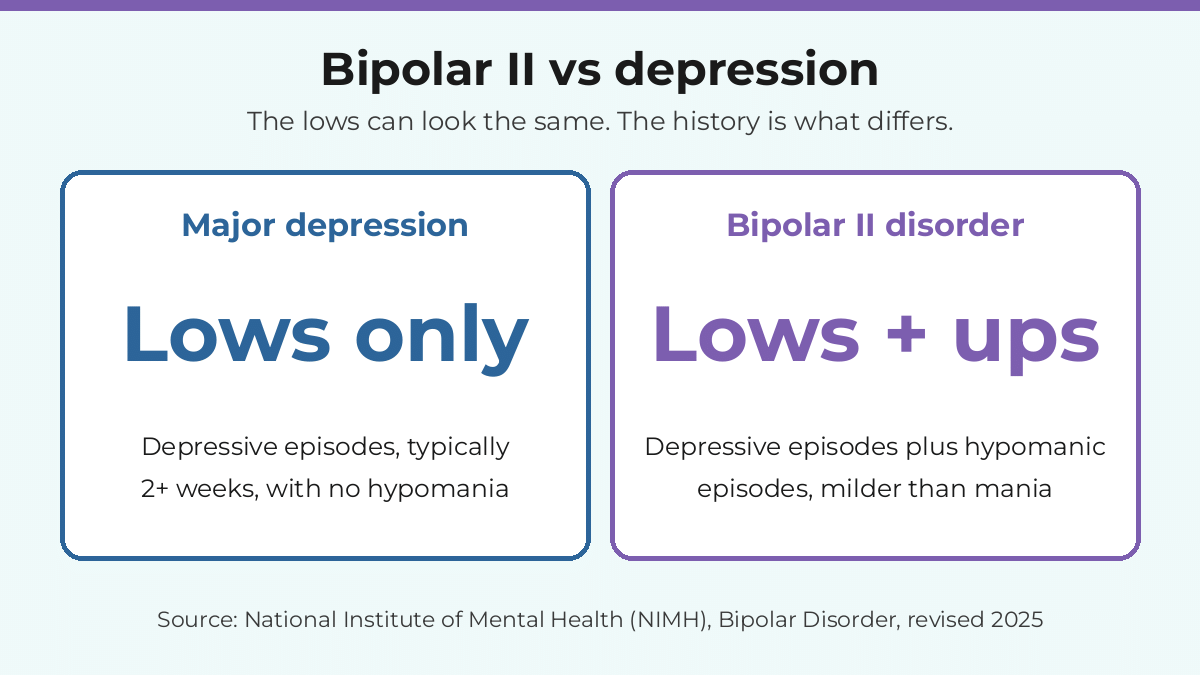
Major depression and bipolar II share the same kind of low. The difference is what happens between the lows. The National Institute of Mental Health explains that bipolar II disorder is defined by a pattern of depressive and hypomanic episodes, with hypomanic episodes that are less severe than the manic episodes of bipolar I disorder. NIMH also notes that many people with bipolar II spend extended periods in a persistent, low-grade depressive state. Major depression, by contrast, involves depressive episodes without any history of hypomania or mania.
In a 2023 JAMA review, Nierenberg and colleagues reported that bipolar disorder affects approximately 8 million adults in the US, depression is the most frequent initial presentation, and about 75% of symptomatic time consists of depressive episodes or symptoms (PubMed). That is why so many people first walk into care, or log in, describing depression.
Bipolar II disorder symptoms: the depressive side
According to NIMH, a depressive episode can include feeling very down, sad, or anxious; feeling slowed down or restless; trouble concentrating or making decisions; sleeping too little or too much; losing interest in almost all activities; and feeling hopeless or worthless. On their own, these look the same whether the cause is major depression or bipolar II.
Hypomania signs that are easy to miss
Hypomanic episodes are like manic episodes but less severe and less disruptive to daily life. NIMH lists signs of the “up” side such as:
- Feeling very up, elated, irritable, or touchy
- Feeling jumpy, wired, or more active than usual
- Racing thoughts and talking fast about many things
- A decreased need for sleep without feeling tired
- Feeling able to do many things at once
- An excessive appetite for food, drinking, sex, or other pleasurable activities
NIMH notes that hypomanic episodes may make a person feel very good and productive, so they may not feel like anything is wrong, even when family and friends notice the change. For many Florida adults, a hypomanic week looks like a great week at work.
Why Bipolar Depression Misdiagnosis Happens
Bipolar depression misdiagnosis is common, and it is rarely anyone’s fault. NIMH explains that people with bipolar II disorder may seek care only for depressive episodes, so hypomanic episodes go unnoticed. The 2023 JAMA review found that diagnosis and optimal treatment are often delayed by a mean of approximately 9 years after an initial depressive episode, while early diagnosis and treatment are associated with a more favorable prognosis.
Overlap with other conditions adds to the confusion. A 2025 review in The Lancet by Singh and colleagues noted that diagnosis can be challenging because symptoms overlap with ADHD, major depressive disorder, psychotic spectrum disorders, and personality disorders, which often leads to a delay in diagnosis (PubMed). NIMH adds that thyroid disease and some prescribed or recreational drugs can mimic or worsen mood symptoms, which is one reason a careful history matters.
Clues that a depression may be bipolar
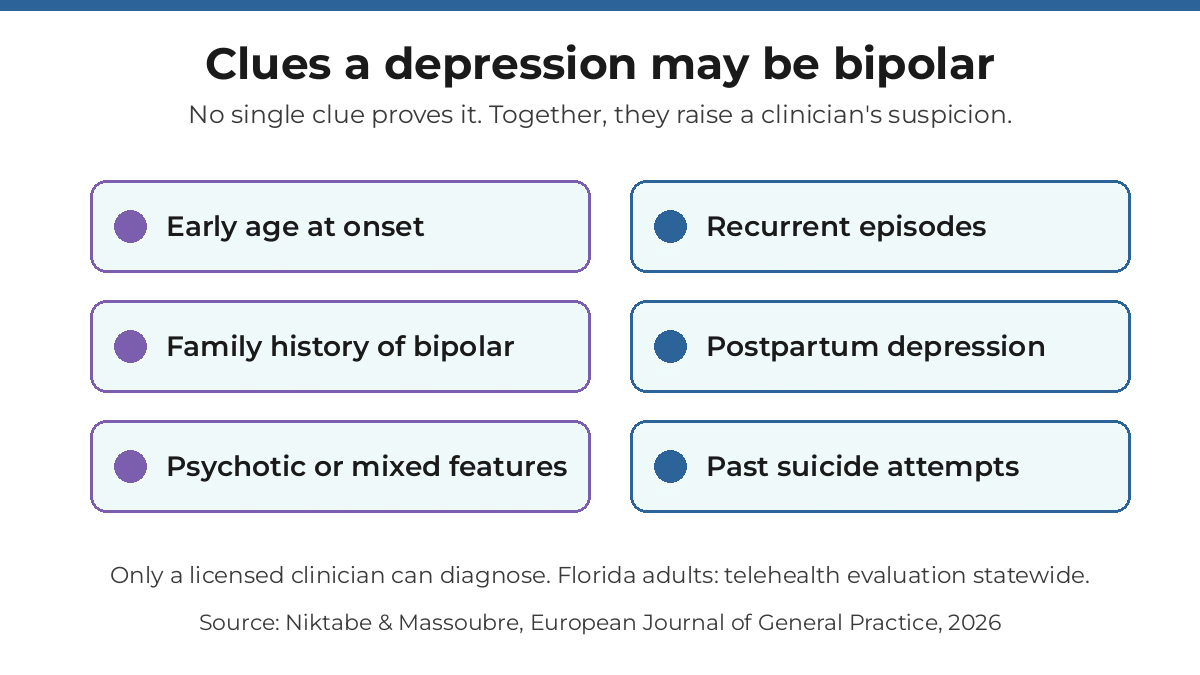
A 2026 systematic review of 36 studies by Niktabe and Massoubre in the European Journal of General Practice found that early age at onset, recurrent episodes, family history of bipolar disorder, cyclothymic temperament, suicide attempts, postpartum depression, psychotic features, and mixed episodes were the most consistent indicators of bipolar disorder (PubMed). The authors stressed that individual features lack enough predictive value on their own, but their combined presence can raise clinical suspicion. They recommended a structured clinical interview alongside screening tools such as the Mood Disorder Questionnaire.
Why the Diagnosis Changes the Medication Plan
Getting bipolar II vs depression right is not just a label. It shapes which medications make sense. NIMH cautions that if subtle signs of bipolar disorder are missed and a depressive episode is treated with antidepressant medication alone, without a mood stabilizer, a manic episode or rapid cycling may be triggered.
Mood stabilizer medication management
The 2023 JAMA review describes first-line options that include mood stabilizers such as lithium, valproate, and lamotrigine, and atypical antipsychotics such as quetiapine, aripiprazole, asenapine, lurasidone, and cariprazine, and states that antidepressants are not recommended as monotherapy. The authors note that some of these medicines are associated with weight gain, so mood stabilizer medication management includes tracking side effects, labs when needed, and physical health over time.
What about antidepressants? A 2025 network meta-analysis of 13 randomized trials (1,362 patients) by Oliva and colleagues in eClinicalMedicine found that no antidepressant was associated with a significantly higher risk of switching to mania than placebo, though venlafaxine showed the highest risk estimate and overall confidence in the evidence was low (PubMed). The authors concluded that antidepressants remain an option for acute bipolar depression, particularly as add-on therapy, and that their use should be individualized. In plain terms: this is a decision to make with a prescriber who knows your full history, not one to make alone.
Medication plus skills-based support
Medication is rarely the whole plan. In a 2021 JAMA Psychiatry network meta-analysis of 39 randomized trials with 3,863 participants, Miklowitz and colleagues found that manualized psychotherapies combined with medication were associated with lower recurrence rates than control treatments (PubMed). Psychoeducation, cognitive behavioral therapy, family-focused work, and interpersonal approaches all appeared in the evidence base, with conclusions tempered by differences between studies.
Bipolar II vs Depression Evaluations by Telehealth in Florida
An online psychiatrist Florida visit, or a visit with a psychiatric nurse practitioner who can prescribe, happens by secure video. To sort out bipolar II vs depression, expect questions about your whole mood history, not just how you feel this week. NIMH notes that bipolar disorder is diagnosed based on the severity, length, and frequency of symptoms over a lifetime, along with family history.
A solid evaluation should cover:
- When your first low period started and how many episodes you remember
- Any stretches of unusually high energy, little need for sleep, or racing thoughts
- How past antidepressants affected you, including feeling “wired” or agitated
- Family history of bipolar disorder, depression, or suicide
- Sleep, alcohol, substance use, thyroid or other medical conditions, and current medications
- Co-occurring conditions such as anxiety or ADHD
Telemedicine has limits. As our FAQ explains, New Age Psychiatry does not provide telehealth care for bipolar I disorder, psychosis, or people with a suicide attempt or suicidal thoughts in the past six months. If your history points that way, we will tell you plainly that a higher level of care is the safer fit.
Practical Steps Before Your First Visit
- Sketch a rough timeline of your low periods and any “up” stretches over the past few years.
- Ask someone who knows you well whether they have noticed periods when you seemed unusually energized, talkative, or irritable.
- List every medication you have tried for mood, the doses, and what happened.
- Note sleep patterns, alcohol, caffeine, and any substances you use.
- Write down any family history of mood disorders you know about.
Who This Guide Is For, and Who Needs Faster Care
This guide is for Florida adults whose depression keeps coming back, who have not felt better on antidepressants, or who wonder whether their “productive streaks” are part of the picture. It is not emergency care. If you or someone you know is thinking about suicide, call or text 988 or chat at 988lifeline.org. For an emergency, call 911 or go to the nearest emergency room.
How New Age Psychiatry Approaches Bipolar II vs Depression in Florida
New Age Psychiatry is a telehealth-only psychiatry practice serving adults across Florida, led by Hilary Ortega, PMHNP-BC. Visits are by video, so you can be seen from home whether you live in Miami, Orlando, Tampa, Fort Lauderdale, or Jacksonville. You need to be in Florida at the time of each visit. The focus is a careful evaluation of your full mood history, evidence-informed medication choices, and steady follow-up.
If you have spent years treating every crash as “just depression,” an evaluation is a reasonable next step. You can also read related guides on the New Age Psychiatry blog, including high-functioning depression in Florida and how to get a psychiatric evaluation online in Florida.
Frequently Asked Questions
What is the main difference between bipolar II and depression?
Both include depressive episodes. Bipolar II also includes hypomanic episodes, periods of elevated or irritable mood and increased energy that is milder than full mania, according to NIMH.
Why is bipolar II often mistaken for depression?
Depression is usually the first and most frequent phase, and hypomania can feel like a good, productive stretch. A 2023 JAMA review found diagnosis is delayed by about 9 years on average after a first depressive episode.
Can antidepressants be used for bipolar II depression?
Major reviews do not recommend antidepressants alone for bipolar disorder. A 2025 meta-analysis found antidepressants may still be an option, mainly as add-on therapy, decided individually with a prescriber.
Can I get a mood evaluation online in Florida?
Yes. New Age Psychiatry offers telehealth evaluations and medication management to adults located in Florida, from Miami and Fort Lauderdale to Tampa, Orlando, and Jacksonville, within the limits described in our FAQ.
References
Miklowitz, D. J., Efthimiou, O., Furukawa, T. A., Scott, J., McLaren, R., Geddes, J. R., & Cipriani, A. (2021). Adjunctive psychotherapy for bipolar disorder: A systematic review and component network meta-analysis. JAMA Psychiatry, 78(2), 141–150. https://doi.org/10.1001/jamapsychiatry.2020.2993
National Institute of Mental Health. (2025). Bipolar disorder (NIH Publication No. 25-MH-8088). U.S. Department of Health and Human Services, National Institutes of Health. https://www.nimh.nih.gov/health/publications/bipolar-disorder
Nierenberg, A. A., Agustini, B., Köhler-Forsberg, O., Cusin, C., Katz, D., Sylvia, L. G., Peters, A., & Berk, M. (2023). Diagnosis and treatment of bipolar disorder: A review. JAMA, 330(14), 1370–1380. https://doi.org/10.1001/jama.2023.18588
Niktabe, D. S., & Massoubre, C. (2026). Distinguishing bipolar disorder from unipolar depression in general practice: A systematic review. European Journal of General Practice, 32(1), Article 2733396. https://doi.org/10.1080/13814788.2026.2733396
Oliva, V., De Prisco, M., La Spina, E., Paolucci, S., Fico, G., Anmella, G., Hidalgo-Mazzei, D., Murru, A., Pompili, M., Fornaro, M., Solmi, M., Yildiz, A., Leucht, S., Vieta, E., & Radua, J. (2025). Switch to mania after acute antidepressant treatment for bipolar depression: A systematic review and network meta-analysis of randomised controlled trials. eClinicalMedicine, 87, Article 103413. https://doi.org/10.1016/j.eclinm.2025.103413
Singh, B., Swartz, H. A., Cuellar-Barboza, A. B., Schaffer, A., Kato, T., Dols, A., Sperry, S. H., Vassilev, A. B., Burdick, K. E., & Frye, M. A. (2025). Bipolar disorder. The Lancet, 406(10506), 963–978. https://doi.org/10.1016/S0140-6736(25)01140-7