

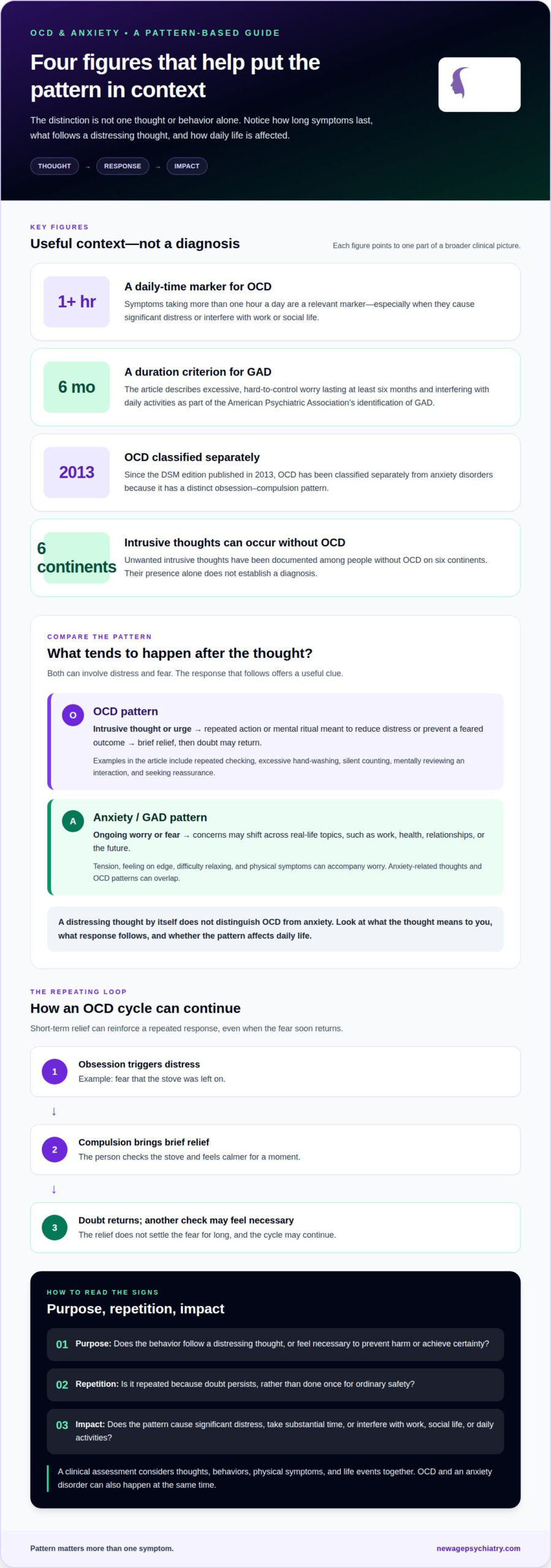
The clearest clue is the pattern: OCD involves distressing, unwanted obsessions and compulsions, which are actions or mental rituals that briefly ease distress. Anxiety disorders more often involve ongoing worry or fear without that same cycle. Symptoms taking more than one hour a day are a relevant marker for OCD, especially when they cause significant distress or interfere with work or social life. If you’re wondering how to know if you have OCD or just anxiety, notice what follows the thought: broad worry, or a repeated urge to neutralize it.
It’s understandable to feel uncertain. Intrusive thoughts and anxiety can occur in more than one condition, and OCD and anxiety disorders can also happen together.
This article explains how the thought-and-behavior pattern differs from ongoing worry, which signs may help distinguish them, and why an assessment considers more than one symptom. You’ll also learn how treatment approaches may overlap and how identifying the pattern can help guide your next step.
Key Takeaways
- Look at the pattern of thoughts, responses, and their impact on daily life, rather than judging a condition by one symptom alone.
- Notice whether worries shift across everyday concerns or lead to repeated attempts to feel certain or prevent feared outcomes.
- Remember that unwanted thoughts can happen without OCD, and more than one mental health condition can be present at the same time.
- Track what happens before and after distressing thoughts; these patterns can help make a professional assessment more informative.
What is obsessive-compulsive disorder (OCD)?
A diagnosis requires obsessions and/or compulsions that are time-consuming, cause significant distress, and impair work or social functioning; time-consuming means more than one hour a day. Since the DSM edition published in 2013, OCD has been classified separately from anxiety disorders because it has a distinct obsession-compulsion pattern.
OCD Obsessions and Compulsions
Obsessions are intrusive, unwanted thoughts, images, or urges. Compulsions are repeated behaviors or mental acts intended to ease distress or prevent a feared outcome. For example, a fear of contamination may prompt excessive hand-washing, even when it feels out of proportion. This distinction matters because diagnosis considers the link between a distressing thought and the response, not simply whether someone prefers order or cleanliness.
The OCD Cycle
The OCD cycle starts when an obsession triggers distress, followed by a compulsion that brings brief relief. For example, someone may fear they left the stove on, check it, and feel calmer for a moment. When doubt returns, another check may seem necessary. This short-term relief can reinforce the repeated response, so the cycle may continue even when the person recognizes that checking does not settle the fear for long.
Mental Rituals and Compulsive Behaviors
Compulsions can be visible actions or private mental rituals, so other people may not notice them. Someone might count silently, repeat a phrase in their mind, mentally review an interaction, or seek reassurance to reduce distress. These responses may be attempts to neutralize an intrusive thought or prevent a feared outcome. Recognizing mental rituals matters because compulsions do not always involve repeated hand-washing or checking.
Compulsions Versus Coping Habits
Coping habits may help manage discomfort, while compulsions can be linked to distressing thoughts and may be hard to resist. To tell whether a behavior is an OCD compulsion or a coping habit, notice whether it follows a distressing thought, feels necessary to prevent harm or achieve certainty, and brings only temporary relief. Checking the stove once for safety differs from returning repeatedly because doubt persists. The behavior’s purpose, repetition, and effect on daily life help clarify the pattern.
Anxiety disorder symptoms
Anxiety is a response to perceived threat or uncertainty; an anxiety disorder involves symptoms that persist or disrupt daily activities. Generalized anxiety disorder (GAD) can involve excessive, hard-to-control worry that shifts from work to health, relationships, or the future. The American Psychiatric Association identifies GAD when excessive worry lasts at least six months and interferes with daily activities. Tension, feeling on edge, difficulty relaxing, and physical symptoms can accompany that worry.
OCD and anxiety can both involve distress, fear, and efforts to feel safer, but the response pattern offers a useful distinction. With GAD, worry often shifts between real-life concerns. With OCD, an intrusive thought may lead to a repeated behavior or mental response intended to reduce distress. Both patterns can be exhausting, and one person can experience OCD and an anxiety disorder at the same time.
Other conditions can resemble aspects of OCD or anxiety. Intrusive thoughts may occur with trauma or depression, as well as OCD, so a thought alone does not identify a disorder. A clinical assessment considers thoughts, behaviors, physical symptoms, and life events together, rather than treating one symptom as a diagnosis.
Seek professional support when repetitive thoughts cause distress, managing them takes substantial time, or symptoms interfere with daily life. Difficulty breaking mental loops on your own can also be a reason to seek help. A clinician can explore the feelings, triggers, and responses involved, including whether anxiety treatment may suit your needs.
Online OCD or anxiety screening tests can help organize concerns, but they can’t establish a diagnosis. Treat a result as a starting point for describing your symptoms, not as a substitute for an assessment. If ongoing worry or physical symptoms are affecting your routine, anxiety treatment can be a next step toward understanding your care options.
How OCD thoughts differ from ordinary unwanted thoughts
An unwanted thought alone does not distinguish OCD from an anxiety disorder. Consider the pattern: what the thought means to you and what response follows.
The Nature of OCD Thoughts
OCD thoughts can feel alien or sharply opposed to a person’s values, while ordinary unwanted thoughts may pass without becoming a repeated focus. Unwanted intrusive thoughts have been documented on six continents among people without OCD, so their presence alone does not establish a diagnosis. For example, a disturbing image may appear briefly and fade. In OCD, the thought may return persistently, cause distress, and prompt efforts to gain certainty or undo its meaning.
OCD Thoughts and Anxiety Thoughts
The content can offer clues, but the pattern matters more than whether a thought seems frightening. OCD thoughts may conflict with someone’s sense of self, such as fearing they might harm someone despite having no wish to do so. Anxiety-related thoughts more often concern plausible real-world worries, such as an upcoming work problem. These patterns can overlap. Someone with generalized anxiety may also have intrusive thoughts, and thought content alone cannot distinguish the conditions.
Obsessions, Compulsions, and General Worry
OCD involves specific obsessions and responses, while general worry often moves among concerns without the same ritualized link. For instance, someone might repeatedly review a conversation to make sure they did not offend anyone, seeking comfort through certainty. With generalized anxiety, worry may shift from that conversation to health or finances. Notice whether a repeated action or mental check briefly reduces distress, then feels necessary again. This response pattern helps explain how obsessions and compulsions differ from general worry.
How OCD and anxiety may be distinguished
If you’re wondering how to know if you have OCD or just anxiety, look beyond the thought’s subject and examine what happens next. An intrusive fear about a stove, for example, could lead to one practical safety check. Repeated checking to neutralize unwanted doubt suggests a different pattern. Generalized anxiety more often involves excessive worry across changing concerns, such as work, health, and eating. The thought itself does not settle the distinction; its trigger, purpose, and effect matter.
Consider three details: what prompted the thought, what response followed, and how long relief lasted. Someone worried about a meeting might prepare notes, then move on. Someone caught in an OCD pattern might repeatedly review each sentence afterward, seeking certainty that no harm was done. These examples are not diagnoses. They can help show whether worry shifts between life concerns or connects to a repeated neutralizing response.
Also notice whether the thought feels unwanted and sharply at odds with your values, or focuses on plausible future problems. OCD thoughts can feel alien, but intrusive thoughts also occur without OCD. Anxiety and OCD can coexist, so noticing one pattern does not rule out the other. A mental health assessment considers thoughts, behaviors, physical symptoms, and life events together, rather than relying on a single example.
Write down a recent episode in plain language: the situation, the thought, what you did next, and whether the comfort lasted. For example, note whether a health worry shifted to finances, or returned to the same feared possibility until you checked or sought reassurance. This record can help clarify how repetitive the pattern feels and whether it disrupts routines, relationships, work, or eating.
A practical way to keep exploring how to know if you have OCD or just anxiety is to track the sequence, not label yourself by one unsettling thought. Repeated attempts to reach certainty, brief relief, and recurring distress point to a different cycle than worry that moves among concerns. Bring those examples to a professional assessment. If anxiety is interfering with daily life, explore anxiety support as a next step.
New Age Psychiatry: ADHD Diagnosis and Treatment
New Age Psychiatry provides OCD and anxiety treatment for adults in Florida who are seeking help with distressing thoughts, repeated behaviors, or persistent worry. A psychiatric evaluation can help clarify how symptoms affect daily life and whether OCD, an anxiety disorder, or both may be involved. That distinction can guide a treatment plan, including medication management when appropriate.
Consider seeking support when symptoms take up time, disrupt work or relationships, or feel difficult to manage alone. You do not need to arrive with a diagnosis. Describing what happens before and after distressing thoughts can help start the conversation.
Contact New Age Psychiatry to discuss support for OCD or anxiety.
Take the Next Step Toward Clarity
Learning how to know if you have OCD or just anxiety can start by making space to describe what you’re experiencing without judging yourself. Before an appointment, jot down what has been weighing on you, how it affects your routines, and what kind of support you hope to receive. You do not need to arrive with the right terminology or a complete explanation.
The next step can be a conversation focused on your needs and options. If symptoms are affecting your well-being, asking for support is a practical way to move forward, not a commitment to having a particular diagnosis. You can contact New Age Psychiatry to discuss care and take the next step at your own pace.
Frequently Asked Questions
Are the treatments different?
Some approaches overlap, while others differ. Cognitive behavioral therapy may help with anxiety, while OCD treatment can use exposure and response prevention, which focuses on facing triggers without completing compulsions. Medication may also be considered for either condition. The right plan depends on the symptoms being treated, their impact, and whether OCD, an anxiety disorder, or both are present.
Can anxiety be misdiagnosed as OCD?
Yes, overlapping symptoms can make the distinction difficult, especially if someone seeks reassurance or repeatedly reviews worries. For example, preparing repeatedly for a presentation might reflect broad performance anxiety, while a ritualized response to an intrusive fear may suggest another pattern. A careful assessment considers the reason behind each behavior and whether multiple conditions may be contributing.
How Do I Know if It’s OCD or Not?
You cannot confirm OCD from a single thought or online checklist. Instead, note when distressing thoughts arise, what you do in response, and how those responses affect your routine. For example, record whether you avoid a task, repeat an action, or ask someone for reassurance. Sharing these observations with a mental health professional can support a more complete evaluation.
How are GAD and OCD diagnosed?
Both diagnoses involve a clinical assessment, but the professional looks for different symptom patterns. The American Psychiatric Association identifies generalized anxiety disorder when excessive worry lasts at least six months and interferes with daily activities. For OCD, the assessment considers obsessions and compulsions, distress, time demands, and disruption. The clinician also considers other symptoms and life circumstances that could shape the picture.
Can OCD cause panic attacks?
OCD can involve intense anxiety, but that does not automatically mean it causes panic disorder. Panic symptoms may arise alongside OCD or in response to a distressing situation. Among U.S. adults who had OCD at some point in their lives, panic disorder occurred in about one case in five. A clinician can assess whether panic episodes form a separate condition or relate to another concern.
Can you have GAD and OCD at the same time?
Yes. Someone may experience broad, hard-to-control worry associated with generalized anxiety disorder and also have OCD symptoms. About one-third of people with OCD also meet criteria for GAD. For example, a person might worry about work and health while also experiencing a separate repetitive pattern. Identifying both matters because an assessment and care plan should address the full set of symptoms.