The clocks fell back on November 1. Now it’s dark before 6, and even though the weather is finally perfect, you feel like you’re walking through wet sand. You sleep nine hours and wake up tired. You want carbs, your couch, and zero texts. You’ve told yourself this is just how you get every year. It might be seasonal depression in Florida, and yes, that’s a real thing here.
This is educational, not a diagnosis. Below: what seasonal affective disorder actually is, why living in Florida lowers the odds but doesn’t zero them out, the summer version that hits some Floridians in August instead of January, and what the research says about light, CBT, and medication. At the end, what a telehealth visit with New Age Psychiatry looks like from anywhere in the state.
Key Takeaways
- The National Institute of Mental Health describes seasonal affective disorder (SAD) as depression with a recurring seasonal pattern, with symptoms lasting about four to five months of the year.
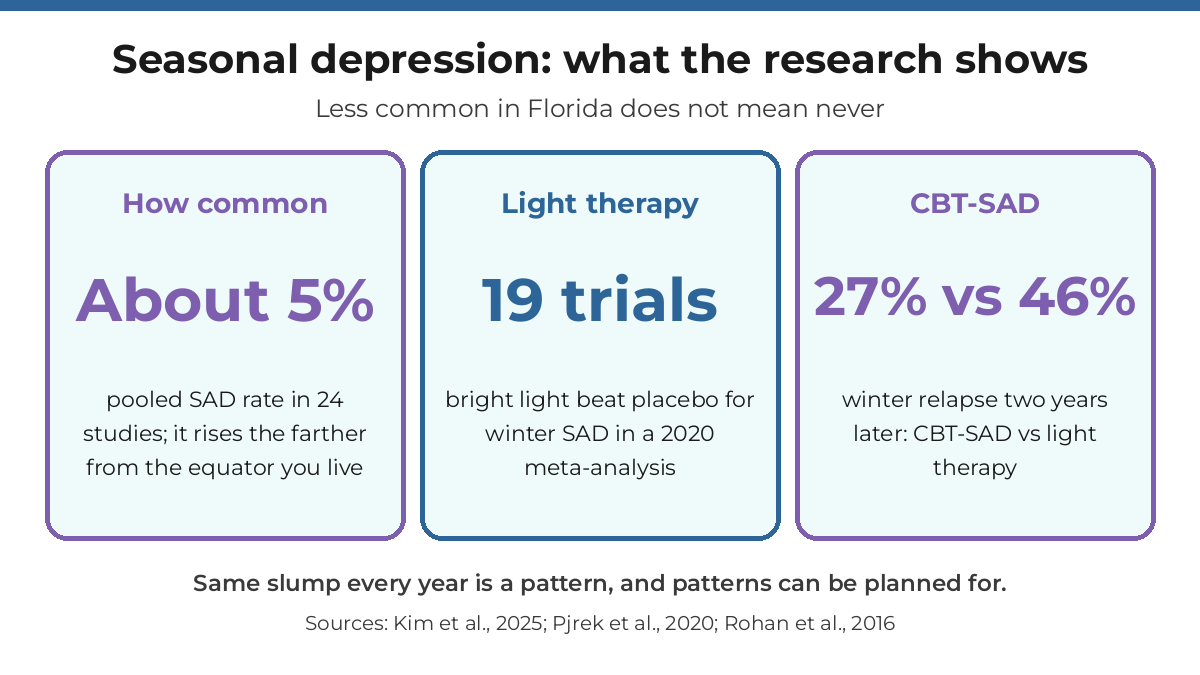
- A 2025 meta-analysis of 24 studies (32,866 people) put pooled SAD prevalence at about 5% and found it rises with latitude. Florida’s position helps, but it’s not a force field.
- Summer-pattern SAD exists. It’s rarer, and it looks different: trouble sleeping, poor appetite, restlessness, anxiety.
- Bright light therapy beat placebo for SAD across 19 randomized trials, and in a 177-person trial, CBT built for SAD worked as well as light and held up better two winters later.
- Psychiatric care by video held up against in-person care for mood disorders in randomized trials, so getting evaluated from Jacksonville or Key West works the same way.
What Seasonal Depression Actually Is
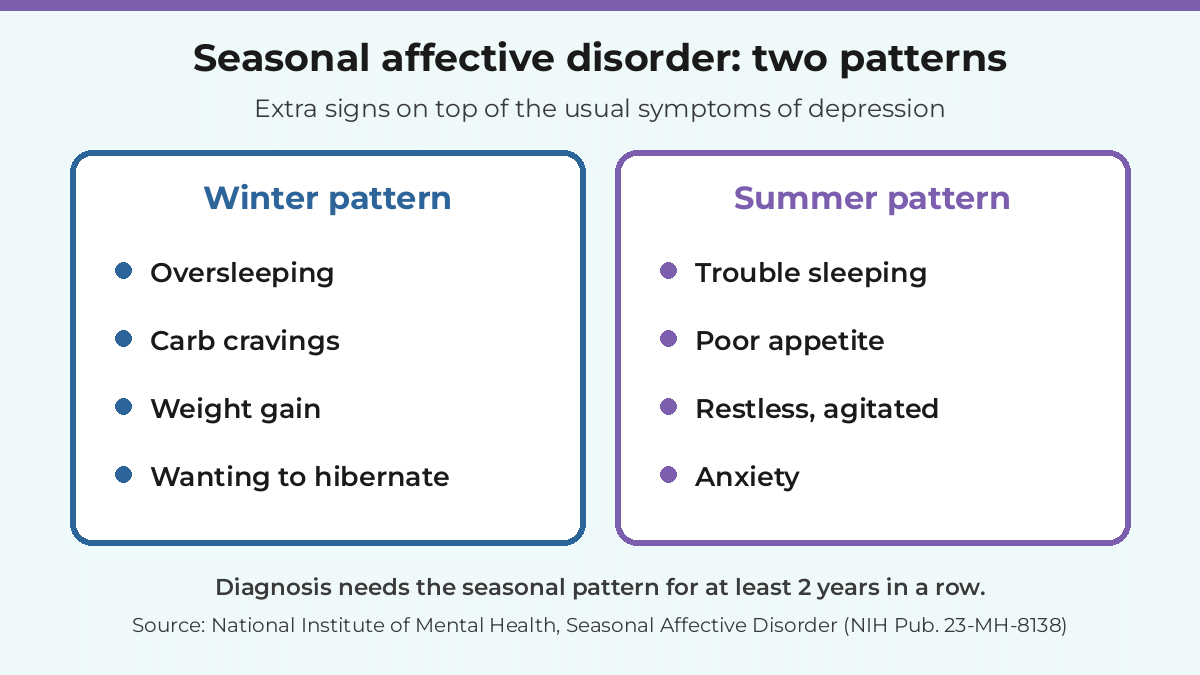
Seasonal affective disorder isn’t a mood. It’s a type of depression with a calendar attached. The National Institute of Mental Health says that in most cases symptoms start in the late fall or early winter and go away in spring and summer, and that a diagnosis requires depressive episodes in a specific season for at least two consecutive years. NIMH also notes SAD usually starts in young adulthood and is much more common in women than in men.
The winter depression pattern has its own flavor on top of regular depression symptoms. NIMH lists oversleeping, overeating with carb cravings and weight gain, and social withdrawal, the feeling of wanting to hibernate. Add the usual depression stuff: low mood most of the day, losing interest in things you like, low energy, trouble concentrating, guilt, hopelessness.
SAD vs. the holiday blues
These get mixed up a lot. Stress about Thanksgiving with your family, money in December, or a lonely New Year’s is real, but NIMH is clear that it isn’t SAD. SAD tracks changes in daylight hours, not the calendar. If the slump starts when the days shorten and lifts in spring whether or not anything stressful happened, that points toward SAD. If it’s tied to one tough week, it probably isn’t.
Seasonal Depression in Florida: Lower Odds, Not Zero
Here’s the part people don’t expect: Florida was one of the test sites in a classic study on this. In 1990, a study by Rosen and colleagues mailed the same screening questionnaire to residents of Nashua, New Hampshire; New York City; Montgomery County, Maryland; and Sarasota, Florida. Winter SAD and milder subsyndromal winter SAD were significantly more common at the more northern sites, while summer SAD showed no link to latitude (PubMed).
Newer data say the same thing. A 2025 meta-analysis by Kim and colleagues pooled 24 studies with 32,866 participants and found a pooled SAD prevalence of 5.01%, subsyndromal SAD of 9.37%, and summer-type SAD of 0.57%, with higher latitude significantly tied to more SAD and subsyndromal SAD but not to summer-type SAD (PubMed). NIMH puts it plainly: people in Alaska or New England are more likely to develop SAD than people in Texas or Florida.
So the odds are lower in Miami than in Minneapolis. That’s it. Lower odds don’t help much if you’re the one who can’t get off the couch in Orlando every December. Our days still shorten in winter, and the shift is easy to brush off because everyone around you is posting beach pictures.
The Florida twist: summer depression
Some people get the reverse. NIMH describes summer depression as a less common pattern where symptoms show up in spring and summer, with trouble sleeping, poor appetite with weight loss, restlessness and agitation, anxiety, and sometimes aggressive behavior. NIMH also mentions a theory that long, hot days can worsen sleep, but says it hasn’t been systematically tested.
If you’ve lived through a Tampa August, you know where this is going. When your worst stretch is July through September, not January, don’t rule out a seasonal pattern just because it’s the “wrong” season. It’s rare, the Kim meta-analysis put it under 1%, so an evaluation also has to look for other things that spike in summer, like sleep problems, anxiety, or plain old depression that happens to start then.
Signs of Seasonal Affective Disorder to Take Seriously
None of these means SAD by itself. A few of them showing up around the same time of year, for two or more years in a row, is worth a real conversation.
- You can tell what month it is by how you feel
- You sleep more but don’t feel rested (winter) or can barely sleep at all (summer)
- Your eating flips: carb cravings and weight gain in winter, or no appetite in summer
- You cancel plans you’d normally enjoy, then feel guilty about it
- Work gets harder because focusing feels like lifting something heavy
- People around you say “you always get like this around this time”
One more thing to tell your clinician: NIMH notes SAD is more common in people with bipolar disorder, especially bipolar II. If you’ve ever had stretches of feeling wired, needing very little sleep, and making big impulsive moves, say so. That changes the plan. Our post on bipolar II vs. depression explains why.
What the Research Says Works
Good news: there’s real research here, and more than one way in.
Light therapy for depression
NIMH describes the standard setup as sitting in front of a 10,000-lux light box for about 30 to 45 minutes each day, usually first thing in the morning, from fall to spring. A 2020 meta-analysis by Pjrek and colleagues pooled 19 randomized trials and found bright light therapy was superior to placebo for SAD, both on depression scores and on response rates (risk ratio 1.42) (PubMed). A 2024 network meta-analysis of 21 randomized trials with 1,037 participants also found phototherapy outperformed comparison treatments for SAD, though the authors rated the quality of the evidence as low (PubMed). So: it works, the studies are smaller than we’d like.
Light isn’t only for the seasonal kind. A 2025 JAMA Psychiatry meta-analysis of 11 trials with 858 patients found that adding bright light to standard care for nonseasonal depression raised remission rates to 40.7%, compared with 23.5% without it (PubMed).
Before you order a light box online, check with a clinician. NIMH says people with certain eye diseases, or on medications that increase sensitivity to light, may need a different option or medical supervision. Timing matters too, and a bipolar history matters a lot.
CBT built for SAD
Cognitive behavioral therapy has a version made for seasonal depression, called CBT-SAD. In a randomized trial of 177 adults, Rohan and colleagues found that six weeks of CBT-SAD and light therapy improved depression about equally, with nearly identical remission rates (47.6% and 47.2%) (PubMed). The follow-up is the interesting part. Two winters later, 27.3% of the CBT group had a recurrence compared with 45.6% of the light therapy group (PubMed). The researchers read that as CBT-SAD lasting longer. Light works while you’re sitting in front of it. Skills come with you.
Medication, and getting ahead of next year
Antidepressants are used for SAD the same way they’re used for other depression, and NIMH notes they usually take four to eight weeks to work. The FDA has approved extended-release bupropion to prevent seasonal episodes. A 2019 Cochrane review of three randomized trials with 1,100 people found bupropion XL lowered the risk of a new seasonal episode (risk ratio 0.56), but it also raised the risk of headaches, insomnia, and nausea, and even in a high-risk group, three out of four people wouldn’t benefit from preventive use (PubMed). That’s why prevention is a decision you make with your prescriber, not a default.
Because SAD is predictable, NIMH says people with a history of it might benefit from starting care before the hard season begins. If you already know October is when things slide, the best time to plan is September.
And if depression has stuck around through more than one medication, seasonal or not, that’s a different conversation. We cover options like ketamine therapy for depression in Florida separately.
When to Get Evaluated
Don’t wait for it to be “bad enough.” Get evaluated if the slump comes back around the same time each year, if it’s affecting work or the people you live with, or if you’ve been told to “just get some sun” and you live in Florida, so that obviously isn’t the fix. An evaluation also checks whether something else is going on, including depression that isn’t seasonal at all.
If you’re having thoughts of suicide, don’t wait for an appointment. Call or text 988, chat at 988lifeline.org, or call 911.
What a Telehealth Visit Looks Like
You don’t have to drive anywhere in the dark to deal with this. In a 2023 meta-analysis of 20 randomized trials, Shaker and colleagues found psychiatric treatment by video was comparable to in-person care for PTSD, mood disorders, and anxiety disorders, with similar patient satisfaction and dropout (PubMed).
At New Age Psychiatry, the first visit is a full psychiatric evaluation by secure video. We’ll go through when your symptoms start and stop each year, sleep, appetite, energy, past episodes, any history of highs, medications you’ve tried, and what’s going on in your life. Then we build a plan, which might include medication, a referral for CBT, guidance on light therapy, or some combination. Follow-ups are where we adjust.
Telehealth has limits. As our FAQ explains, New Age Psychiatry doesn’t provide telehealth care for people with a history of psychosis, a recent suicide attempt or suicidal thoughts in the past six months, thought disorders, bipolar I disorder, or dementia. If that’s where things are, we’ll tell you plainly that a higher level of care is the safer fit.
Frequently Asked Questions
Can you get seasonal depression in Florida?
Yes. Research consistently finds SAD is less common at southern latitudes, and NIMH names Florida as a lower-risk state, but lower risk isn’t no risk. Florida days still get shorter in winter, and some people have a summer pattern instead.
What’s the difference between winter depression and summer depression?
Winter-pattern SAD tends to bring oversleeping, carb cravings, weight gain, and pulling away from people. Summer-pattern SAD tends to bring insomnia, poor appetite, restlessness, and anxiety. Both include the core symptoms of depression.
Does light therapy for depression really work?
For winter-pattern SAD, randomized trials support it, though many are small. A 2025 meta-analysis also found it helped as an add-on for nonseasonal depression. Check with a clinician first, especially if you have eye problems, take light-sensitizing medication, or have any history of bipolar disorder.
Is it SAD or just the holiday blues?
SAD follows daylight, not events. It shows up the same season year after year, lasts months, and lifts when the season changes. Holiday stress is tied to specific events and usually fades when they pass.
Can I get evaluated for seasonal depression online in Florida?
Yes. New Age Psychiatry sees adults located in Florida by secure video, from Miami and Fort Lauderdale to Orlando, Tampa, and Jacksonville, within the limits in our FAQ.
Seasonal Depression Care by Telehealth Across Florida
New Age Psychiatry is a telehealth-only psychiatry practice for adults across Florida, led by Hilary Ortega, PMHNP-BC. Visits happen by secure video, whether you’re in Fort Lauderdale, Tampa, Orlando, Jacksonville, or a small town off I-75. The first visit is a real evaluation, not a five-minute checklist.
If you read that first paragraph and thought “that’s me every November,” that’s a good enough reason to book. You can keep reading on the New Age Psychiatry blog, including high-functioning depression in Florida and how to get a psychiatric evaluation online in Florida, or visit our online psychiatrist in Florida page for more on telehealth psychiatry Florida options.
References
Chen, Z. W., Zhang, X. F., & Tu, Z. M. (2024). Treatment measures for seasonal affective disorder: A network meta-analysis. Journal of Affective Disorders, 350, 531–536. https://doi.org/10.1016/j.jad.2024.01.028
Gartlehner, G., Nussbaumer-Streit, B., Gaynes, B. N., Forneris, C. A., Morgan, L. C., Greenblatt, A., Wipplinger, J., Lux, L. J., Van Noord, M. G., & Winkler, D. (2019). Second-generation antidepressants for preventing seasonal affective disorder in adults. Cochrane Database of Systematic Reviews, 2019(3), Article CD011268. https://doi.org/10.1002/14651858.CD011268.pub3
Kim, K., Kim, J., Jung, S., Kim, H. W., Kim, H. S., Son, E., Ko, D. S., Yoon, S., Kim, B. S., Kim, W. K., Lim, C., Kim, K., Lee, D., & Kim, Y. H. (2025). Global prevalence of seasonal affective disorder by latitude: A systematic review and meta-analysis. Journal of Affective Disorders, 390, Article 119807. https://doi.org/10.1016/j.jad.2025.119807
Menegaz de Almeida, A., Aquino de Moraes, F. C., Cavalcanti Souza, M. E., Cavalcanti Orestes Cardoso, J. H., Tamashiro, F., Miranda, C., Fernandes, L., Kreuz, M., & Alves Kelly, F. (2025). Bright light therapy for nonseasonal depressive disorders: A systematic review and meta-analysis. JAMA Psychiatry, 82(1), 38–46. https://doi.org/10.1001/jamapsychiatry.2024.2871
National Institute of Mental Health. (2023). Seasonal affective disorder (NIH Publication No. 23-MH-8138). U.S. Department of Health and Human Services, National Institutes of Health. https://www.nimh.nih.gov/health/publications/seasonal-affective-disorder
Pjrek, E., Friedrich, M. E., Cambioli, L., Dold, M., Jäger, F., Komorowski, A., Lanzenberger, R., Kasper, S., & Winkler, D. (2020). The efficacy of light therapy in the treatment of seasonal affective disorder: A meta-analysis of randomized controlled trials. Psychotherapy and Psychosomatics, 89(1), 17–24. https://doi.org/10.1159/000502891
Rohan, K. J., Mahon, J. N., Evans, M., Ho, S. Y., Meyerhoff, J., Postolache, T. T., & Vacek, P. M. (2015). Randomized trial of cognitive-behavioral therapy versus light therapy for seasonal affective disorder: Acute outcomes. American Journal of Psychiatry, 172(9), 862–869. https://doi.org/10.1176/appi.ajp.2015.14101293
Rohan, K. J., Meyerhoff, J., Ho, S. Y., Evans, M., Postolache, T. T., & Vacek, P. M. (2016). Outcomes one and two winters following cognitive-behavioral therapy or light therapy for seasonal affective disorder. American Journal of Psychiatry, 173(3), 244–251. https://doi.org/10.1176/appi.ajp.2015.15060773
Rosen, L. N., Targum, S. D., Terman, M., Bryant, M. J., Hoffman, H., Kasper, S. F., Hamovit, J. R., Docherty, J. P., Welch, B., & Rosenthal, N. E. (1990). Prevalence of seasonal affective disorder at four latitudes. Psychiatry Research, 31(2), 131–144. https://doi.org/10.1016/0165-1781(90)90116-m
Shaker, A. A., Austin, S. F., Storebø, O. J., Schaug, J. P., Ayad, A., Sørensen, J. A., Tarp, K., Bechmann, H., & Simonsen, E. (2023). Psychiatric treatment conducted via telemedicine versus in-person modality in posttraumatic stress disorder, mood disorders, and anxiety disorders: Systematic review and meta-analysis. JMIR Mental Health, 10, Article e44790. https://doi.org/10.2196/44790