
You left for the 9:00 appointment at 8:52. The drive is 20 minutes on a good day, and it’s I-4, so it’s never a good day. You weren’t being rude. In your head, eight minutes honestly felt like plenty. If that’s your whole life, from missed school pickups to the Publix run that somehow ate two hours, you might be dealing with ADHD time blindness. It isn’t a personality flaw, and it isn’t laziness.
This post is educational, not a diagnosis. I’ll walk through what time blindness actually means, what the research on ADHD time perception does and doesn’t show, the signs that point past “bad with time,” and what has evidence behind it. At the end, what an ADHD evaluation by telehealth with New Age Psychiatry looks like from anywhere in Florida.
Key Takeaways
- “Time blindness” isn’t an official diagnosis. It’s a nickname for something the National Institute of Mental Health does list as an adult ADHD problem: poor time management, planning, and organization.
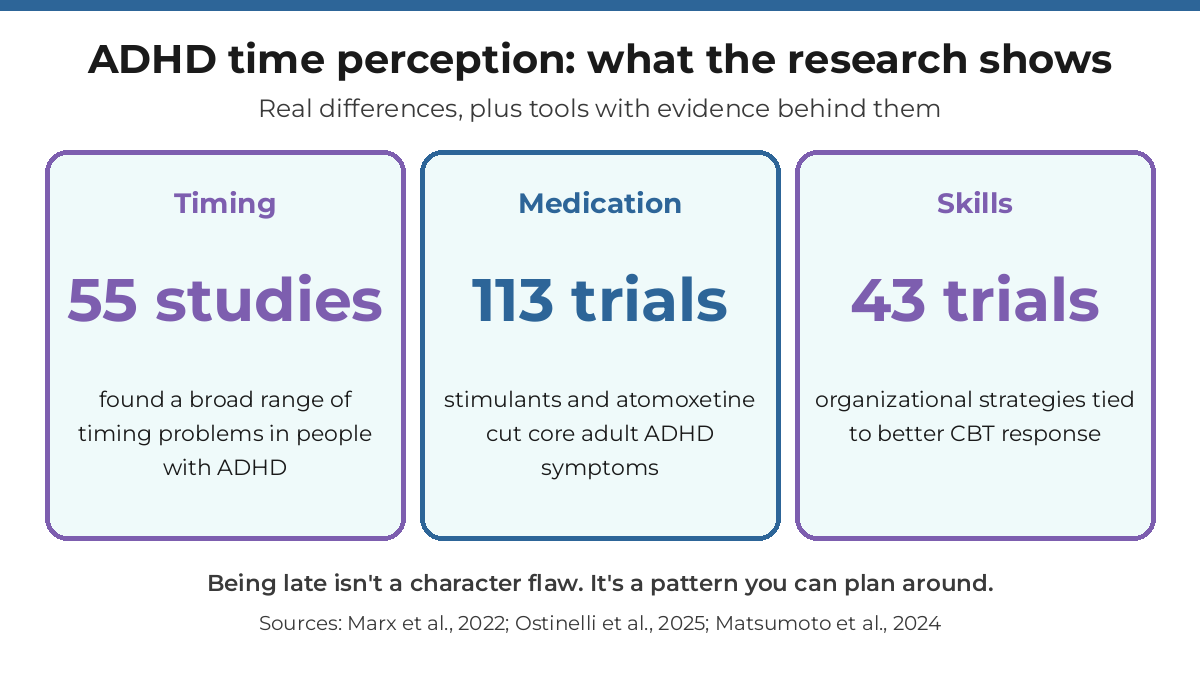
- A 2022 meta-analysis of 55 studies found people with ADHD have a broad range of timing problems in the lab, from judging short durations to estimating and producing intervals.
- The adult research is thinner and messier than the internet makes it sound. Some studies find clear deficits, some don’t.
- In a 2025 analysis of 113 randomized trials in adults, stimulants and atomoxetine were the only options that beat placebo on both self-ratings and clinician ratings of core ADHD symptoms.
- Skills matter too. Across 43 trials, organizational strategies were the CBT piece most linked to people actually responding.
What ADHD Time Blindness Actually Means
You won’t find “time blindness” in the diagnostic manual. People with ADHD started using it because “I’m bad with time” doesn’t cover it. The National Institute of Mental Health lists poor time management, planning, or organization, along with procrastination and choosing immediate rewards over future ones, among the ways adult ADHD shows up in daily life. NIMH also says adults with ADHD can find it hard to keep appointments.
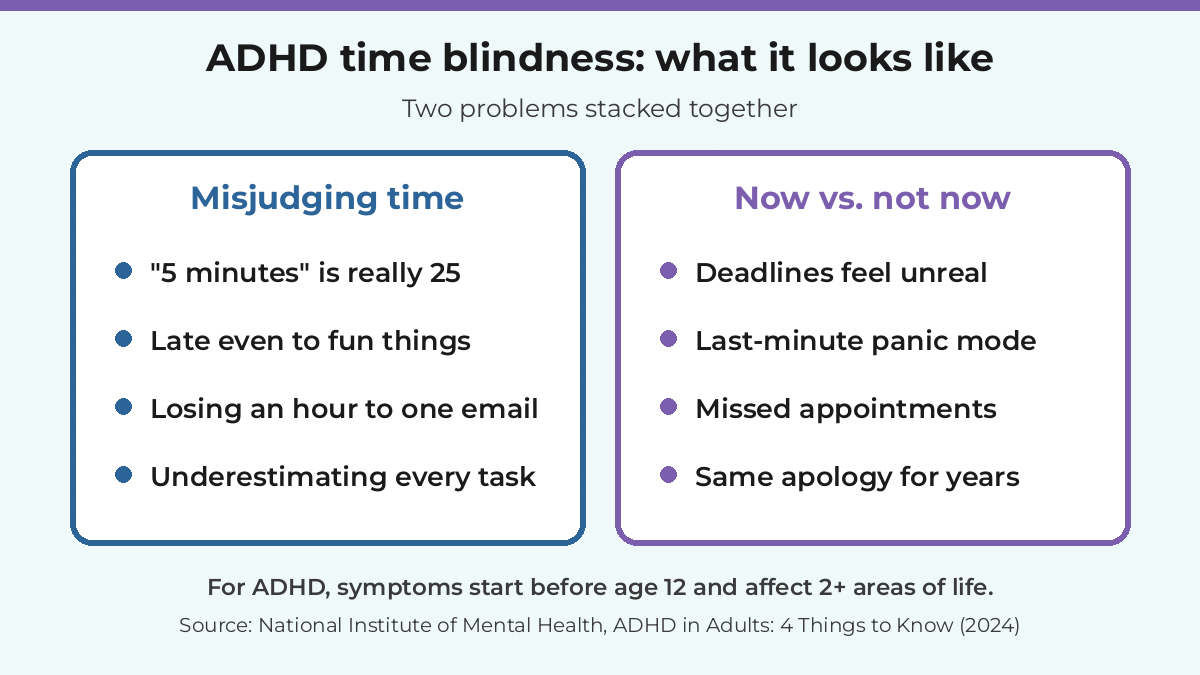
In real life it looks like two problems stacked together. First, you misjudge how long things take. Second, time that isn’t right in front of you doesn’t feel real. Tuesday’s deadline is just a fact until it’s Monday night, and then it’s an emergency. I think of it as two time zones: now and not now. Anything stuck in “not now” barely exists.
Is it really about the brain’s clock?
Partly, and the evidence is decent. A 2022 meta-analysis by Marx and colleagues pooled 55 studies and found people with ADHD had more trouble telling very short durations apart, more variability when judging durations of several seconds, and less accurate time estimation and production, a pattern the authors read as an accelerated internal clock (PubMed). On the reproduction tasks, distraction and impatience with waiting both played a part. A 2024 meta-analysis by Metcalfe and colleagues pulled together 824 effect sizes and found a moderate overall time-perception deficit in ADHD (mean g of 0.688), with the size of the gap depending on age (PubMed).
Where the research gets messy
I’m not going to oversell this. The adult research is thin. A 2023 review of a decade of adult studies by Mette found very few studies on time perception in adult ADHD, and mixed results: some showed clear deficits in time estimation, reproduction, and time management, while others found no clear link (PubMed). A Czech national study by Ptáček and colleagues tested adults grouped by ADHD symptom severity and found no specific differences in lab time-perception tasks by severity, even though people with more severe symptoms reported more trouble managing time in real life (PubMed).
That gap makes sense to me. A stopwatch task in a quiet room isn’t a Monday with three kids, a work call, and a 4:30 dentist appointment in Coral Springs. Your real-world struggle counts even if a lab test can’t catch it.
Signs It’s More Than “Bad With Time”
Everyone runs late sometimes. Here’s what tends to separate an ADHD pattern from a busy week:
- You’re late to things you were excited about, not just things you dreaded
- “Five minutes” in your head is routinely 25 on the clock
- You set ten alarms and still lose an hour to one email or one video
- Deadlines don’t feel real until they’re about to hit, then you pull it off in a panic
- You’ve apologized for the same thing at work, at home, and with friends for years
The timeline matters. NIMH says ADHD in adults requires symptoms that started before age 12 and that cause problems in at least two areas of life. If the lateness started last year along with poor sleep, low mood, or a lot of worry, that’s a different story and worth sorting out. The CDC points out that sleep disorders, anxiety, depression, and some learning disabilities can cause symptoms that look like ADHD. Sleep is a big one either way: NIMH notes sleep problems affect up to 70% of adults with ADHD.
Plenty of people find this out late. CDC data from a 2023 national survey estimated 15.5 million U.S. adults (6.0%) had a current ADHD diagnosis, and about half of them were diagnosed at 18 or older (PubMed). If you’re a woman who got labeled “spacey” or “a lot” growing up, our post on adult ADHD in women in Florida is worth a read.
What Helps With Adult ADHD Time Management
Short version: medication for the brain side, skills for the life side. NIMH says effective ADHD treatment often involves a combination, and sometimes it takes trying more than one thing.
Medication
The biggest look at adult ADHD options so far is a 2025 network meta-analysis in The Lancet Psychiatry. Ostinelli and colleagues analyzed 113 randomized trials with 14,887 adults and found stimulants and atomoxetine were the only treatments that reduced core ADHD symptoms at about 12 weeks on both self-reported and clinician-reported scales, though more people stopped atomoxetine than placebo, and the medications didn’t improve quality of life in those trials (PubMed). That last part is worth sitting with. A pill can make it easier to start and stay on task. It doesn’t build a calendar for you.
On time perception specifically, a 2019 review by Ptacek and colleagues noted that when people with ADHD are treated with medication, their perception of time tends to normalize (PubMed). That’s encouraging, but it comes from small studies, so I treat it as a reason to pay attention, not a promise. If you want the practical side of prescriptions, see how to get ADHD medication online in Florida.
CBT and organizational skills
Therapy for ADHD isn’t just talking about your childhood. A 2026 meta-analysis of 14 randomized trials by Liu and colleagues found CBT improved core ADHD symptoms and executive function in adults, along with depressive mood and anxiety or stress (PubMed). Which part of CBT does the work? A 2024 network meta-analysis of 43 trials with 3,817 participants by Matsumoto and colleagues found organizational strategies were tied to better treatment response, and problem-solving techniques were tied to less inattention (PubMed).
Organizational strategies sound boring. They are boring. They’re also where the data point. In practice that means making time visible: an analog clock where you can see it, timers you can’t ignore, writing down how long things actually took so your estimates get real, and planning backward from when you need to walk out the door. NIMH also mentions that some adults get support from an ADHD coach who teaches executive function skills.
When to Get Evaluated
Get evaluated if being late or missing deadlines has cost you something real: a job, a grade, a relationship, a fee you keep paying. Same if you’ve tried every planner on Amazon and you’re still in the same spot. An evaluation also checks whether something else explains it, like depression, anxiety, or sleep problems, or whether ADHD and one of those are both in the picture.
If you’re having thoughts of suicide, don’t wait for an appointment. Call or text 988, chat at 988lifeline.org, or call 911.
What an ADHD Telehealth Visit Looks Like
A lot of adults already go this route. The same CDC survey found about half of adults with ADHD had used telehealth for ADHD-related services (PubMed). And yes, for the time-blind, not having to drive anywhere is a real perk.
Telehealth ADHD care should still be careful. A 2024 expert consensus statement on telepsychiatry and ADHD supported continuing telepsychiatry evaluations and treatment while encouraging rating scales and input from people who know the patient well, and urged extra caution before starting immediate-release stimulants in young adults with no prior diagnosis (PubMed). That’s how we work.
At New Age Psychiatry, the first visit is a full psychiatric evaluation by secure video. We go through your history back to childhood, rating scales, sleep, mood, anxiety, substance use, and what’s happening at work and home. With your permission, we may ask to hear from a partner or parent. Then we build a plan, which might include medication, a referral for CBT or ADHD coaching, or both. Follow-ups are where we adjust.
Telehealth has limits. As our FAQ explains, New Age Psychiatry doesn’t provide telehealth care for people with a history of psychosis, a recent suicide attempt or suicidal thoughts in the past six months, thought disorders, bipolar I disorder, or dementia. If that’s where things are, we’ll tell you plainly that a higher level of care is the safer fit.
Frequently Asked Questions
Is ADHD time blindness a real thing?
The name is informal, but the problem is well described. NIMH lists poor time management as an adult ADHD symptom, and meta-analyses find timing differences in people with ADHD. The adult lab research is mixed, so a good evaluation looks at your actual life, not one test.
Can time blindness happen without ADHD?
Yes. CDC notes that sleep disorders, anxiety, and depression can produce symptoms that look like ADHD. That’s why the history matters, especially whether the pattern goes back to childhood.
Does ADHD medication fix time blindness?
It can make a difference for core symptoms, and some small studies suggest time perception improves with treatment. Most people still need practical systems. Medication makes the systems easier to stick with.
Can I get an ADHD evaluation online in Florida?
Yes. New Age Psychiatry sees adults located in Florida by secure video, from Miami and Fort Lauderdale to Orlando, Tampa, and Jacksonville, within the limits in our FAQ.
ADHD Care by Telehealth Across Florida
New Age Psychiatry is a telehealth-only psychiatry practice for adults across Florida, led by Hilary Ortega, PMHNP-BC. Visits happen by secure video, whether you’re in Miami, Tampa, Orlando, Jacksonville, or somewhere off US-27 with one stoplight. The first visit is a real evaluation, not a five-minute checklist.
If you read the opening and thought “that’s literally me,” that’s reason enough to book. You can keep reading on the New Age Psychiatry blog, including ADHD emotional dysregulation and procrastination and adult ADHD, or visit our online psychiatrist in Florida page for more on telehealth psychiatry Florida options.
References
Centers for Disease Control and Prevention. (2026, October 21). Diagnosing ADHD. U.S. Department of Health and Human Services. https://www.cdc.gov/adhd/diagnosis/index.html
Hong, J., Mattingly, G. W., Carbray, J. A., Cooper, T. V., Findling, R. L., Gignac, M., Glaser, P. E., Lopez, F. A., Maletic, V., McIntyre, R. S., Robb, A. S., Singh, M. K., Stein, M. A., & Stahl, S. M. (2024). Expert consensus statement for telepsychiatry and attention-deficit hyperactivity disorder. CNS Spectrums, 29(5), 451–462. https://doi.org/10.1017/S1092852924000208
Liu, Y., Zhu, F., Yu, Y., Song, Y., Luo, H., Xu, B., Lin, S., Ha, Z., Kuang, D., Xie, Y., Chen, Z., & Ren, Y. (2026). A meta-analysis of the intervention effect of cognitive behavioral therapy on adult ADHD. Journal of Affective Disorders, 399, Article 121107. https://doi.org/10.1016/j.jad.2025.121107
Marx, I., Cortese, S., Koelch, M. G., & Hacker, T. (2022). Meta-analysis: Altered perceptual timing abilities in attention-deficit/hyperactivity disorder. Journal of the American Academy of Child & Adolescent Psychiatry, 61(7), 866–880. https://doi.org/10.1016/j.jaac.2021.12.004
Matsumoto, K., Hamatani, S., Kunisato, Y., & Mizuno, Y. (2024). Components of cognitive-behavioural therapy for mitigating core symptoms in attention-deficit hyperactivity disorder: A systematic review and network meta-analysis. BMJ Mental Health, 27(1), Article e301303. https://doi.org/10.1136/bmjment-2024-301303
Metcalfe, K. B., McFeaters, C. D., & Voyer, D. (2024). Time-perception deficits in attention-deficit/hyperactivity disorder: A systematic review and meta-analysis. Developmental Neuropsychology, 49(1), 1–24. https://doi.org/10.1080/87565641.2023.2293712
Mette, C. (2023). Time perception in adult ADHD: Findings from a decade-A review. International Journal of Environmental Research and Public Health, 20(4), Article 3098. https://doi.org/10.3390/ijerph20043098
National Institute of Mental Health. (2024). ADHD in adults: 4 things to know (NIH Publication No. 24-MH-3573). U.S. Department of Health and Human Services, National Institutes of Health. https://www.nimh.nih.gov/health/publications/adhd-what-you-need-to-know
Ostinelli, E. G., Schulze, M., Zangani, C., Farhat, L. C., Tomlinson, A., Del Giovane, C., Chamberlain, S. R., Philipsen, A., Young, S., Cowen, P. J., Bilbow, A., Cipriani, A., & Cortese, S. (2025). Comparative efficacy and acceptability of pharmacological, psychological, and neurostimulatory interventions for ADHD in adults: A systematic review and component network meta-analysis. The Lancet Psychiatry, 12(1), 32–43. https://doi.org/10.1016/S2215-0366(24)00360-2
Ptáček, R., Vňuková, M., Děchtěrenko, F., Weissenberger, S., Kitzlerová, E., Ptáčková, H., & Anders, M. (2022). Attention-deficit/hyperactivity disorder (ADHD) and time perception in adults: Do adults with different ADHD symptomatology severity perceive time differently? Findings from the National Czech Study. Medical Science Monitor, 28, Article e936849. https://doi.org/10.12659/MSM.936849
Ptacek, R., Weissenberger, S., Braaten, E., Klicperova-Baker, M., Goetz, M., Raboch, J., Vnukova, M., & Stefano, G. B. (2019). Clinical implications of the perception of time in attention deficit hyperactivity disorder (ADHD): A review. Medical Science Monitor, 25, 3918–3924. https://doi.org/10.12659/MSM.914225
Staley, B. S., Robinson, L. R., Claussen, A. H., Katz, S. M., Danielson, M. L., Summers, A. D., Farr, S. L., Blumberg, S. J., & Tinker, S. C. (2024). Attention-deficit/hyperactivity disorder diagnosis, treatment, and telehealth use in adults: National Center for Health Statistics Rapid Surveys System, United States, October-November 2023. MMWR. Morbidity and Mortality Weekly Report, 73(40), 890–895. https://doi.org/10.15585/mmwr.mm7340a1