
You sit facing the door at restaurants. A car door slams in the Publix parking lot and your whole body jolts. You check the locks twice, sleep light, and snap at whoever comes up behind you too quietly. You’ve lived this way so long you figure it’s just your personality. It might not be. It might be PTSD hypervigilance, your nervous system still guarding against something that already happened.
This is educational, not a diagnosis. Below are the signs of hypervigilance, what the research says about why a brain gets stuck on high alert, why Florida hurricane seasons can keep feeding it, and what a telehealth psychiatry visit with New Age Psychiatry looks like if you’re anywhere in the state.
Key Takeaways
- The National Institute of Mental Health lists being easily startled, feeling tense or on guard, poor sleep, and irritability among PTSD’s arousal symptoms, and says they’re often constant.
- A 2025 meta-analysis of 77 studies found that people with anxiety disorders, OCD, or PTSD reacted more strongly than healthy volunteers to signals that were actually safe.
- In a representative sample of Florida adults surveyed around Hurricanes Irma and Michael, repeated storm exposure was tied to more posttraumatic stress symptoms over time.
- A network meta-analysis of 157 randomized trials found that psychotherapies for adult PTSD work, with trauma-focused CBT having the most research behind it.
- In randomized trials, psychiatric care by video held up against in-person care for PTSD, mood, and anxiety disorders.
What PTSD Hypervigilance Is (and Isn’t)
Hypervigilance means your threat radar never powers down. You’re scanning, bracing, listening for the thing that’s about to go wrong. After a car wreck on I-4, an assault, a deployment, a violent childhood, or a storm that tore the roof off, that radar made sense. It kept you alive. The problem is when it keeps running at full power for months or years after the danger is over.
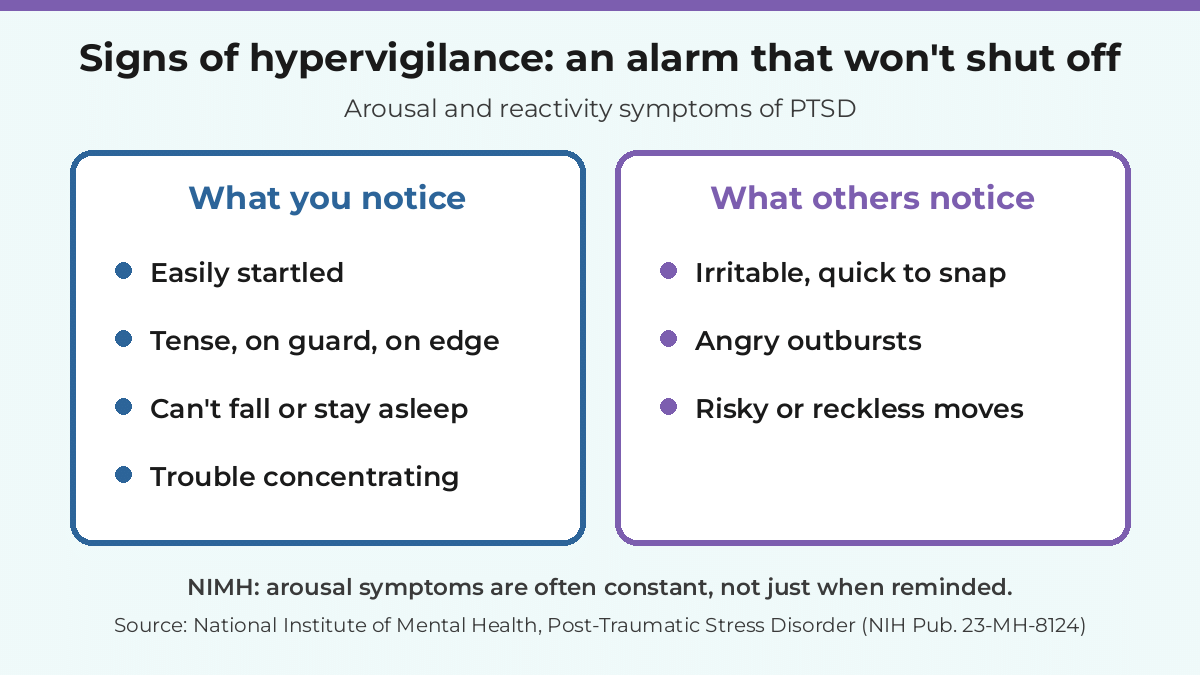
The National Institute of Mental Health groups this under the arousal and reactivity symptoms of PTSD. Its list includes being easily startled, feeling tense, on guard, or on edge, trouble concentrating, trouble falling or staying asleep, irritability or angry outbursts, and risky or reckless behavior. NIMH also notes that arousal symptoms are often constant, not something that only shows up when you’re reminded of what happened. A diagnosis of PTSD needs more than this, including re-experiencing, avoidance, and mood symptoms lasting at least a month. Plenty of people have hypervigilance without the full diagnosis, and it’s still worth taking seriously.
“I’m not traumatized. I’m just careful.”
That’s the line people use. Being careful is fine. Being careful because you can’t turn it off is different. If you’re exhausted by 2 p.m. from watching everything, if your partner says you “flinch at nothing,” or if you can’t relax at the beach in Fort Lauderdale because there are too many people behind you, that’s not caution. That’s a nervous system stuck in the on position.
Signs of Hypervigilance in Everyday Florida Life
Here’s what it can look like on a regular Tuesday, whether you’re in a Jacksonville kitchen or a parking garage in Miami. None of these means PTSD on its own. Several of them, sticking around for weeks, means it’s time for a real evaluation.
- You pick the seat with your back to the wall and an eye on the exit
- Loud noises, like thunder, fireworks on the Fourth, or a dropped pan, hit you like a punch
- You wake up at 3 a.m. and listen to the house
- You get irritable fast and feel bad about it later
- Crowds at theme parks in Orlando or game day in Tampa feel more like a threat than fun
- You read people’s faces constantly, looking for the moment the mood turns
Why the Brain Stays on High Alert: Hyperarousal Symptoms and the Research
A lot of people blame themselves for this, so let’s clear it up. This isn’t a willpower problem. It’s learning. Your brain learned that the world is dangerous, and it learned it well.
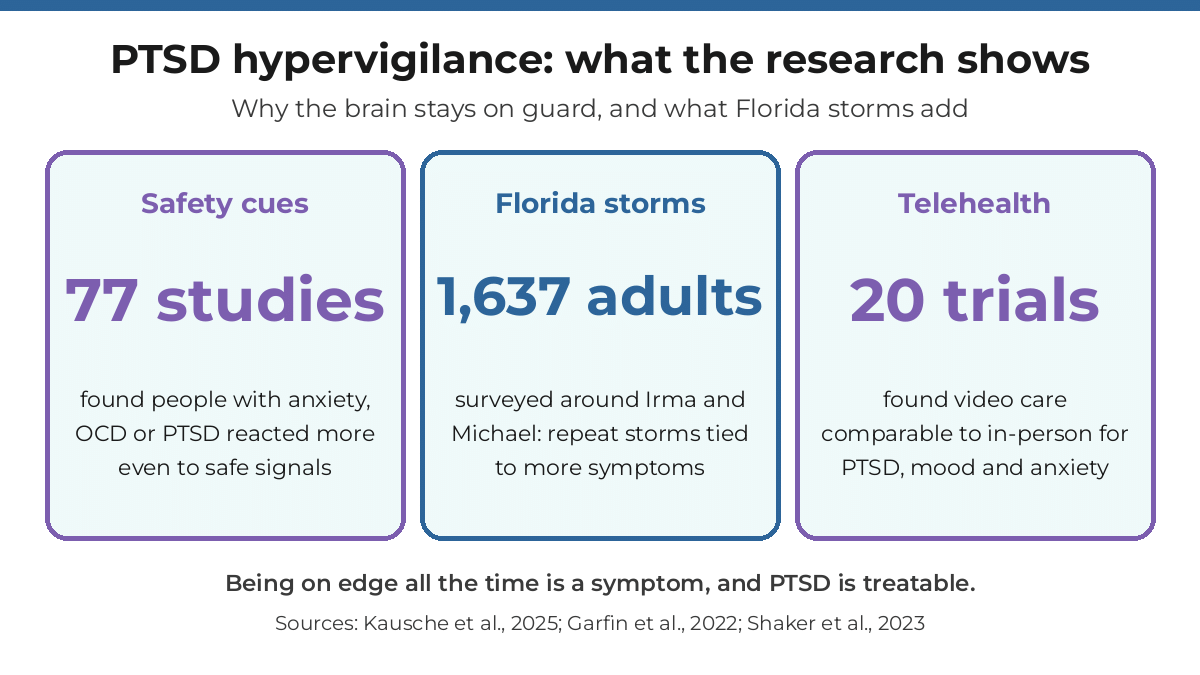
A 2025 meta-analysis by Kausche and colleagues pooled 77 fear-conditioning studies with 2,052 patients and 3,258 healthy controls. People with anxiety disorders, OCD, or PTSD reacted more strongly to cues that signaled safety, not just to cues that signaled threat, and kept showing heightened threat expectancy even during extinction, the phase where the brain is supposed to relearn that something is safe (PubMed). Put simply, the “all clear” signal doesn’t land the way it should.
Attention gets pulled too. In a 2022 meta-analysis of 40 eye-tracking studies, Clauss and colleagues found that anxiety and fear-related symptoms were linked both to looking toward threat faster and to keeping attention on it longer (PubMed). The effects were small. Still, if you always clock the one guy at the bar who seems off and then can’t stop watching him, that’s what this looks like in real life.
Hyperarousal can drive the rest of PTSD
Being on edge isn’t just one symptom sitting off to the side. In a study that followed 698 war survivors with PTSD in five Balkan countries for a year, Schlechter and colleagues found that hyperarousal symptoms predicted other PTSD symptoms at follow-up, while several avoidance symptoms were predicted by the others (PubMed). The authors say cause and effect still needs testing. Still, it’s one more reason not to shrug off the jumpiness and bad sleep as “just stress.”
Hurricane PTSD in Florida: Why Every Season Can Stack Up
We live in a state where a cone on the weather map can wreck a whole week. For people who’ve already been through a bad storm, each new one can land harder.
Garfin and colleagues surveyed a representative sample of Florida adults in the 60 hours before Hurricane Irma in 2017, again a month later, and again after Hurricane Michael in 2018. Their analysis in JAMA Network Open found that prior mental health problems, earlier hurricane loss or injury, hours of hurricane media coverage, and direct and indirect exposure were tied to more posttraumatic stress symptoms, and the authors concluded that people seemed to become sensitized to respond with more symptoms over time (PubMed).
The media piece matters. An earlier analysis of the same 1,637 Floridians by Thompson and colleagues found that more exposure to coverage of the approaching storm was linked to worse adjustment a month after Irma (PubMed). So yes, get your official updates. Then close the live stream. Watching the spaghetti models for six hours doesn’t make you safer, and for a hypervigilant brain it’s fuel. If storm season is a big part of this for you, our post on hurricane season anxiety in Florida has a practical plan.
What Actually Helps PTSD Hypervigilance
PTSD is treatable. Here’s what the evidence actually supports, without the hype.
Trauma-focused talk therapy
A 2023 network meta-analysis by Hoppen and colleagues pulled together 157 randomized trials with 11,565 adults. All the psychological approaches they studied worked better than control conditions, and trauma-focused CBT had the most research behind it and slightly larger effects than non-trauma-focused approaches (PubMed). If you’re seeing a therapist, or need a referral to one, that’s often part of the plan alongside psychiatric care.
Medication, starting with sleep
Medication can take the edge off. Here’s the honest size of that effect. A 2021 meta-analysis of 115 trials by Hoskins and colleagues found that SSRIs beat placebo for PTSD symptoms but with a small effect, with small benefits also seen for sertraline, paroxetine, fluoxetine, venlafaxine, and quetiapine, and for prazosin and risperidone as add-ons (PubMed). Small isn’t nothing, especially when you’re also sleeping again.
Sleep is often where we start. A 2022 PTSD medication algorithm from Bajor and colleagues, whose lead author works at the James A. Haley VA in Tampa, puts treating sleep problems as the first step, with prazosin recommended for nightmares and disturbed awakenings, before moving to an SSRI for the remaining daytime symptoms (PubMed). It’s hard to feel calm on four hours of broken sleep, so sleep gets attention early.
Where ketamine fits
You may have heard about ketamine for PTSD. The research is early but interesting. In a 30-person randomized trial in the American Journal of Psychiatry, Feder and colleagues found that 67% of people with chronic PTSD who got six ketamine infusions over two weeks responded, compared with 20% in the control group (PubMed). That’s one small study. The same 2022 algorithm says the evidence isn’t strong enough yet to make ketamine a standard PTSD step. At New Age Psychiatry, ketamine is one option we look at for treatment-resistant depression, which some people with trauma histories also live with. If that’s you, read our ketamine therapy for depression in Florida guide and we can talk about whether you’re a fit.
Telehealth Psychiatry in Florida for PTSD: Does Video Work?
For a lot of hypervigilant people, a crowded waiting room is its own little nightmare. Doing the visit from your own couch, with the door where you can see it, can make it easier to show up at all.
And the evidence holds up. A 2023 meta-analysis of 20 randomized trials by Shaker and colleagues, nine of them in PTSD, found that psychiatric treatment by telemedicine was comparable to in-person care in efficacy, patient satisfaction, and dropout rates (PubMed). In an earlier trial of 132 veterans at a Southeastern VA, Acierno and colleagues found that prolonged exposure therapy delivered by home-based telehealth was non-inferior to in-person sessions for reducing PTSD symptoms (PubMed).
What a first video visit covers
Expect a straight conversation, not a quiz. We’ll go over what happened (only as much as you want to share on day one), how long you’ve felt on guard, how you’re sleeping, how your work and relationships are holding up, alcohol and cannabis use, any history of depression, anxiety, or ADHD, and what you’ve already tried. You need to be physically in Florida during the visit.
Who This Is For, and When You Need Faster Care
This is for Florida adults who’ve been through something hard, whether that’s combat, abuse, a crash, a medical scare, or a storm, and who are tired of living on alert. If you’ve noticed PTSD bleeding into your closest relationships, our post on how untreated PTSD affects relationships is worth a read, and if your trauma goes back years, see our guide to complex PTSD care in Florida.
Telehealth has limits. As our FAQ explains, New Age Psychiatry doesn’t provide telehealth care for people with a history of psychosis, a recent suicide attempt or suicidal thoughts in the past six months, thought disorders, bipolar I disorder, or dementia. If that’s where things are, we’ll tell you plainly that a higher level of care is the safer fit. If you or someone you know is thinking about suicide, call or text 988, chat at 988lifeline.org, or call 911.
Frequently Asked Questions
What does PTSD hypervigilance feel like?
Most people describe it as never fully relaxing. You’re scanning rooms, jumping at noises, sleeping light, and getting irritable fast. It often feels so normal that people think it’s their personality.
Can you have hypervigilance without PTSD?
Yes. It can show up with anxiety disorders too, or in the weeks right after a trauma. A diagnosis of PTSD needs a specific mix of symptoms lasting at least a month, which is why an evaluation matters.
Can hurricanes cause PTSD in Florida?
A serious storm can be a traumatic event, and research on Florida adults found that repeated hurricane exposure was linked to more posttraumatic stress symptoms over time. Not everyone who lives through a storm develops PTSD.
Does hypervigilance go away?
It can ease as PTSD gets treated. Trauma-focused therapy has the strongest research behind it, and treating sleep and adding medication when it fits are part of standard PTSD care. It’s not instant, and it’s not supposed to be.
Can I get evaluated for PTSD online in Florida?
Yes. New Age Psychiatry sees adults located in Florida by secure video, from Miami and Fort Lauderdale to Orlando, Tampa, and Jacksonville, within the limits in our FAQ.
PTSD Hypervigilance Care by Telehealth Across Florida
New Age Psychiatry is a telehealth-only psychiatry practice for adults across Florida, led by Hilary Ortega, PMHNP-BC. Visits happen by secure video, so it doesn’t matter if you’re in Miami, Tampa, Orlando, Jacksonville, or a small town off I-75. The first visit is a real evaluation of your history, not a five-minute checklist, and follow-ups are where we adjust the plan.
If you read the first paragraph and recognized yourself, that’s enough of a reason to book. You can keep reading on the New Age Psychiatry blog, including PTSD telehealth in Florida and how to get a psychiatric evaluation online in Florida, or visit our online psychiatrist in Florida page for more on telehealth psychiatry Florida options.
References
Acierno, R., Knapp, R., Tuerk, P., Gilmore, A. K., Lejuez, C., Ruggiero, K., Muzzy, W., Egede, L., Hernandez-Tejada, M. A., & Foa, E. B. (2017). A non-inferiority trial of prolonged exposure for posttraumatic stress disorder: In person versus home-based telehealth. Behaviour Research and Therapy, 89, 57–65. https://doi.org/10.1016/j.brat.2016.11.009
Bajor, L. A., Balsara, C., & Osser, D. N. (2022). An evidence-based approach to psychopharmacology for posttraumatic stress disorder (PTSD): 2022 update. Psychiatry Research, 317, Article 114840. https://doi.org/10.1016/j.psychres.2022.114840
Clauss, K., Gorday, J. Y., & Bardeen, J. R. (2022). Eye tracking evidence of threat-related attentional bias in anxiety- and fear-related disorders: A systematic review and meta-analysis. Clinical Psychology Review, 93, Article 102142. https://doi.org/10.1016/j.cpr.2022.102142
Feder, A., Costi, S., Rutter, S. B., Collins, A. B., Govindarajulu, U., Jha, M. K., Horn, S. R., Kautz, M., Corniquel, M., Collins, K. A., Bevilacqua, L., Glasgow, A. M., Brallier, J., Pietrzak, R. H., Murrough, J. W., & Charney, D. S. (2021). A randomized controlled trial of repeated ketamine administration for chronic posttraumatic stress disorder. American Journal of Psychiatry, 178(2), 193–202. https://doi.org/10.1176/appi.ajp.2020.20050596
Garfin, D. R., Thompson, R. R., Holman, E. A., Wong-Parodi, G., & Silver, R. C. (2022). Association between repeated exposure to hurricanes and mental health in a representative sample of Florida residents. JAMA Network Open, 5(6), Article e2217251. https://doi.org/10.1001/jamanetworkopen.2022.17251
Hoppen, T. H., Jehn, M., Holling, H., Mutz, J., Kip, A., & Morina, N. (2023). The efficacy and acceptability of psychological interventions for adult PTSD: A network and pairwise meta-analysis of randomized controlled trials. Journal of Consulting and Clinical Psychology, 91(8), 445–461. https://doi.org/10.1037/ccp0000809
Hoskins, M. D., Bridges, J., Sinnerton, R., Nakamura, A., Underwood, J. F. G., Slater, A., Lee, M. R. D., Clarke, L., Lewis, C., Roberts, N. P., & Bisson, J. I. (2021). Pharmacological therapy for post-traumatic stress disorder: A systematic review and meta-analysis of monotherapy, augmentation and head-to-head approaches. European Journal of Psychotraumatology, 12(1), Article 1802920. https://doi.org/10.1080/20008198.2020.1802920
Kausche, F. M., Carsten, H. P., Sobania, K. M., & Riesel, A. (2025). Fear and safety learning in anxiety- and stress-related disorders: An updated meta-analysis. Neuroscience & Biobehavioral Reviews, 169, Article 105983. https://doi.org/10.1016/j.neubiorev.2024.105983
National Institute of Mental Health. (2023). Post-traumatic stress disorder (NIH Publication No. 23-MH-8124). U.S. Department of Health and Human Services, National Institutes of Health. https://www.nimh.nih.gov/health/publications/post-traumatic-stress-disorder-ptsd
Schlechter, P., Hellmann, J. H., McNally, R. J., & Morina, N. (2022). The longitudinal course of posttraumatic stress disorder symptoms in war survivors: Insights from cross-lagged panel network analyses. Journal of Traumatic Stress, 35(3), 879–890. https://doi.org/10.1002/jts.22795
Shaker, A. A., Austin, S. F., Storebø, O. J., Schaug, J. P., Ayad, A., Sørensen, J. A., Tarp, K., Bechmann, H., & Simonsen, E. (2023). Psychiatric treatment conducted via telemedicine versus in-person modality in posttraumatic stress disorder, mood disorders, and anxiety disorders: Systematic review and meta-analysis. JMIR Mental Health, 10, Article e44790. https://doi.org/10.2196/44790
Thompson, R. R., Holman, E. A., & Silver, R. C. (2019). Media coverage, forecasted posttraumatic stress symptoms, and psychological responses before and after an approaching hurricane. JAMA Network Open, 2(1), Article e186228. https://doi.org/10.1001/jamanetworkopen.2018.6228