

Fast relief isn’t the same as established anxiety treatment. If you’re considering low dose ketamine for anxiety, it’s reasonable to ask how strong the research is, how long benefits might last, and what risks treatment may involve. Ketamine is used off-label for anxiety. Early findings are promising but limited, and they don’t guarantee that it will help you or provide lasting relief.
This article explains what current evidence does and doesn’t show, including the limits of anxiety-specific research. It also covers potential side effects such as dissociation, why medical oversight matters, and what to consider when care is delivered through telehealth.
A careful decision starts with your symptoms, health history, and treatment goals. New Age Psychiatry provides virtual psychiatric evaluations and ongoing medication management for adults in Florida, including low-dose ketamine therapy for eligible adults. An evaluation can help put treatment options in context. You can discuss what you hope to address, what questions to raise, and how follow-up can support informed care.
Key Takeaways
- Low dose ketamine for anxiety is an off-label treatment. Early research is promising but limited, not conclusive.
- “Low dose” doesn’t mean risk-free. Understand possible side effects and safety considerations before making a treatment decision.
- A psychiatric evaluation can put your symptoms, health history, and treatment goals in context before ketamine is considered.
- Virtual care can support assessment and ongoing medication management, but it doesn’t remove the need for individualized clinical oversight.
- New Age Psychiatry provides low-dose ketamine therapy for eligible adults in Florida as part of individualized care, without assuming a particular response or outcome.
Low-dose ketamine for anxiety: what it means and what it does not promise
People may look into low dose ketamine for anxiety when symptoms persist or previous treatments haven’t helped enough. The term “low-dose” can sound precise, but it doesn’t refer to one universally accepted dose or treatment plan. A clinician considers the dose and format in the context of your symptoms, medical history, and care needs.
Put simply, supervised psychiatric ketamine treatment is clinician-directed use of ketamine below doses used to produce anesthesia, with medical assessment and follow-up. It is not a do-it-yourself approach or a promise of relief. The distinction matters. A dose lower than anesthetic use isn’t risk-free, and the label alone can’t establish whether treatment is appropriate for you.
What does low-dose ketamine mean in anxiety care?
In anxiety care, “low-dose” describes treatment in relation to ketamine’s anesthetic use. It is not a single threshold that applies to every patient. The clinical context and treatment plan determine what the term means in practice. Some people explore additional options because symptoms remain difficult despite care. This is sometimes described as treatment-resistant or refractory anxiety, but it doesn’t describe everyone interested in ketamine.
“Refractory” generally means symptoms have not improved enough with appropriate treatments tried so far. It isn’t a judgment about effort or character, and it doesn’t automatically make ketamine the next step. An evaluation can review which treatments you’ve tried, how anxiety affects daily life, and whether another approach may be more suitable.
How does anxiety treatment differ from ketamine’s other uses?
Ketamine’s established FDA-approved use is as an anesthetic. It is not FDA-approved specifically to treat anxiety, so prescribing it for anxiety is off-label. Off-label means a clinician prescribes an approved medication for a purpose that isn’t among its FDA-approved uses. This is a recognized practice in medicine, but it doesn’t mean the FDA has evaluated ketamine as an anxiety treatment or established a standard anxiety protocol.
Evidence and approval can vary by condition and formulation. Esketamine, a related but distinct medication, is FDA-approved for treatment-resistant depression, not anxiety. That approval shouldn’t be treated as proof that ketamine is approved for anxiety or that results will transfer between conditions or formulations. A 2026 guide to ketamine’s therapeutic uses offers broader context about how its mental health uses differ.
Anxiety-specific research has explored possible symptom improvement, but findings don’t establish a universal response or guarantee lasting benefit. Study results may not predict what you will experience. Ketamine-assisted psychotherapy provides a general overview of ketamine’s mental health applications, including discussion of anxiety, but it isn’t a substitute for clinical evidence or an individualized assessment.
Potential benefit is one consideration, not a certainty. Understanding what anxiety-focused research can and cannot tell us is a useful next step.
What research says about low-dose ketamine and anxiety symptoms
Research on ketamine for anxiety is encouraging enough to merit careful study, but it isn’t strong enough to promise a reliable result. The evidence base is smaller and less settled than headlines about fast relief may suggest. A reported improvement in a study is a reason to investigate further, not proof that everyone with anxiety will respond or that benefits will last.
What does the anxiety-specific research actually examine?
Studies and reviews have examined ketamine in people with particular anxiety-related diagnoses, including generalized anxiety disorder and social anxiety disorder. Some research also considers PTSD and OCD, which are distinct conditions rather than interchangeable forms of anxiety. Findings from a selected group, especially people with persistent symptoms, may not apply to everyone seeking care.
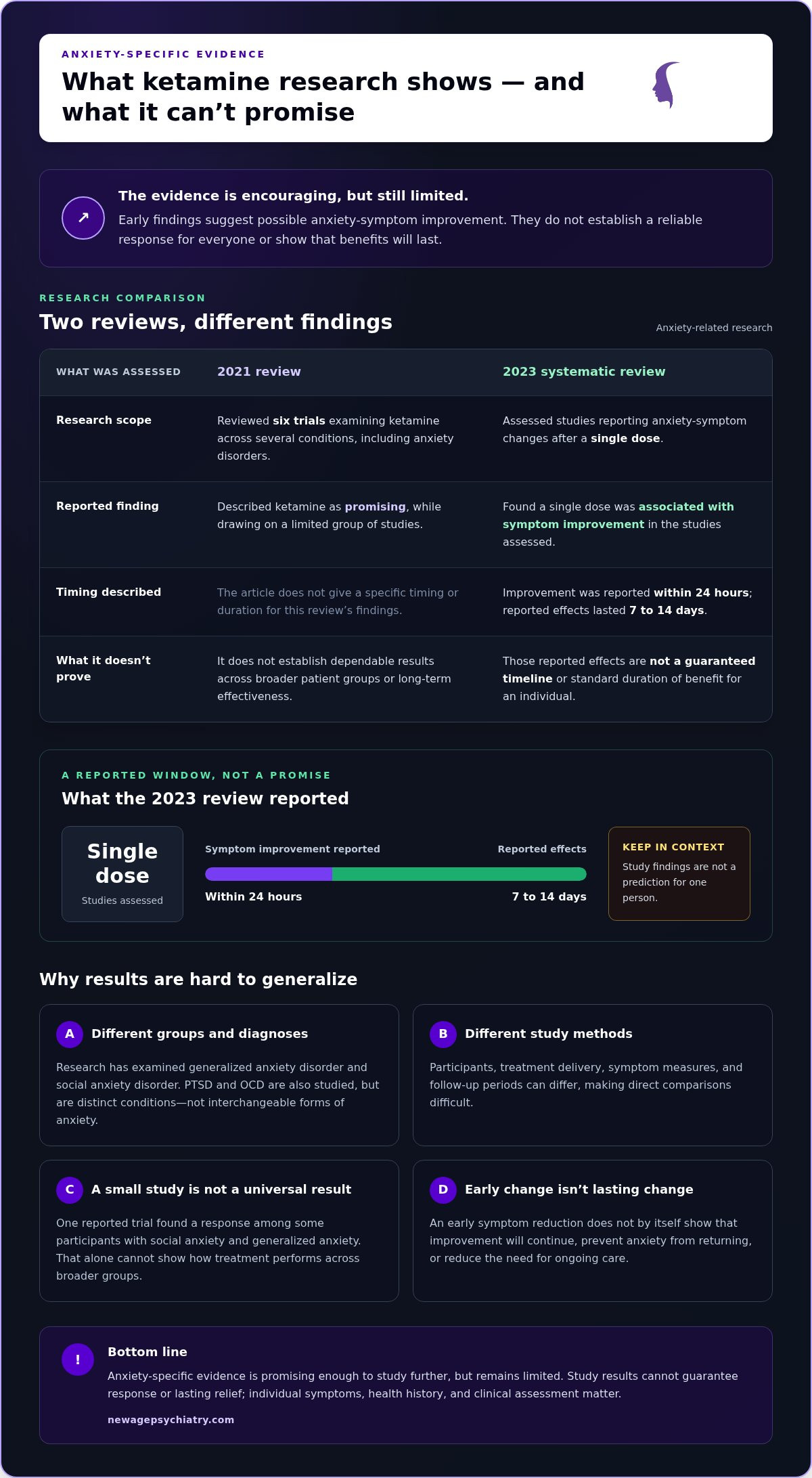
A 2021 review of six trials described ketamine as promising for several conditions, including anxiety disorders, while drawing on a limited group of studies. One reported trial found a response among some participants with social anxiety and generalized anxiety. A result from one small study can’t establish how treatment performs across broader patient groups. Differences in participants, treatment delivery, and symptom measures also make direct comparisons difficult.
Evidence summary: A 2021 review of six trials found early support for ketamine’s possible effects on anxiety-related conditions, but the limited evidence does not establish a dependable response or long-term effectiveness for everyone.
A 2023 systematic review reported that a single dose was associated with anxiety symptom improvement within 24 hours in the studies it assessed, with reported effects lasting from 7 to 14 days. That finding describes results in specific studies, not a guaranteed timeline or standard duration of benefit for an individual. Study design, diagnosis, treatment format, and outcome measures all affect what a result can tell us.
Why is it difficult to predict how long benefits may last?
Researchers may measure symptoms soon after treatment and then use different follow-up periods to see whether changes continue. An early reduction in symptoms doesn’t show by itself that improvement will remain, prevent anxiety from returning, or reduce the need for ongoing care. Longer-term evidence for anxiety is less established than short-term findings.
Individual responses vary, too. A study average can’t predict a particular person’s experience, and a result from one diagnosis or treatment format shouldn’t be assumed to apply to another. A clinician’s assessment should consider your symptoms, history, prior care, and how any change would be monitored, rather than relying on a headline or a single study result.
For Florida adults weighing these findings, a virtual psychiatric evaluation can help put treatment options in the context of personal symptoms and history. The research supports informed discussion, not a promise that low dose ketamine for anxiety will work or provide lasting relief.
Safety, side effects, and the concern that low-dose ketamine is risk-free
“Low-dose” describes a treatment approach, not a guarantee of safety. Ketamine can still affect perception, mood, and blood pressure, so low dose ketamine for anxiety calls for individualized screening and clinician oversight. Your medical history, current symptoms, other medications, and treatment setting all matter when weighing possible benefits and risks.
What risks and side effects should patients understand?
Ketamine may cause dissociation, a temporary change in how you experience your body or surroundings. Some people may also experience an increase in blood pressure. Effects vary, and a lower dose doesn’t mean these effects cannot occur. A clinician can explain which effects may be expected in the planned treatment context and which symptoms should prompt timely medical attention.
There’s a difference between a possible short-term treatment effect and a concerning or unexpected reaction. Contact your treating clinician about symptoms that feel severe, persist, or cause concern. Urgent or life-threatening symptoms call for emergency help. Don’t change a treatment plan or add substances to manage an effect without clinical guidance.
Ketamine also carries a risk of psychological dependence and misuse, particularly when used without medical supervision. Discussing this risk isn’t an accusation or judgment. It helps the clinician understand the full picture and plan care thoughtfully. Be open about past or current substance use, cravings, or concerns about control, even if the conversation feels difficult.
Who may need additional assessment before considering treatment?
Suitability depends on your health and psychiatric history, not on a single checklist. A clinician may need to understand blood-pressure concerns, other relevant health conditions, changes in mood or perception, past treatment experiences, and medicines or substances that could affect safety. These details are topics for assessment, not automatic reasons to rule someone out.
Before an evaluation, prepare a current medication list and note any medical or substance-use history you want the clinician to understand. Write down questions about monitoring and follow-up, too. For virtual care, discuss how the plan accounts for safety during and after treatment. Meeting remotely doesn’t make clinical oversight unnecessary.
Safety depends on individualized screening, an appropriate treatment plan, and clinician oversight, not on the label “low dose” alone. A safety discussion should leave room for uncertainty and for choosing another option if ketamine doesn’t fit your needs.
If you or someone else is in immediate danger or facing a mental health crisis, call emergency services or call or text 988 in the United States for the Suicide & Crisis Lifeline. Ketamine treatment is not a crisis response.
What to expect from an evaluation and virtual ketamine care
A psychiatric evaluation helps build a full picture before deciding whether low dose ketamine for anxiety belongs in a care plan. The clinician can discuss your symptoms and health history, review possible treatment options, and assess whether ketamine is appropriate for you. If you and the clinician agree on a plan, follow-up helps assess how it is working and whether it still fits.
Telehealth can make psychiatric assessment and ongoing medication management accessible to adults in Florida without traveling to an office. A screen doesn’t replace medical judgment or safety planning. Treatment decisions still need to account for personal risks, and the clinician should explain how questions or concerns will be addressed during follow-up.
How can patients prepare for a psychiatric evaluation?
Preparation can make it easier to describe what’s happening. Note when anxiety began, how symptoms have changed, and what treatments you’ve tried. Include current medications and relevant medical history. Describe how anxiety affects sleep, work, relationships, or everyday activities. These details show how it affects your functioning beyond a symptom label.
Bring questions, too. For example, ask what outcome treatment is intended to support, what remains uncertain in the evidence, what side effects may occur, and what alternatives might make sense. If ketamine is discussed, clarify what the care plan involves, how safety concerns are handled, and whom to contact with questions after treatment. These are reasonable parts of shared decision-making, not signs that you’re challenging the clinician.
What should ongoing follow-up help assess?
Follow-up gives you and the clinician a chance to review symptom changes, daily functioning, side effects, and whether the agreed plan remains appropriate. A useful check-in can consider concrete changes, such as whether anxiety interferes less with sleep or routine responsibilities, alongside your overall experience. The clinician may adjust the plan as they learn more about response and safety. One early impression doesn’t need to settle the decision.
Virtual care can support this continuing conversation, but it doesn’t make monitoring or communication less important. Before treatment, ask what follow-up will look like and how to raise concerns between appointments. The approach to telehealth care for depression also illustrates how psychiatric assessment and management can take place remotely while treatment remains individualized.
For adults in Florida considering ketamine, a virtual psychiatric evaluation can connect symptoms and health history to available options. Explore virtual psychiatric care with New Age Psychiatry to discuss anxiety treatment with clinical support.
Considering low-dose ketamine for anxiety with New Age Psychiatry
Research findings and safety considerations can frame the decision, but they can’t determine whether ketamine fits your situation. New Age Psychiatry provides virtual psychiatric evaluations and medication management for adults in Florida, including low-dose ketamine therapy for eligible adults. Treatment is part of an individualized discussion, not a guaranteed answer or a suitable option for every anxiety diagnosis.
How can a clinician help make the decision personal?
A clinician can consider how anxiety affects your life alongside your symptom history, health background, and previous care. That context helps guide a discussion of potential treatment options, including their known limits and uncertainties. The goal isn’t to steer every patient toward ketamine. It’s to support an informed choice, set realistic expectations, and consider how psychiatric care and follow-up may fit together.
Use the conversation to clarify what matters most to you. Describe which symptoms you most want to address, what you’ve already tried, and what concerns you have about side effects or ongoing care. Ask what would make a treatment plan worth continuing or reconsidering. A thoughtful discussion should leave room for questions and alternatives, as well as a decision not to pursue ketamine.
What is a practical next step for Florida adults?
If you’re an adult in Florida considering care, a virtual psychiatric evaluation provides a setting to discuss anxiety, review your history, and understand potential next steps. Treatment decisions depend on the clinician’s assessment and your individual circumstances.
Before an appointment, bring a brief timeline of your symptoms, a list of current medications, and notes about treatments you’ve tried. Consider writing down questions such as:
- What options may fit my symptoms and health history?
- What benefits are possible, and what remains uncertain?
- What risks, monitoring, and follow-up should I understand?
- How will we review whether the plan is helping?
Virtual outpatient psychiatry can support evaluation and ongoing management, but it isn’t emergency crisis intervention or inpatient care. If you need immediate help because of a crisis or danger, seek emergency support rather than waiting for a routine appointment.
Exploring care doesn’t commit you to a particular treatment. Explore virtual psychiatric care for adults in Florida and discuss whether low dose ketamine for anxiety or another option makes sense for your needs.
Take the next step at your own pace
You don’t need to decide on ketamine before speaking with a clinician. Bring your priorities into the conversation: which anxiety symptoms affect you most, what you hope could change, and what uncertainties or risks you want to understand. That can make the discussion more personal and keep the focus on care that fits your needs, whether or not low dose ketamine for anxiety is ultimately considered.
New Age Psychiatry offers virtual psychiatric care for adults in Florida, including evaluation and ongoing medication management, as well as low-dose ketamine therapy for eligible adults. There is no guaranteed outcome. An evaluation is an opportunity to discuss options and ask questions, not a commitment to a particular treatment.
Explore virtual psychiatric care for anxiety and take a thoughtful next step with clinical support. You deserve care that takes your concerns seriously and gives you room to make an informed choice.
Frequently Asked Questions
Can low-dose ketamine help with anxiety?
It may ease anxiety symptoms for some people, but current evidence is limited and can’t predict an individual response. Research has examined specific groups and conditions, so findings may not apply equally to every anxiety diagnosis. If you’re considering low dose ketamine for anxiety, discuss your symptoms, past treatments, and goals with a psychiatric clinician rather than relying on another person’s experience or a general claim of rapid relief.
Is low-dose ketamine FDA-approved for anxiety?
No. Ketamine is FDA-approved as an anesthetic, not specifically for anxiety. A clinician may prescribe an FDA-approved medication off-label for another purpose, but off-label use doesn’t mean the FDA has approved it for that condition. Esketamine is a distinct medication approved for treatment-resistant depression, not anxiety. Ask the clinician to explain the treatment’s regulatory status and how that relates to the evidence for your situation.
How quickly might ketamine affect anxiety symptoms?
Some studies report changes within a day, but that isn’t a reliable prediction for any one person. A 2023 systematic review reported anxiety symptom improvement within 24 hours after a single dose in the studies it assessed. Those findings don’t establish a standard onset, guarantee relief, or show that improvement will continue. Review changes in symptoms and daily functioning with your clinician rather than judging treatment by one moment or day.
Is low-dose ketamine the same as microdosing?
Not necessarily. “Microdosing” is used informally and doesn’t have one consistent meaning across settings. Low-dose psychiatric treatment refers to clinician-directed use below anesthetic dosing, with the plan based on clinical context. The terms shouldn’t be treated as interchangeable instructions for use. Don’t experiment with ketamine or change a prescribed plan on your own. Ask the clinician what the dose description means in your specific care plan.
Can ketamine cause dissociation or other side effects?
Yes. Possible effects include dissociation, dizziness, nausea, and changes in blood pressure, though experiences vary. Before treatment, share your health history and all medicines or substances you use so the clinician can consider possible risks. Ask which effects require prompt medical attention and how to report them. Severe or alarming symptoms warrant urgent medical help. Being candid about substance-use concerns helps the clinician plan care without judgment.
Can I drive after ketamine treatment?
Don’t assume it’s safe to drive immediately after treatment. Ketamine may affect perception, coordination, or judgment, including through dissociation, and the impact can vary. Ask your clinician for instructions specific to your treatment and follow them, even if you feel alert. Plan transportation in advance if driving may be restricted, and don’t drive while you feel impaired. Your clinician can clarify when it’s appropriate to resume driving.
Is virtual psychiatric care appropriate for discussing ketamine treatment?
Yes. A virtual psychiatric evaluation provides a setting to discuss anxiety symptoms, health history, prior care, and whether ketamine or another option merits consideration. New Age Psychiatry provides virtual psychiatric care for adults in Florida, including ongoing medication management and low-dose ketamine therapy for eligible adults. Remote outpatient care isn’t emergency or inpatient treatment. If you’re in immediate danger or crisis, call emergency services or call or text 988.