
It’s Thanksgiving, which means someone in your family is about to line everybody up for a photo by the pool or on the back porch. If you already know you’ll be the one “taking” the picture so you don’t have to be in it, because of your skin, your nose, or your hairline, this post is for you. When one part of your appearance eats hours of your day and nobody else can even see what you see, that may be body dysmorphic disorder, often called BDD.
This post is educational, not medical advice for your situation. I’ll cover what body dysmorphic disorder looks like day to day, how common it really is, why a procedure usually doesn’t end it, what the research says works, and how a telehealth evaluation with New Age Psychiatry works anywhere in Florida.
Key Takeaways
- Body dysmorphic disorder affects about 2% of adults. It usually starts before age 18, and adult men and women get it at similar rates.
- It’s not vanity. It’s an obsessive-compulsive related condition built around checking, hiding, and comparing a flaw other people barely notice.
- About 1 in 5 people asking for cosmetic surgery met criteria for BDD in one large meta-analysis, and most people with BDD don’t feel better after a procedure.
- Cognitive behavioral therapy and SSRI medications have the best evidence, and online CBT has held up in randomized trials.
What Is Body Dysmorphic Disorder?
Everybody has a feature they’d change. That’s not BDD. Body dysmorphic disorder is when the thought about that feature won’t leave you alone, and you keep doing things to check it, fix it, or hide it.
A 2024 review in Nature Reviews Disease Primers by Rück and colleagues describes it as an obsessive-compulsive related condition with an intense preoccupation with perceived flaws that other people can’t see, affecting about 2% of adults, usually starting before age 18, and carrying considerable suicide risk (PubMed). The same review notes that people can spend several hours a day stuck on these flaws. Some stop working. Some barely leave the house.
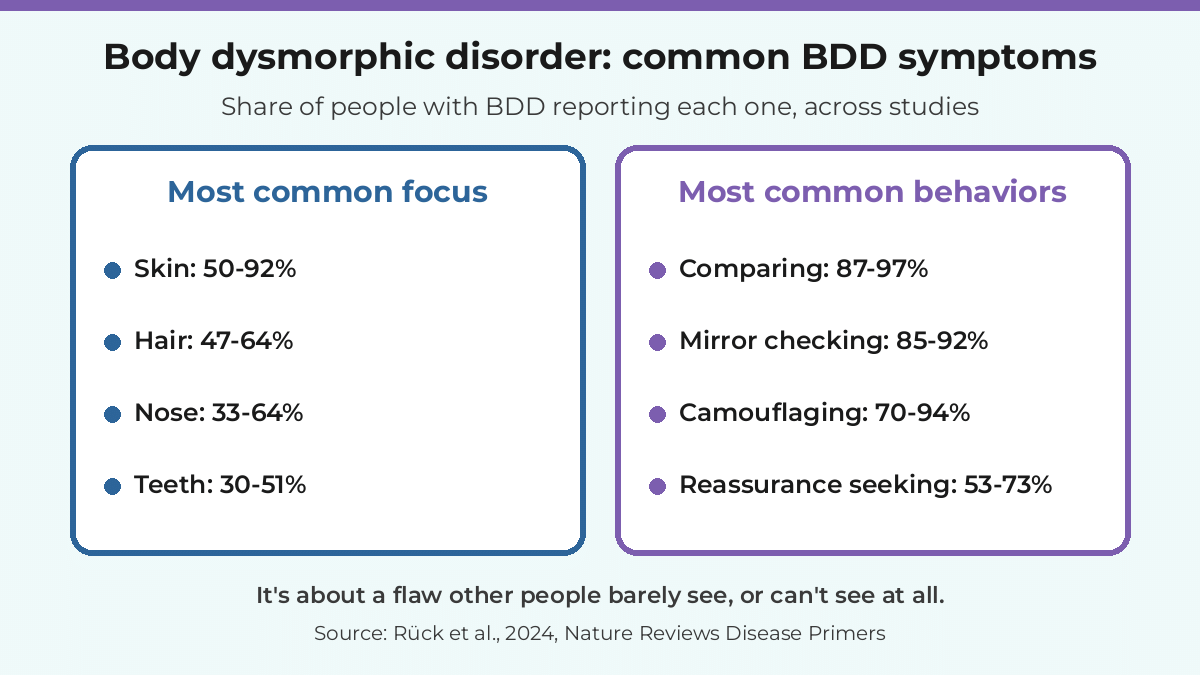
The most common targets in that review were skin, hair, and nose. The most common behaviors were comparing yourself to other people (87% to 97% of people with BDD), mirror checking (85% to 92%), and camouflaging (70% to 94%), like makeup, hats, or angling your face away from the camera. There’s also a version called muscle dysmorphia, mostly seen in men, where the worry is that your body is too small or not muscular enough. If you’re in a Miami gym twice a day and still think you look scrawny, that one’s worth knowing about.
BDD symptoms that are easy to miss
Some of these don’t look like a mental health problem from the outside. They look like being “particular”:
- Checking every reflective surface, car windows included, or avoiding mirrors completely
- Changing outfits over and over before you can leave the house
- Asking people if you look okay and not believing them when they say yes
- Picking at your skin to “fix” it
- Skipping the beach, the pool party, or a date because of how you think you look
In Florida, you’re in shorts or a swimsuit for most of the year. There’s no sweater season to hide in, which is part of why BDD can shrink a Florida life so fast.
How Common Is Body Dysmorphic Disorder?
About 2 in 100 adults in the general population, per the Rück review. In certain settings it’s a lot higher. A 2023 meta-analysis by McGrath and colleagues pooled 22 studies of 7,159 people that used structured diagnostic interviews and found that BDD showed up in 20.0% of people in cosmetic and dermatology settings and 7.4% of people in mental health settings (PubMed). The authors were upfront that the studies varied a lot in quality, so those numbers are estimates.
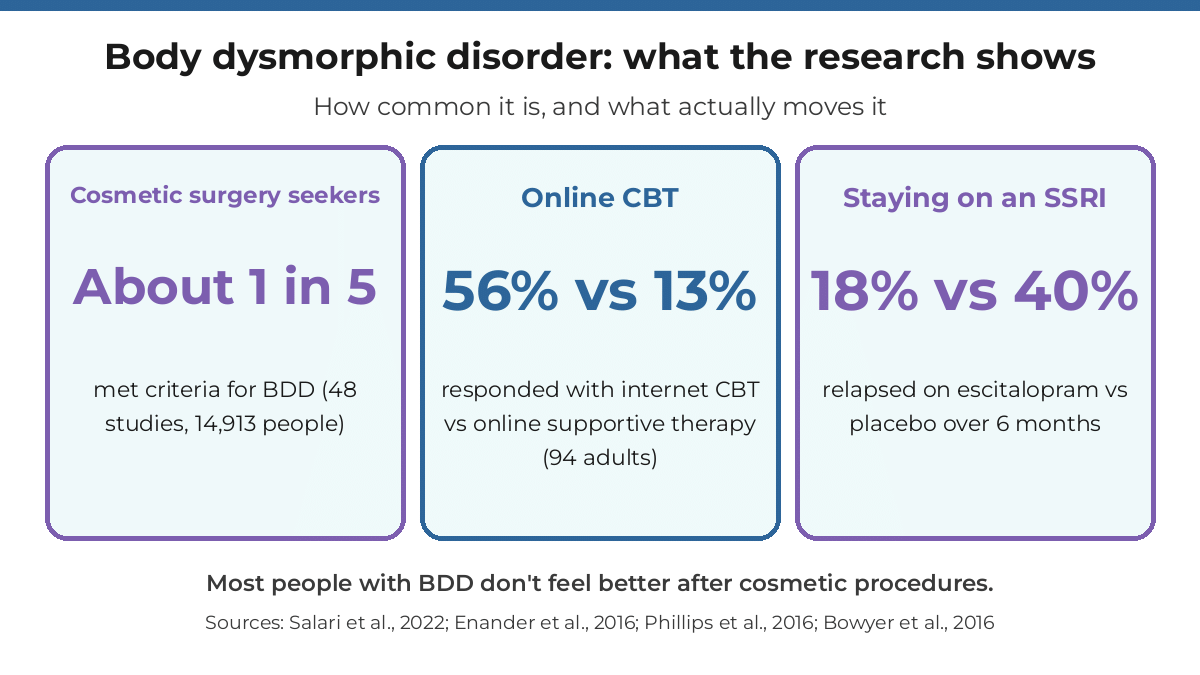
A separate 2022 meta-analysis by Salari and colleagues looked at 48 studies with 14,913 people asking for cosmetic surgery and found a BDD prevalence of 19.2%, about 1 in 5 (PubMed). Think about how many med spas you pass on the way to Publix in Fort Lauderdale or Tampa. A lot of people with BDD end up in a dermatologist’s or surgeon’s chair long before anyone asks how they’re doing mentally.
It also gets missed in psychiatry. The Rück review points out that people with BDD often come in for low mood or social anxiety and never mention the appearance part, out of shame or because they’re convinced the flaw is real.
Body Dysmorphic Disorder and Cosmetic Procedures
I’ll be honest here because this is where people lose a lot of money and a lot of hope. If the problem were really your nose, a new nose would fix it. With BDD, it usually doesn’t.
A 2016 review in Body Image by Bowyer and colleagues concluded that most people with BDD have poor outcomes after cosmetic procedures, though the authors couldn’t rule out that some people with mild BDD and a very specific concern might benefit (PubMed). The 2024 Rück review goes further and says cosmetic treatments aren’t recommended for BDD because outcomes are typically unpredictable or poor.
I’m not anti-Botox and I’m not judging anyone’s filler. I’m saying that if you’ve had three procedures and feel the same or worse, that’s information.
Why BDD Is Worth Taking Seriously
This isn’t a cosmetic problem with a mental health label slapped on it. A 2016 meta-analysis of 17 studies by Angelakis and colleagues found that people with BDD had about 3.6 times the odds of suicidality, including higher odds of both suicidal thoughts and suicide attempts (PubMed). The authors flagged that many of the studies were small or lower quality, so the exact number is rough. The direction isn’t.
If you’re having thoughts of not wanting to be alive, don’t wait for an appointment. Call or text 988, chat at 988lifeline.org, or call 911.
What Actually Works for Body Dysmorphic Disorder
Two things have real evidence: a specific kind of cognitive behavioral therapy built for BDD, and SSRI medications. Often both.
CBT for BDD, including online
CBT for BDD isn’t just talking about self-esteem. It works on the checking, hiding, and comparing directly, a lot like exposure work for OCD. The Rück review counted ten randomized trials showing it works better than a waitlist or other therapies.
If there’s no BDD specialist anywhere near you, here’s the good news: it holds up online. In a 2016 trial in The BMJ, Enander and colleagues randomized 94 adults to 12 weeks of therapist-guided internet CBT or online supportive therapy, and 56% of the internet CBT group were responders at follow-up, compared with 13% in the supportive therapy group (PubMed). When that same program was rolled out in a regular Swedish public clinic, Lundström and colleagues found that 69% of 163 patients responded and 48% reached full or partial remission (PubMed).
Even an app has shown promise. In a 2022 randomized trial of 80 adults by Wilhelm and colleagues, 12 weeks of app-based CBT with coach support led to significantly lower BDD severity than a waitlist, with a large effect (PubMed). That was one trial, so it needs repeating, but it’s encouraging.
Medication for BDD
SSRIs like fluoxetine, sertraline, and escitalopram are the first-line medications, per the Rück review. BDD usually needs relatively high doses, similar to OCD, and a fair trial is at least 12 to 16 weeks, including about a month at the highest dose you can tolerate. That’s slower than anyone wants, and it’s easy to quit before it has a chance.
Staying on it matters too. In a 2016 American Journal of Psychiatry trial, Phillips and colleagues gave 100 adults with BDD escitalopram for 14 weeks, and 67% responded; among responders randomized to keep taking it or switch to placebo for six months, 18% relapsed on escitalopram vs 40% on placebo (PubMed).
BDD and depression travel together a lot. A 2026 meta-analysis of 46 studies by Loewen and colleagues found that antidepressants, especially SSRIs, and CBT both substantially reduced depressive symptoms in people with BDD, though results varied a lot between trials (PubMed). If you also deal with obsessions that have nothing to do with how you look, our guide to OCD medication for Florida adults covers the overlap.
Body Dysmorphic Disorder Care by Telehealth in Florida
At New Age Psychiatry, the first visit is a full psychiatric evaluation by secure video. You can keep your camera angled however you need to. We’ll talk about what part of your appearance takes up your day, how many hours it costs you, what you do to check or hide it, any procedures you’ve had, and whether depression, anxiety, OCD, or eating concerns are part of it. Then we decide together: medication, a referral to a CBT therapist who knows BDD, or both.
Telehealth has limits. As our FAQ explains, New Age Psychiatry doesn’t provide telehealth care for people with a history of psychosis, a recent suicide attempt or suicidal thoughts in the past six months, thought disorders, bipolar I disorder, or dementia. If that’s where things are, we’ll tell you plainly that a higher level of care is the safer fit.
If you’re already on an SSRI and feeling flat, read feeling emotionally numb from antidepressants. If your checking is more about your health than your looks, health anxiety may fit better.
Frequently Asked Questions
Is body dysmorphia the same as low self-esteem?
No. Plenty of people don’t love how they look. BDD is a diagnosable condition with hours of preoccupation, repetitive checking or hiding, and real damage to work, relationships, or daily life.
Is BDD the same as an eating disorder?
They can overlap, but they’re different. Eating disorders usually center on weight and shape. BDD can focus on any feature, and skin, hair, and nose are the most common.
Will a cosmetic procedure fix BDD?
Usually not. The research says most people with BDD don’t feel better afterward, which is why the evaluation comes first.
Can I be seen online anywhere in Florida?
Yes. New Age Psychiatry sees adults located in Florida by secure video, from Miami and Fort Lauderdale to Orlando, Tampa, and Jacksonville, within the limits in our FAQ.
Telehealth Psychiatry Across Florida
New Age Psychiatry is a telehealth-only psychiatry practice for adults across Florida, led by Hilary Ortega, PMHNP-BC. Whether you’re in a condo in Brickell, a townhouse in Orlando, or a ranch house outside Jacksonville, the visit happens from wherever you can close a door and talk. No waiting room, and no lobby mirror to walk past.
If you’ve spent years thinking the flaw is the problem, it might be worth checking whether the flaw is really the problem. Keep reading on the New Age Psychiatry blog or visit our online psychiatrist in Florida page for more on telehealth psychiatry Florida options.
References
Angelakis, I., Gooding, P. A., & Panagioti, M. (2016). Suicidality in body dysmorphic disorder (BDD): A systematic review with meta-analysis. Clinical Psychology Review, 49, 55–66. https://doi.org/10.1016/j.cpr.2016.08.002
Bowyer, L., Krebs, G., Mataix-Cols, D., Veale, D., & Monzani, B. (2016). A critical review of cosmetic treatment outcomes in body dysmorphic disorder. Body Image, 19, 1–8. https://doi.org/10.1016/j.bodyim.2016.07.001
Enander, J., Andersson, E., Mataix-Cols, D., Lichtenstein, L., Alström, K., Andersson, G., Ljótsson, B., & Rück, C. (2016). Therapist guided internet based cognitive behavioural therapy for body dysmorphic disorder: Single blind randomised controlled trial. BMJ, 352, Article i241. https://doi.org/10.1136/bmj.i241
Loewen, A., Peñuelas-Calvo, I., Alacreu-Crespo, A., Jiménez-Muñoz, L., Grijalba-Chiva, S., Mata-Iturralde, L., & Porras-Segovia, A. (2026). Effects of pharmacological and psychological treatments on depressive symptoms in body dysmorphic disorder: A systematic review and meta-analysis. Current Psychiatry Reports, 28(1), Article 38. https://doi.org/10.1007/s11920-026-01688-y
Lundström, L., Flygare, O., Ivanova, E., Mataix-Cols, D., Enander, J., Pascal, D., Chen, L. L., Andersson, E., & Rück, C. (2023). Effectiveness of Internet-based cognitive-behavioural therapy for obsessive-compulsive disorder (OCD-NET) and body dysmorphic disorder (BDD-NET) in the Swedish public health system using the RE-AIM implementation framework. Internet Interventions, 31, Article 100608. https://doi.org/10.1016/j.invent.2023.100608
McGrath, L. R., Oey, L., McDonald, S., Berle, D., & Wootton, B. M. (2023). Prevalence of body dysmorphic disorder: A systematic review and meta-analysis. Body Image, 46, 202–211. https://doi.org/10.1016/j.bodyim.2023.06.008
Phillips, K. A., Keshaviah, A., Dougherty, D. D., Stout, R. L., Menard, W., & Wilhelm, S. (2016). Pharmacotherapy relapse prevention in body dysmorphic disorder: A double-blind, placebo-controlled trial. The American Journal of Psychiatry, 173(9), 887–895. https://doi.org/10.1176/appi.ajp.2016.15091243
Rück, C., Mataix-Cols, D., Feusner, J. D., Shavitt, R. G., Veale, D., Krebs, G., & Fernández de la Cruz, L. (2024). Body dysmorphic disorder. Nature Reviews Disease Primers, 10(1), Article 92. https://doi.org/10.1038/s41572-024-00577-z
Salari, N., Kazeminia, M., Heydari, M., Darvishi, N., Ghasemi, H., Shohaimi, S., & Mohammadi, M. (2022). Body dysmorphic disorder in individuals requesting cosmetic surgery: A systematic review and meta-analysis. Journal of Plastic, Reconstructive & Aesthetic Surgery, 75(7), 2325–2336. https://doi.org/10.1016/j.bjps.2022.04.098
Wilhelm, S., Weingarden, H., Greenberg, J. L., Hoeppner, S. S., Snorrason, I., Bernstein, E. E., McCoy, T. H., & Harrison, O. T. (2022). Efficacy of app-based cognitive behavioral therapy for body dysmorphic disorder with coach support: Initial randomized controlled clinical trial. Psychotherapy and Psychosomatics, 91(4), 277–285. https://doi.org/10.1159/000524628