
Thursday is Thanksgiving. For a lot of people in Florida, it’s the first one with an empty chair. Maybe it’s your mom’s sweet potato casserole nobody else can make right, or your husband’s spot on the lanai where he used to fry the turkey. Most grief softens over time, even when it never fully leaves. But for some people it doesn’t move at all, and a year or two later they’re still stuck at the day it happened. That has a name: prolonged grief disorder.
This post is educational, not medical advice for your situation. I’ll walk through what prolonged grief disorder is, how grief vs depression actually differ, who’s more at risk, what the research says works, and how a telehealth evaluation with New Age Psychiatry works anywhere in Florida.
Key Takeaways
- Prolonged grief disorder became an official diagnosis in the DSM-5-TR in 2022. For adults, the loss has to be at least a year old.
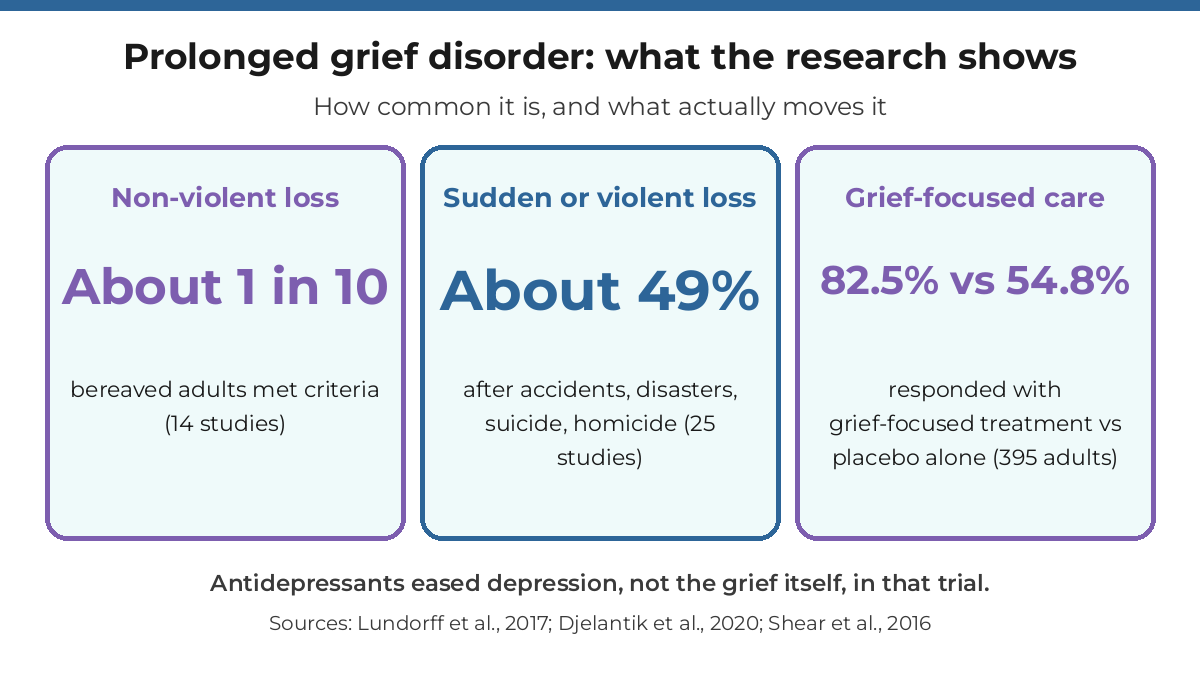
- About 1 in 10 adults bereaved by a non-violent death develop it. After sudden or violent deaths, the rate in studies runs much higher.
- It overlaps with depression, but it isn’t the same thing, and the treatments aren’t identical.
- Grief-focused therapy is the main treatment. Antidepressants didn’t fix the grief itself in the biggest trial, but they did ease depression symptoms riding along with it.
What Is Prolonged Grief Disorder?
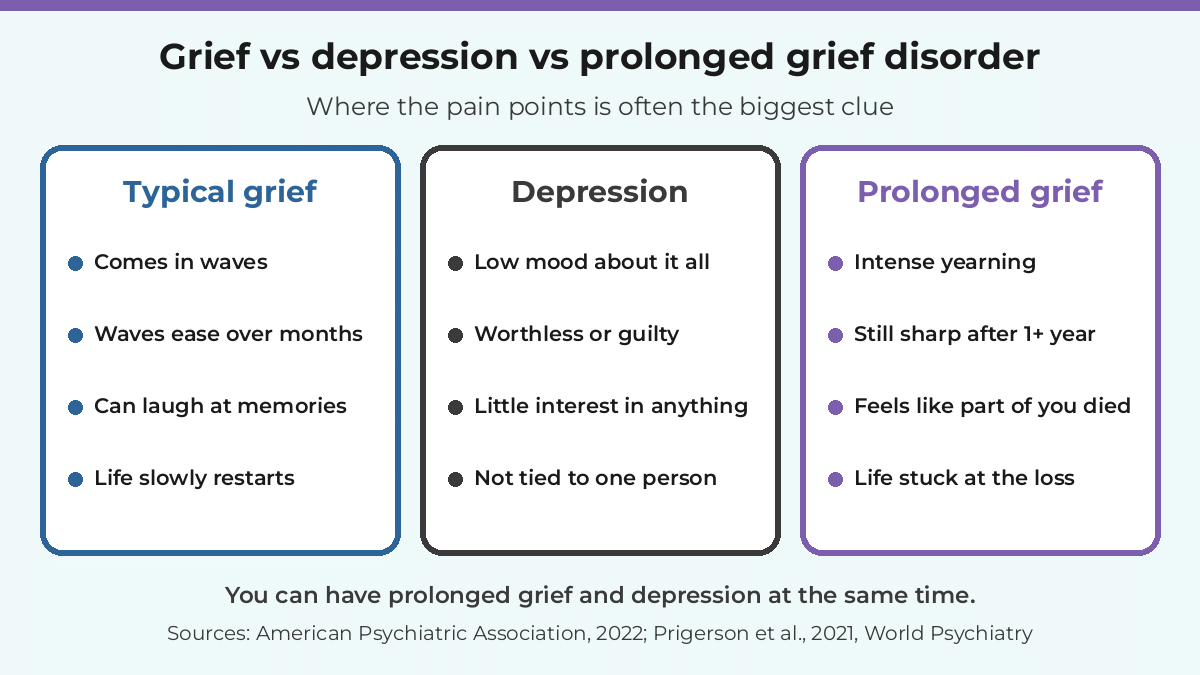
Normal grief comes in waves. You can laugh at a story about the person at dinner and cry in the shower an hour later, and over months the waves get further apart. Prolonged grief disorder is different. The longing doesn’t loosen its grip, and your life kind of stops at the funeral.
According to the American Psychiatric Association, a diagnosis requires that the death happened at least a year ago for adults, with intense longing for the person or preoccupation with thoughts of them, plus at least 3 of 8 symptoms nearly every day for the past month. Those symptoms include feeling like part of you died, disbelief about the death, avoiding reminders, intense emotional pain, trouble re-engaging with friends or plans, emotional numbness, feeling life is meaningless, and intense loneliness. The grief also has to last longer than your culture or faith would expect, and it has to get in the way of work, home, or family life.
A 2025 review in The Lancet by Killikelly and colleagues described the core of it as yearning, preoccupation, or both, alongside emotional pain, identity disturbance, and loss of meaning, with symptoms that typically take shape 6 to 12 months after the death (PubMed). The same review linked it to higher rates of suicidality, health problems like high blood pressure, and lower life satisfaction. This isn’t “you loved them too much.” It’s a pattern that can be measured and treated.
How Common Is Prolonged Grief Disorder?
Most grieving people never get here. A 2017 meta-analysis of 14 studies by Lundorff and colleagues found that about 9.8% of adults bereaved by a non-violent death met criteria for prolonged grief disorder, and the rate was higher in samples with an older average age (PubMed). Florida has plenty of retirees, and plenty of adult kids in Tampa and Fort Lauderdale caring for aging parents, so this one hits close to home here.
The kind of death matters a lot. A 2020 meta-analysis of 25 studies by Djelantik and colleagues looked at losses from accidents, disasters, suicide, and homicide, and found a pooled prevalence of prolonged grief disorder of about 49% after these unnatural losses, with lower rates as more time passed since the loss (PubMed). The authors flagged that those studies varied a lot in method, so treat that number as rough. Still, if you lost someone to an overdose, a crash on I-4, or a suicide, a heavier and longer grief isn’t a sign you’re doing it wrong.
Veterans are worth calling out too. In a nationally representative study of 2,441 U.S. veterans, Na and colleagues found 7.3% screened positive for prolonged grief disorder, and those who did were 5 to 9 times more likely to screen positive for PTSD, major depression, and generalized anxiety disorder (PubMed). After adjusting for other conditions, they were still 2 to 3 times more likely to report suicidal thoughts and behaviors.
Grief vs Depression: How to Tell Them Apart
This is where people get mixed up, and honestly, clinicians do too. Both can look like crying, poor sleep, pulling away from people, and not caring about things you used to love. The difference is usually what the pain is about.
With depression, the heaviness tends to spread over everything. You feel worthless, flat, guilty about all of it. With prolonged grief, the pain points at one person. You ache for them. You replay the last phone call. You can’t open their closet, or you can’t stop going into it. You may feel fine about yourself in general and still feel like the world doesn’t make sense without them.
Research backs up that they’re separate. In a 2021 study in World Psychiatry, Prigerson and colleagues tested the new DSM criteria in bereaved adults from Yale, Utrecht, and Oxford and found that a prolonged grief disorder diagnosis was distinct from major depression, PTSD, and generalized anxiety disorder, yet was tied to suicidal ideation, worse quality of life, and functional impairment at baseline and at follow-up (PubMed). Translation: you can have one without the other, and you can absolutely have both. When both show up, both need attention.
Signs your grief might need a closer look
It’s been more than a year and the longing is as sharp as the first month. You’ve stopped seeing friends because everything reminds you of them, or because nothing seems worth it without them. Work is slipping. You’re drinking more to get through evenings. You feel like part of you died too. Any of that is worth a real conversation. And if you’re having thoughts of not wanting to be alive, don’t wait for an appointment. Call or text 988, chat at 988lifeline.org, or call 911.
What Actually Works for Prolonged Grief Disorder
I’ll be blunt about medication here, because people expect a pill to fix this. The best trial we have says it doesn’t, at least not the grief part. In a 2016 JAMA Psychiatry trial, Shear and colleagues randomized 395 bereaved adults with complicated grief (the older name for this condition) to citalopram, placebo, or either one plus 16 weeks of complicated grief treatment. 82.5% responded to complicated grief treatment with placebo vs 54.8% with placebo alone, adding citalopram didn’t improve grief response, and citalopram alone wasn’t significantly better than placebo; citalopram did reduce depressive symptoms more when added to the grief-focused work (PubMed). Suicidal thinking also dropped more in the people who got the grief-focused therapy.
So the grief work does the heavy lifting. A 2024 meta-analysis in the Journal of Consulting and Clinical Psychology by Komischke-Konnerup and colleagues pooled 22 randomized trials with 2,602 bereaved adults and found grief-focused cognitive behavioral therapy had a medium effect on prolonged grief symptoms right after treatment and a large effect at follow-up, and it also eased PTSD symptoms, depression, and anxiety (PubMed). The authors noted the evidence was inconsistent across studies, so it’s not a magic fix. It’s just the best-supported option.
Can it work remotely? Early trials say yes. In a 2021 randomized trial by Treml and colleagues, 58 adults with prolonged grief symptoms after losing someone to suicide did a 5-week internet-based grief program of ten writing assignments and saw large improvements in prolonged grief symptoms compared with a waitlist (PubMed). A 2023 trial by Lenferink and colleagues found 12 weeks of online cognitive behavioral therapy strongly reduced prolonged grief, PTSD, and depression symptoms in people bereaved by traffic accidents, though 42% of the treatment group dropped out (PubMed). Both were small studies, but they’re encouraging if driving across Miami-Dade for weekly appointments feels impossible right now.
Where psychiatry fits
The APA notes that there are currently no medications that treat the specific symptoms of grief. That’s not the whole story, though. Prolonged grief rarely shows up alone. If depression, panic, PTSD symptoms, or months of bad sleep are piled on top, those are things a psychiatric provider can treat, and treating them can give you enough footing to do the grief work. My job is to sort out what’s grief, what’s depression or anxiety, and what’s both, and then build a plan that doesn’t just throw a prescription at a broken heart.
Prolonged Grief Disorder Care by Telehealth in Florida
At New Age Psychiatry, the first visit is a full psychiatric evaluation by secure video. We talk about who you lost and how, how long it’s been, sleep, appetite, alcohol, work, and whether depression, anxiety, or trauma symptoms are part of the picture. Then we decide together what makes sense: monitoring, medication for co-occurring depression or anxiety, a referral to a grief-focused therapist, or a mix.
Telehealth has limits. As our FAQ explains, New Age Psychiatry doesn’t provide telehealth care for people with a history of psychosis, a recent suicide attempt or suicidal thoughts in the past six months, thought disorders, bipolar I disorder, or dementia. If that’s where things are, we’ll tell you plainly that a higher level of care is the safer fit.
If the holidays tend to drag your mood down in general, our post on seasonal depression in Florida is worth a read. If you’ve been functioning on the outside but running on empty for years, see high-functioning depression. And if grief is wrecking your sleep, this one on sleep, anxiety, and depression may fit.
Frequently Asked Questions
How long is too long to grieve?
There’s no deadline on missing someone. For adults, prolonged grief disorder can’t be diagnosed until at least a year after the death, and it’s about intensity and how much it disrupts your life, not just time passing. Lots of people still cry on birthdays ten years later, and that’s normal.
Is complicated grief the same as prolonged grief disorder?
Mostly, yes. “Complicated grief” is the older research term. Prolonged grief disorder is the official diagnosis now in the DSM-5-TR.
Can an antidepressant fix grief?
Not the grief itself, based on the largest trial so far. An antidepressant can make sense if depression is also there, ideally alongside grief-focused therapy.
Can I be seen online anywhere in Florida?
Yes. New Age Psychiatry sees adults located in Florida by secure video, from Miami and Fort Lauderdale to Orlando, Tampa, and Jacksonville, within the limits in our FAQ.
Telehealth Psychiatry Across Florida
New Age Psychiatry is a telehealth-only psychiatry practice for adults across Florida, led by Hilary Ortega, PMHNP-BC. Whether you’re in a high-rise in Brickell, a ranch house in Kissimmee, or a bungalow in Jacksonville’s Riverside, the visit happens from wherever you can close a door and talk.
If this year’s holidays feel like something to survive instead of something to enjoy, you don’t have to just white-knuckle it. Keep reading on the New Age Psychiatry blog or visit our online psychiatrist in Florida page for more on telehealth psychiatry Florida options.
References
American Psychiatric Association. (2025, August). Prolonged grief disorder. https://www.psychiatry.org/patients-families/prolonged-grief-disorder
Djelantik, A. A. A. M. J., Smid, G. E., Mroz, A., Kleber, R. J., & Boelen, P. A. (2020). The prevalence of prolonged grief disorder in bereaved individuals following unnatural losses: Systematic review and meta regression analysis. Journal of Affective Disorders, 265, 146–156. https://doi.org/10.1016/j.jad.2020.01.034
Killikelly, C., Smith, K. V., Zhou, N., Prigerson, H. G., O’Connor, M.-F., Kokou-Kpolou, C. K., Boelen, P. A., & Maercker, A. (2025). Prolonged grief disorder. The Lancet, 405(10489), 1621–1632. https://doi.org/10.1016/S0140-6736(25)00354-X
Komischke-Konnerup, K. B., Zachariae, R., Boelen, P. A., Marello, M. M., & O’Connor, M. (2024). Grief-focused cognitive behavioral therapies for prolonged grief symptoms: A systematic review and meta-analysis. Journal of Consulting and Clinical Psychology, 92(4), 236–248. https://doi.org/10.1037/ccp0000884
Lenferink, L. I. M., Eisma, M. C., Buiter, M. Y., de Keijser, J., & Boelen, P. A. (2023). Online cognitive behavioral therapy for prolonged grief after traumatic loss: A randomized waitlist-controlled trial. Cognitive Behaviour Therapy, 52(5), 508–522. https://doi.org/10.1080/16506073.2023.2225744
Lundorff, M., Holmgren, H., Zachariae, R., Farver-Vestergaard, I., & O’Connor, M. (2017). Prevalence of prolonged grief disorder in adult bereavement: A systematic review and meta-analysis. Journal of Affective Disorders, 212, 138–149. https://doi.org/10.1016/j.jad.2017.01.030
Na, P. J., Fischer, I. C., Shear, K. M., & Pietrzak, R. H. (2023). Prevalence, correlates, and psychiatric burden of prolonged grief disorder in U.S. military veterans: Results from a nationally representative study. The American Journal of Geriatric Psychiatry, 31(7), 543–548. https://doi.org/10.1016/j.jagp.2023.02.007
Prigerson, H. G., Boelen, P. A., Xu, J., Smith, K. V., & Maciejewski, P. K. (2021). Validation of the new DSM-5-TR criteria for prolonged grief disorder and the PG-13-Revised (PG-13-R) scale. World Psychiatry, 20(1), 96–106. https://doi.org/10.1002/wps.20823
Shear, M. K., Reynolds, C. F., III, Simon, N. M., Zisook, S., Wang, Y., Mauro, C., Duan, N., Lebowitz, B., & Skritskaya, N. (2016). Optimizing treatment of complicated grief: A randomized clinical trial. JAMA Psychiatry, 73(7), 685–694. https://doi.org/10.1001/jamapsychiatry.2016.0892
Treml, J., Nagl, M., Linde, K., Kündiger, C., Peterhänsel, C., & Kersting, A. (2021). Efficacy of an internet-based cognitive-behavioural grief therapy for people bereaved by suicide: A randomized controlled trial. European Journal of Psychotraumatology, 12(1), Article 1926650. https://doi.org/10.1080/20008198.2021.1926650