
You’ve been on sertraline for two years. You feel like yourself again. Your sleep is back, you’re not crying in the car in the Publix parking lot, and you’re starting to wonder why you’re still taking a pill every morning. So you’re thinking about stopping antidepressants. That’s a fair question, and it deserves a real plan, not a coin flip at the bathroom sink.
This post is educational, not medical advice for your situation. I’ll cover what antidepressant discontinuation symptoms actually look like, how common they are, why the speed of tapering matters, how to tell antidepressant withdrawal from a relapse, and how a medication review works by telehealth with New Age Psychiatry anywhere in Florida. Please don’t stop a medication on your own after reading it.
Key Takeaways
- About 3 in 10 people notice at least one symptom after stopping an antidepressant. Severe symptoms are uncommon, roughly 3 in 100.
- Dizziness is the most common one. Nausea, vertigo, and nervousness show up too.
- Stopping raises the chance of depression or anxiety coming back, so timing matters.
- A slow taper paired with therapy support did as well as staying on medication in a 2026 analysis of 76 trials.
- Cold turkey is the version I’d talk you out of.
You’re Not the Only One Thinking About Stopping Antidepressants
Lots of adults take these medications. CDC data from the National Health Interview Survey show that 11.4% of U.S. adults took prescription medication for depression in 2023, and women were more than twice as likely as men to take it (PubMed). In Florida that’s a lot of people in Miami, Orlando, Tampa, and Jacksonville who will, at some point, ask the same question you’re asking.
Wanting to come off isn’t a failure, and it isn’t ungrateful to the medication. Maybe the side effects bug you. Maybe you’re planning a pregnancy, or you just want to know who you are without it. Those are all good reasons to have the conversation. The goal is to have it before the last pill, not after.
Antidepressant Discontinuation Symptoms: What They Feel Like
Discontinuation symptoms are the physical and emotional changes some people feel in the days after lowering or stopping an antidepressant. Your brain got used to the medication. Pull it out fast and things can feel off for a while.
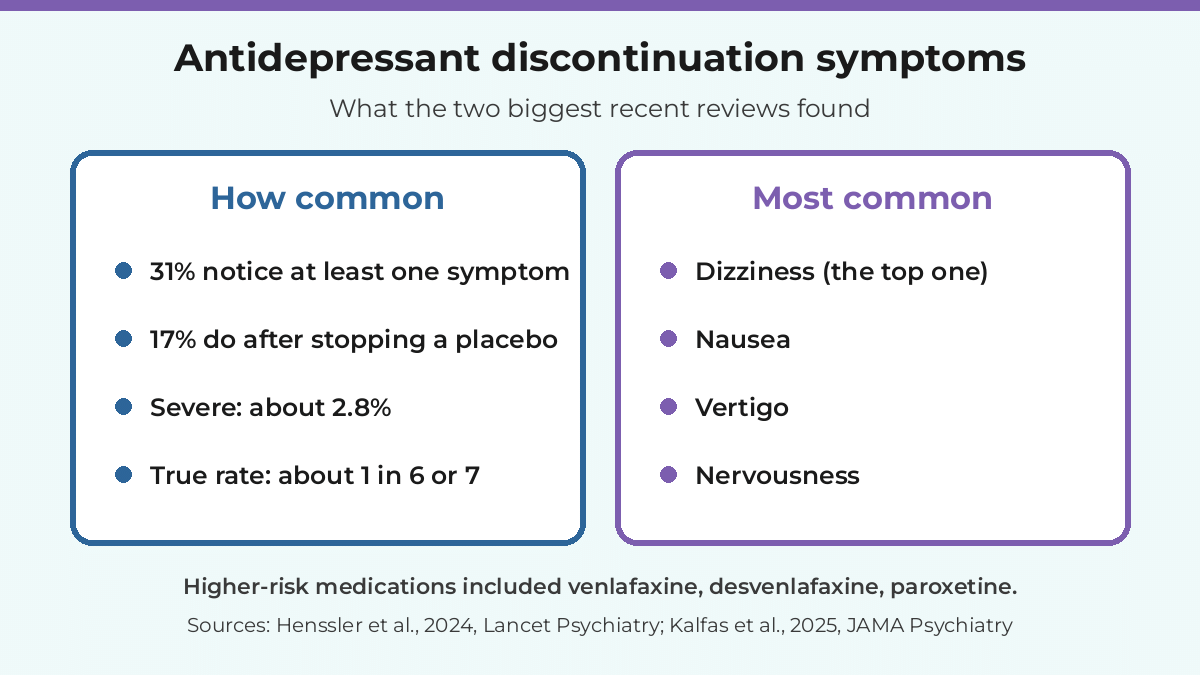
The best recent numbers come from two big reviews. A 2025 JAMA Psychiatry meta-analysis of 50 studies and 17,828 participants by Kalfas and colleagues found that stopping antidepressants raised the odds of dizziness, nausea, vertigo, and nervousness compared with stopping a placebo, and dizziness was the most common symptom; at one week, people who stopped averaged about one more symptom than people who didn’t (PubMed). The same review found that stopping wasn’t linked to worse depression symptoms in the studies that measured it.
So how many people get them? A 2024 Lancet Psychiatry meta-analysis of 79 studies and 21,002 patients by Henssler and colleagues found 31% of people reported at least one discontinuation symptom after stopping an antidepressant, compared with 17% after stopping a placebo, and severe symptoms showed up in about 2.8% versus 0.6% (PubMed). Once you subtract the placebo effect, the authors estimated about 1 in 6 or 7 people get true discontinuation symptoms. They also flagged desvenlafaxine, venlafaxine, imipramine, and escitalopram as more likely to cause them, and paroxetine and venlafaxine-type drugs as more likely to cause severe ones.
My honest read: most people who stop carefully do fine. A smaller group has a rough couple of weeks. A few have a hard time. You don’t know in advance which group you’re in, which is exactly why the plan matters.
Withdrawal or Relapse? How to Tell the Difference
This is the part people get wrong. You feel awful two weeks after stopping and decide “see, I can’t live without it.” Or the opposite happens: depression slowly creeps back over three months and you blame the weather.
Some general patterns help. Withdrawal tends to start within days of a dose drop and often comes with physical stuff, like dizziness or nausea. Relapse usually builds more slowly and looks like your old depression or anxiety: the flat mornings, the dread, the sleep going sideways. The Kalfas review put it plainly: because mood worsening wasn’t tied to discontinuation itself, depression that shows up later after stopping points to relapse.
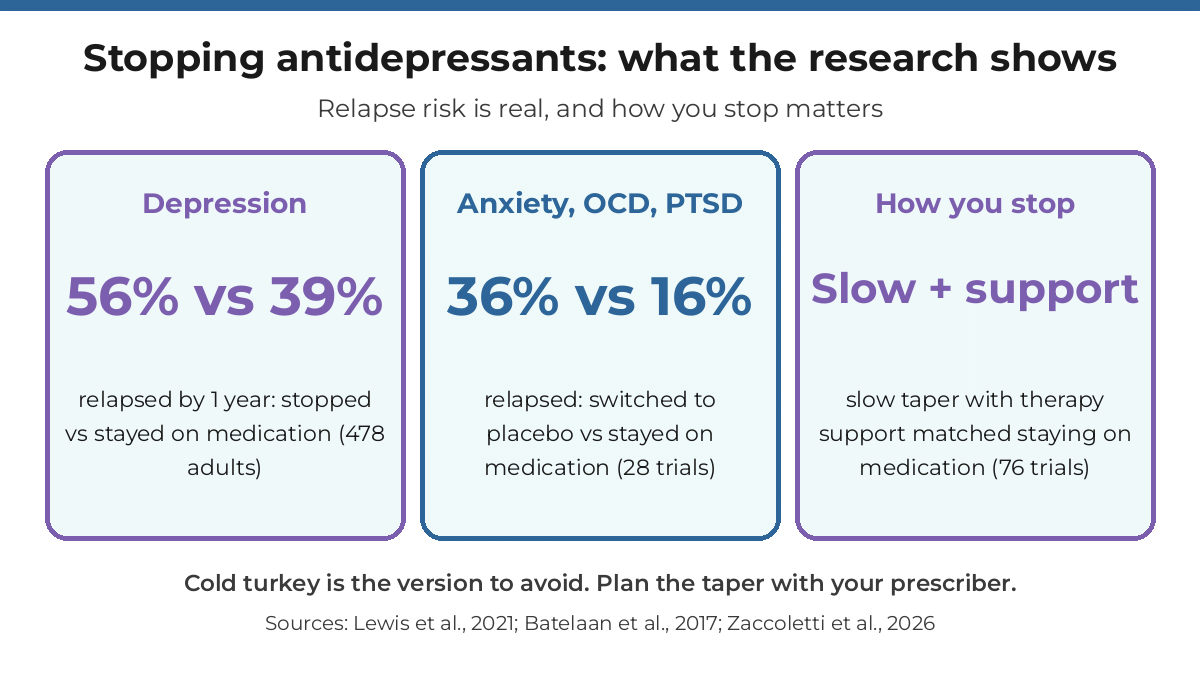
Relapse is a real risk, not a scare tactic. In the 2021 ANTLER trial in the New England Journal of Medicine, Lewis and colleagues randomized 478 primary care patients who felt well enough to stop. By 52 weeks, 56% of the group that stopped had relapsed, compared with 39% of the group that stayed on their antidepressant (PubMed). Anxiety looks similar. A 2017 BMJ meta-analysis of 28 trials by Batelaan and colleagues found relapse within a year in about 36.4% of people with anxiety disorders, OCD, or PTSD who were switched to placebo, versus 16.4% who stayed on their antidepressant (PubMed).
None of that means you have to stay on medication forever. It means you stop on purpose, at a good time, with someone watching for the early signs.
Tapering Antidepressants: Slower Than You Think
The old advice was a two to four week taper. That’s often too fast. In a 2019 Lancet Psychiatry analysis, Horowitz and Taylor pointed out that short tapers of two to four weeks showed minimal benefit over stopping abruptly, while tapers over months, down to doses well below the usual minimum, did better at reducing withdrawal symptoms (PubMed). Their look at PET imaging data showed that cutting doses hyperbolically, in shrinking steps, lowers the drug’s effect on the serotonin transporter in a steady, even way. Translation: the cuts should get smaller as the dose gets lower.
The newest evidence adds a second ingredient. A 2026 network meta-analysis in Lancet Psychiatry by Zaccoletti and colleagues pooled 76 trials and 17,379 people and found that in remitted depression, slow tapering plus psychological support prevented relapse about as well as staying on the antidepressant, and beat abrupt or fast discontinuation; slow tapering alone didn’t clearly beat stopping abruptly (PubMed). The evidence for anxiety was thinner. So the slow taper isn’t the whole plan. Support during the taper, like CBT or regular check-ins, is part of it.
Can that support happen remotely? There’s some early evidence. In the 2024 REDUCE trial in JAMA Network Open, Kendrick and colleagues added internet and telephone support to a family doctor’s medication review for 330 people on long-term antidepressants. By 6 months, 45.5% of the supported group and 41.9% of the usual-care group had stopped, withdrawal symptoms were slightly milder with the extra support, and there were no significant harms (PubMed).
What a careful taper usually looks like
Every plan is individual, but in my practice it usually goes like this. We talk about why now, and whether life is calm enough for it. If you’re mid-move to Fort Lauderdale or it’s peak hurricane season and you’re running on four hours of sleep, maybe not this month. We look at which medication you’re on, since some are harder to come off than others. We drop the dose in steps, slower toward the end, and we schedule follow-ups so we can pause or slow down if something feels wrong. And we agree ahead of time on what relapse signs would make us rethink the plan.
When to Talk to a Prescriber Before Stopping
Honestly, always. But especially if you’ve had more than one episode of depression, if you’re on venlafaxine, desvenlafaxine, or paroxetine, if you’ve tried stopping before and it went badly, or if you’ve missed doses and felt dizzy or queasy within a day or two. That last one is a clue your body is sensitive to dose changes.
The research has gaps too. The 2021 Cochrane review by Van Leeuwen and colleagues found only 33 studies on ways to discontinue long-term antidepressants, most tapers lasted four weeks or less, and withdrawal symptoms were often mixed up with relapse in the data (PubMed). That’s another reason to go slow and pay attention to how you actually feel, not just the schedule on paper.
If you’re having thoughts of suicide, don’t wait for an appointment. Call or text 988, chat at 988lifeline.org, or call 911.
Antidepressant Medication Reviews by Telehealth in Florida
At New Age Psychiatry, a medication review happens by secure video. If you’re a new patient, we start with a full psychiatric evaluation: your history, how many episodes you’ve had, what you’re taking and for how long, sleep, anxiety, alcohol, and what’s going on in your life right now. Then we decide together whether to stay the course, lower the dose, switch, or taper off. Follow-ups are where the real work happens, because that’s where we catch withdrawal early or spot a relapse before it settles in.
Telehealth has limits. As our FAQ explains, New Age Psychiatry doesn’t provide telehealth care for people with a history of psychosis, a recent suicide attempt or suicidal thoughts in the past six months, thought disorders, bipolar I disorder, or dementia. If that’s where things are, we’ll tell you plainly that a higher level of care is the safer fit.
If you’re also wondering whether your medication is the right one in the first place, our post on feeling emotionally numb from antidepressants and our guide to medications for treating depression are good next reads.
Frequently Asked Questions
Will I definitely get withdrawal if I stop?
No. In the largest review so far, about 31% of people reported at least one discontinuation symptom after stopping, and severe symptoms were uncommon. Some medications carry more risk than others, which is one reason to plan the taper with your prescriber.
How long should tapering antidepressants take?
It depends on the medication, the dose, how long you’ve taken it, and how you respond. Research suggests tapers of several weeks or less are often too fast for some people, and that the last steps should be the smallest.
Can I get help stopping my antidepressant online in Florida?
Yes. New Age Psychiatry sees adults located in Florida by secure video, from Miami and Fort Lauderdale to Tampa, Orlando, and Jacksonville, within the limits in our FAQ.
Telehealth Psychiatry Across Florida
New Age Psychiatry is a telehealth-only psychiatry practice for adults across Florida, led by Hilary Ortega, PMHNP-BC. Whether you’re in a Brickell condo, a house off Baymeadows in Jacksonville, or a quiet street in Tampa, the visit happens from wherever you have privacy and a decent connection.
If you’ve been staring at that pill bottle wondering if you still need it, let’s figure it out together, on purpose. You can keep reading on the New Age Psychiatry blog or visit our online psychiatrist in Florida page for more on telehealth psychiatry Florida options.
References
Batelaan, N. M., Bosman, R. C., Muntingh, A., Scholten, W. D., Huijbregts, K. M., & van Balkom, A. J. L. M. (2017). Risk of relapse after antidepressant discontinuation in anxiety disorders, obsessive-compulsive disorder, and post-traumatic stress disorder: Systematic review and meta-analysis of relapse prevention trials. BMJ, 358, Article j3927. https://doi.org/10.1136/bmj.j3927
Elgaddal, N., Weeks, J. D., & Mykyta, L. (2025). Characteristics of adults age 18 and older who took prescription medication for depression: United States, 2023 (NCHS Data Brief No. 528). National Center for Health Statistics. https://doi.org/10.15620/cdc/174589
Henssler, J., Schmidt, Y., Schmidt, U., Schwarzer, G., Bschor, T., & Baethge, C. (2024). Incidence of antidepressant discontinuation symptoms: A systematic review and meta-analysis. The Lancet Psychiatry, 11(7), 526–535. https://doi.org/10.1016/S2215-0366(24)00133-0
Horowitz, M. A., & Taylor, D. (2019). Tapering of SSRI treatment to mitigate withdrawal symptoms. The Lancet Psychiatry, 6(6), 538–546. https://doi.org/10.1016/S2215-0366(19)30032-X
Kalfas, M., Tsapekos, D., Butler, M., McCutcheon, R. A., Pillinger, T., Strawbridge, R., Bhat, B. B., Haddad, P. M., Cowen, P. J., Howes, O. D., Joyce, D. W., Nutt, D. J., Baldwin, D. S., Pariante, C. M., Lewis, G., Young, A. H., Lewis, G., Hayes, J. F., & Jauhar, S. (2025). Incidence and nature of antidepressant discontinuation symptoms: A systematic review and meta-analysis. JAMA Psychiatry, 82(9), 896–904. https://doi.org/10.1001/jamapsychiatry.2025.1362
Kendrick, T., Stuart, B., Bowers, H., Haji Sadeghi, M., Page, H., Dowrick, C., Moore, M., Gabbay, M., Leydon, G. M., Yao, G. L., Little, P., Griffiths, G., Lewis, G., May, C., Moncrieff, J., Johnson, C. F., Macleod, U., Gilbody, S., Dewar-Haggart, R., . . . Geraghty, A. W. A. (2024). Internet and telephone support for discontinuing long-term antidepressants: The REDUCE cluster randomized trial. JAMA Network Open, 7(6), Article e2418383. https://doi.org/10.1001/jamanetworkopen.2024.18383
Lewis, G., Marston, L., Duffy, L., Freemantle, N., Gilbody, S., Hunter, R., Kendrick, T., Kessler, D., Mangin, D., King, M., Lanham, P., Moore, M., Nazareth, I., Wiles, N., Bacon, F., Bird, M., Brabyn, S., Burns, A., Clarke, C. S., . . . Lewis, G. (2021). Maintenance or discontinuation of antidepressants in primary care. The New England Journal of Medicine, 385(14), 1257–1267. https://doi.org/10.1056/NEJMoa2106356
Van Leeuwen, E., van Driel, M. L., Horowitz, M. A., Kendrick, T., Donald, M., De Sutter, A. I., Robertson, L., & Christiaens, T. (2021). Approaches for discontinuation versus continuation of long-term antidepressant use for depressive and anxiety disorders in adults. Cochrane Database of Systematic Reviews, 2021(4), Article CD013495. https://doi.org/10.1002/14651858.CD013495.pub2
Zaccoletti, D., Mosconi, C., Gastaldon, C., Benedetti, L., Gottardi, C., Papola, D., Ponzi, O., Purgato, M., Naudet, F., Cristea, I. A., Barbui, C., & Ostuzzi, G. (2026). Comparison of antidepressant deprescribing strategies in individuals with clinically remitted depression: A systematic review and network meta-analysis. The Lancet Psychiatry, 13(1), 24–36. https://doi.org/10.1016/S2215-0366(25)00330-X