
You used to handle a packed week without blinking. Now you snap at people you love, wake at 3 a.m., and feel flat for reasons you cannot name. In Miami you blame stress. In Orlando you blame the kids, the job, or the heat. In Tampa you wonder if this is just who you are now. For many women in their 40s and early 50s, these changes have a name worth knowing: perimenopause depression, a real and treatable shift in mood during the years leading up to menopause.
This is an educational overview, not a personal diagnosis and not a promise of a quick fix. You will learn what the menopausal transition is, what 2023–2026 research says about menopause and depression, how perimenopause mood swings differ from a depressive episode, and how New Age Psychiatry evaluates mood by video for adults from Fort Lauderdale to Jacksonville.
Key Takeaways
- Perimenopause, also called the menopausal transition, usually begins between ages 45 and 55 and can last several years.
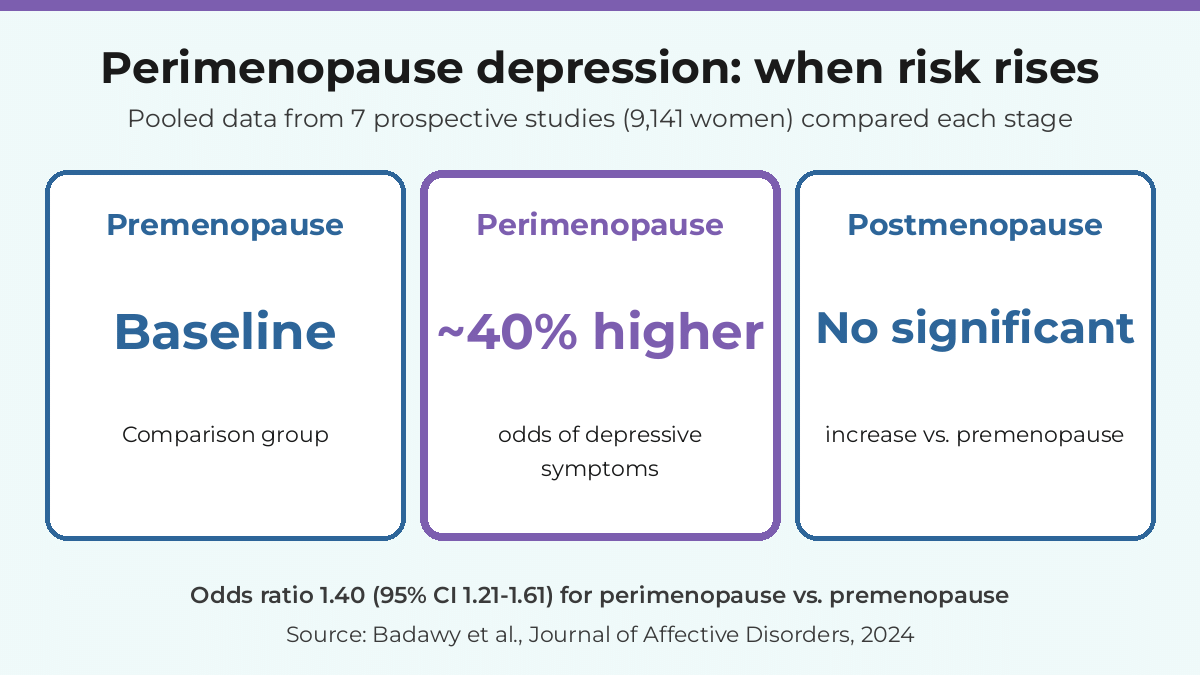
- A 2024 meta-analysis found perimenopausal women had about 40% higher odds of depressive symptoms or diagnoses than premenopausal women.
- Roughly one in three women report depressive symptoms around the menopausal transition, according to large 2024 and 2026 reviews.
- Moodiness, poor sleep, and trouble concentrating can come from hormonal change, depression, or both, so a careful history matters.
- Antidepressants and psychotherapy are front-line options for perimenopausal depression. Estrogen may help some women, but it is not approved as a depression treatment.
- An online psychiatrist Florida visit can review your mood, sleep, and cycle history by secure video anywhere in the state.
What Is Perimenopause Depression?
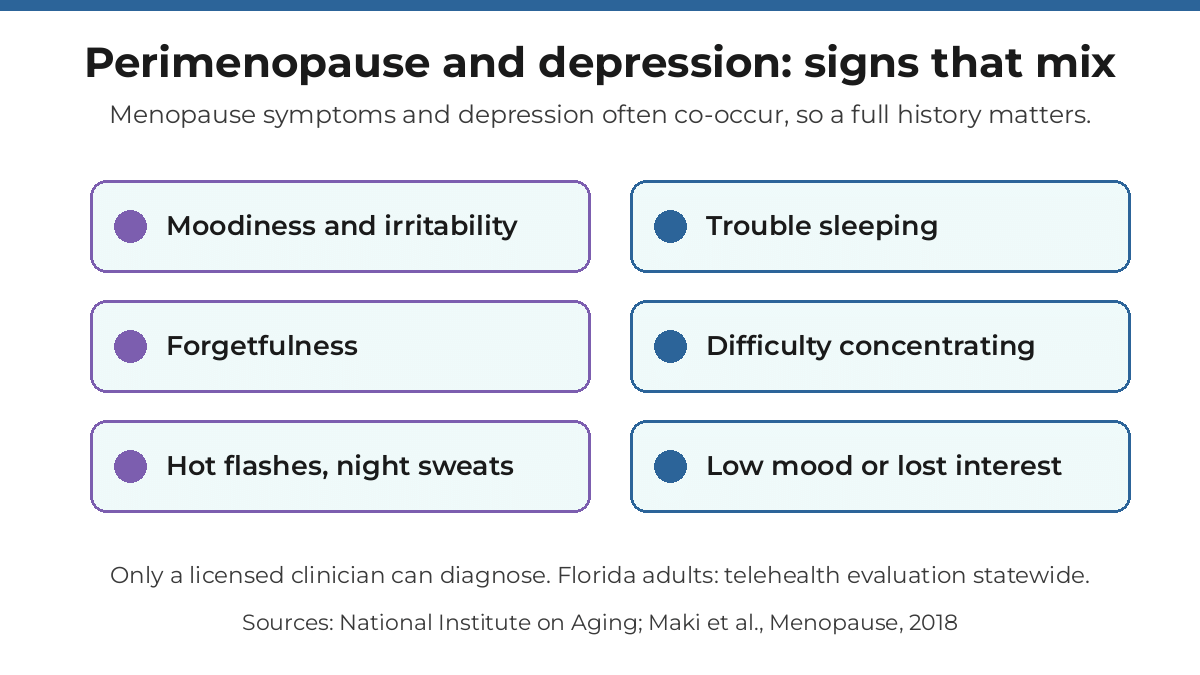
Perimenopause is the stretch of time before periods stop for good. The National Institute on Aging explains that most women begin the menopausal transition between ages 45 and 55, the process may last for several years, and the average age of menopause in the United States is 52. During this time, estrogen and progesterone production declines, and NIA lists symptoms that can include hot flashes, night sweats, trouble sleeping, moodiness and irritability, forgetfulness, and difficulty concentrating.
Perimenopause depression is not a separate diagnosis in its own right. It describes a depressive episode, or a cluster of depressive symptoms, that begins or returns during this window. An expert panel convened by the North American Menopause Society and the National Network of Depression Centers described perimenopause as a window of vulnerability for both depressive symptoms and major depressive episodes, and noted that most midlife women who have a major depressive episode during perimenopause have had a prior episode of depression (PubMed).
How Common Is Depression in Perimenopause?
The research is consistent: mood changes during the transition are common, not a personal failing. In a 2024 systematic review and meta-analysis of prospective cohort studies, Badawy and colleagues found that perimenopausal women were at significantly higher risk for depressive symptoms and diagnoses than premenopausal women (odds ratio 1.40), while postmenopausal women did not show a significantly increased risk (PubMed). The meta-analysis pooled seven studies with 9,141 women.
Prevalence studies point the same way. A 2024 global meta-analysis of 55 studies and 76,817 participants by Jia and colleagues reported a pooled depression prevalence of 33.9% in perimenopausal women and 34.9% in postmenopausal women (PubMed), with the authors noting high variation between studies. A larger 2026 review in General Hospital Psychiatry by Balasubramanian and colleagues, covering 102 studies, found a pooled point prevalence of depressive symptoms of 32% in perimenopausal women and concluded that nearly one in three women experience depressive, anxiety, or insomnia symptoms around the menopausal transition (PubMed). Those authors called for routine mental health screening during this stage.
Who is more likely to notice a change?
Not every woman follows the same path. In the long-running Study of Women’s Health Across the Nation (SWAN), Avis and colleagues followed 1,582 women and found that among women who started with low depressive symptoms, symptoms rose until about one year before the final menstrual period, and anxiety, stressful life events, and poorer physical role function contributed to that increase (PubMed). Among women who began with higher symptoms, more social support and less sleep disturbance were linked with greater improvement. A personal history of depression also matters, as the expert guideline above notes.
Perimenopause Mood Swings vs a Depressive Episode
Perimenopause mood swings and depression can look alike, and they often travel together. The NAMS guideline explains that midlife depression commonly presents with classic depressive symptoms combined with menopause symptoms such as hot flashes and sleep disturbance, and that menopause symptoms complicate, co-occur, and overlap with the presentation of depression. That overlap is why a quick checklist is not enough.
Signs that deserve a closer look
- Low mood, emptiness, or loss of interest that lasts most days for two weeks or longer
- Irritability or anger that feels out of proportion and out of character
- Sleep that stays broken even on nights without hot flashes
- Pulling away from friends, family, or work you used to enjoy
- Worry or anxiety that has started to run the day
- Feeling hopeless or thinking about death
The guideline recommends that diagnosis include identifying your menopausal stage, assessing psychiatric and menopause symptoms together, considering midlife stressors, ruling out other causes, and using validated screening tools.
Perimenopausal Depression Treatment: What the Evidence Says
The good news is that perimenopausal depression treatment draws on well-studied options. According to the NAMS expert panel, proven therapeutic options for depression, antidepressants and psychotherapy, are the front-line treatments for perimenopausal depression. Medication choices are individualized based on your symptoms, past response, other medicines, and health history.
Hormone therapy and mood
Many women ask about estrogen. The same guideline notes that estrogen therapy is not approved to treat perimenopausal depression, although there is evidence of antidepressant effects in perimenopausal women, particularly those with hot flashes or night sweats. A 2023 meta-analysis of 14 randomized controlled trials by Zhang and colleagues found that exogenous estrogen improved depressive mood compared with control conditions, and that women in perimenopause appeared more sensitive to estrogen than women in other reproductive stages (PubMed).
The picture on hormone therapy and mood is still developing. A 2026 narrative review by Langhe and colleagues concluded that estrogen therapy, particularly transdermal 17β-estradiol, may have antidepressant effects in perimenopausal women, while its effect on postmenopausal depression is less clear, and that findings vary enough to require individualized decisions (PubMed). If hormone therapy is on the table, that conversation usually includes your gynecologist or primary care clinician, who can weigh your personal medical history.
Everyday supports that matter
Sleep, stress, and connection show up again and again in the research. In the SWAN analysis, social support and less sleep disturbance were linked with improving symptoms. Protecting sleep, staying active, limiting alcohol, and leaning on people you trust are reasonable steps alongside clinical care, not substitutes for it.
Perimenopause Depression Care by Telehealth in Florida
An online psychiatrist Florida visit, or a visit with a psychiatric nurse practitioner who can prescribe, happens by secure video. To understand perimenopause depression, expect questions about more than this week’s mood.
A thorough evaluation should cover:
- When the changes started and how they relate to changes in your cycle
- Any past episodes of depression, postpartum depression, or premenstrual mood symptoms
- Sleep, hot flashes, night sweats, and energy
- Anxiety, irritability, and how mood is affecting work and relationships
- Current medications, hormone use, alcohol, and other substances
- Medical conditions or recent lab work your other clinicians have ordered
Telemedicine has limits. As our FAQ explains, New Age Psychiatry does not provide telehealth care for people with a recent suicide attempt or suicidal thoughts in the past six months, psychosis, or bipolar I disorder. If your history points that way, we will tell you plainly that a higher level of care is the safer fit.
Practical Steps Before Your First Visit
- Track mood, sleep, and your cycle for two to four weeks, even with a simple notes app.
- Write down when you first noticed the change and anything that makes it better or worse.
- List every medication and supplement you take, including any hormones or birth control.
- Note any personal or family history of depression, postpartum depression, or PMDD.
- Bring recent lab results or notes from your gynecologist or primary care clinician if you have them.
Who This Guide Is For, and Who Needs Faster Care
This guide is for Florida women in midlife who feel “not like myself,” whose depression has returned in their 40s, or who wonder whether irritability and poor sleep are more than stress. It is not emergency care. If you or someone you know is thinking about suicide, call or text 988 or chat at 988lifeline.org. For an emergency, call 911 or go to the nearest emergency room.
How New Age Psychiatry Approaches Perimenopause Depression in Florida
New Age Psychiatry is a telehealth-only psychiatry practice serving adults across Florida, led by Hilary Ortega, PMHNP-BC. Visits are by video, so you can be seen from home whether you live in Miami, Orlando, Tampa, Fort Lauderdale, or Jacksonville. You need to be in Florida at the time of each visit. The focus is a careful evaluation of your mood history, evidence-informed medication choices, and steady follow-up.
If you have been telling yourself this is just your personality now, an evaluation is a reasonable next step. You can also read related guides on the New Age Psychiatry blog, including PMDD and mental health, high-functioning depression in Florida, and how to get a psychiatric evaluation online in Florida.
Frequently Asked Questions
Can perimenopause cause depression?
Perimenopause is linked with a higher risk of depression. A 2024 meta-analysis found about 40% higher odds of depressive symptoms or diagnoses in perimenopause compared with premenopause. A past history of depression raises the likelihood.
How do I know if it is perimenopause mood swings or depression?
The two often overlap. Low mood or loss of interest lasting most days for two weeks or more, or symptoms that disrupt work and relationships, are reasons for a professional evaluation rather than waiting it out.
Is hormone therapy a treatment for perimenopausal depression?
Estrogen is not approved to treat depression, though research suggests it may have antidepressant effects for some perimenopausal women. Antidepressants and psychotherapy remain front-line options, and hormone decisions involve your gynecologist or primary care clinician.
Can I get a mood evaluation online in Florida?
Yes. New Age Psychiatry offers telehealth evaluations and medication management to adults located in Florida, from Miami and Fort Lauderdale to Tampa, Orlando, and Jacksonville, within the limits described in our FAQ.
References
Avis, N. E., Colvin, A., Chen, Y., Joffe, H., & Kravitz, H. M. (2024). Depressive symptoms over the final menstrual period: Study of Women’s Health Across the Nation (SWAN). Journal of Affective Disorders, 367, 426–433. https://doi.org/10.1016/j.jad.2024.08.237
Badawy, Y., Spector, A., Li, Z., & Desai, R. (2024). The risk of depression in the menopausal stages: A systematic review and meta-analysis. Journal of Affective Disorders, 357, 126–133. https://doi.org/10.1016/j.jad.2024.04.041
Balasubramanian, I., Abhijita, B., Krishnamoorthy, Y., Gnanadhas, J., Beg, M. J., & Menon, V. (2026). Prevalence and incidence of depressive, anxiety, and insomnia symptoms in perimenopausal and postmenopausal women: Systematic review and meta-analysis. General Hospital Psychiatry, 100, 325–335. https://doi.org/10.1016/j.genhosppsych.2026.03.010
Jia, Y., Zhou, Z., Xiang, F., Hu, W., & Cao, X. (2024). Global prevalence of depression in menopausal women: A systematic review and meta-analysis. Journal of Affective Disorders, 358, 474–482. https://doi.org/10.1016/j.jad.2024.05.051
Langhe, R., Kelly, T., Ibrahim, R., Al-Janabi, R., Mohammed, G., & Mousa, N. (2026). The role of hormone replacement therapy in the management of perimenopausal mental health symptoms: A narrative review. International Journal of Gynaecology and Obstetrics, 173(2), 698–709. https://doi.org/10.1002/ijgo.70728
Maki, P. M., Kornstein, S. G., Joffe, H., Bromberger, J. T., Freeman, E. W., Athappilly, G., Bobo, W. V., Rubin, L. H., Koleva, H. K., Cohen, L. S., & Soares, C. N. (2018). Guidelines for the evaluation and treatment of perimenopausal depression: Summary and recommendations. Menopause, 25(10), 1069–1085. https://doi.org/10.1097/GME.0000000000001174
National Institute on Aging. (n.d.). What is menopause? U.S. Department of Health and Human Services, National Institutes of Health. Retrieved October 27, 2026, from https://www.nia.nih.gov/health/menopause/what-menopause
Zhang, J., Yin, J., Song, X., Lai, S., Zhong, S., & Jia, Y. (2023). The effect of exogenous estrogen on depressive mood in women: A systematic review and meta-analysis of randomized controlled trials. Journal of Psychiatric Research, 162, 21–29. https://doi.org/10.1016/j.jpsychires.2023.04.002