

Online care can do more than make ADHD appointments easier to attend. For adults asking “is online psychiatry effective for ADHD,” it can support evaluation and ongoing treatment when care includes a thorough clinical assessment and evidence-based approaches such as cognitive behavioral therapy or behavior modification. Medication may also be part of a treatment plan when clinically appropriate.
It’s understandable to ask whether online psychiatry is effective for ADHD and can provide the depth and continuity ADHD care requires. A thoughtful virtual assessment explores symptoms, their history, and their effects on daily life, helping a psychiatric provider determine whether ADHD may explain the challenges you’re experiencing.
This article explains what an online ADHD evaluation involves, how diagnosis and treatment may work, and what can shape virtual medication care. You’ll also learn how therapy, follow-up, and convenience fit into a treatment plan, so you can better understand whether online psychiatry aligns with your needs.
Key Takeaways
- A virtual ADHD evaluation combines clinical discussion with assessment tools; online quizzes alone can’t establish a diagnosis.
- Learn how clinical interviews and online assessments work together to inform an adult ADHD evaluation.
- Medication decisions and follow-up depend on clinical needs and the prescribing rules that apply in your state.
- Explore how evidence-based therapy and behavior strategies can complement medication in an ADHD treatment plan.
- Understand what to prepare for a virtual visit and how online care can make ongoing appointments easier to access.
Does an ADHD treatment plan include medication and therapy?
It can include both, but medication and therapy address different parts of ADHD care. Medication may target symptoms such as distractibility, while cognitive behavioral therapy can build planning and organization strategies. Online ADHD interventions may be beneficial when they use clinically proven approaches, including online cognitive behavioral therapy and behavior modification. A licensed mental health professional can match these approaches to an adult’s symptoms, goals, and daily challenges. For example, missed deadlines may call for practical routines alongside a medication discussion.
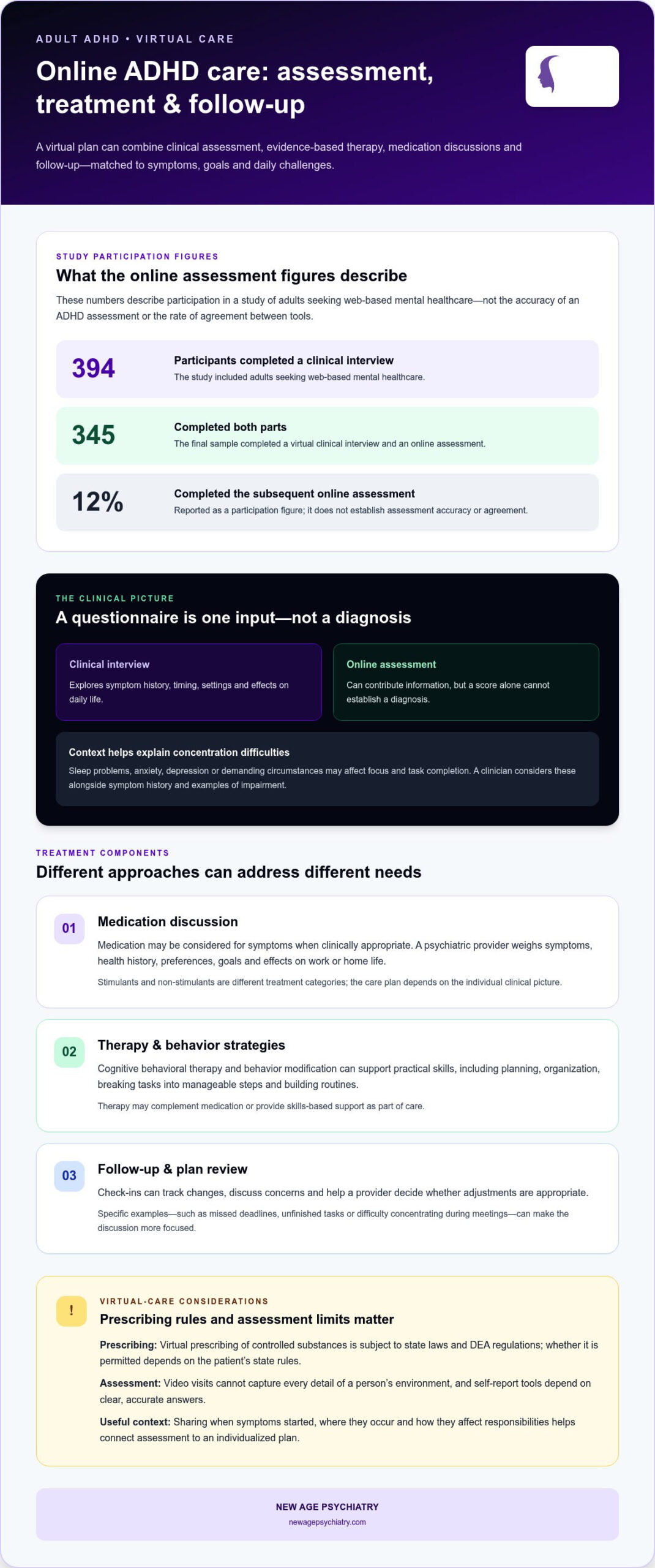
Assessment agreement depends on how well an online tool aligns with a clinical interview. In a study of adults seeking web-based mental healthcare, 394 participants completed a clinical interview. The final sample included 345 adults who completed both a virtual clinical interview and an online assessment. Of respondents, 12% completed the subsequent online assessment. These figures describe participation, not the accuracy or agreement rate. Clinicians interpret assessment results alongside symptom history, examples of impairment, and other relevant information. A questionnaire score alone cannot show whether the interview and a person’s lived experience match.
Disagreement can arise when an online questionnaire captures current difficulties but misses their context. Sleep problems, anxiety, depression, or demanding circumstances may affect concentration and task completion. A patient might report frequent forgetfulness, for example, while the interview reveals that it began after a major sleep disruption. Differences in how adults understand questions can also shape answers. A mental health professional can clarify timing, settings, and impact, then consider whether the pattern fits ADHD or needs further assessment.
Medication management starts with that broader clinical picture, not a screening result by itself. A psychiatric provider considers reported symptoms, health history, treatment goals, and how difficulties affect work or home life. Online providers may prescribe controlled substances when medically necessary, subject to state laws and DEA regulations. Whether a psychiatrist can prescribe ADHD medication virtually depends on the patient’s state’s online-prescribing regulations. Follow-up can help track changes, discuss concerns, and adjust the plan when clinically appropriate. Therapy may continue alongside medication or offer skills-based support as part of adhd treatment.
Online assessment also has limits. A video visit cannot capture every detail of a person’s environment, and self-report tools depend on clear, accurate answers. Researchers need further work on how online assessments perform across different adult populations and how interview findings align with online results. For now, patients can make an assessment more useful by sharing concrete examples: when symptoms started, where they occur, and how they affect responsibilities. That evidence helps connect evaluation to an individualized plan involving medication, cognitive strategies, or both.
Why Seek Online ADHD Treatment?
Online care can connect assessment, medication discussions, and follow-up through a virtual format. For adults considering whether online psychiatry is effective for ADHD, the value depends on how well each visit supports clear treatment decisions.
Medication Management and Follow-Up
Medication management involves reviewing ADHD symptoms, discussing treatment options, and tracking how a plan fits daily life. During follow-up, patients can describe specific changes, such as whether organizing work tasks feels more manageable or side effects interfere with routines. These details help a psychiatric provider assess the plan and decide whether adjustments are appropriate.
Useful follow-up has a clear purpose. Before each appointment, note the medication taken, changes noticed, and questions that need attention. If you have difficulty concentrating during afternoon meetings, that concrete example gives the visit more focus than a general statement that symptoms remain challenging. Online appointments support these check-ins without travel.
Combining Therapy and Medication
Medication and therapy can address different needs within one ADHD treatment plan. Medication may be considered for symptoms, while therapy can help patients practice organization strategies, break tasks into manageable steps, and build routines. For example, someone who struggles to start household tasks might work on a simple planning method and discuss medication response as part of care. The approach depends on treatment goals.
Stimulants and non-stimulant medications are different treatment categories. A psychiatric provider considers the patient’s symptoms, health history, preferences, and treatment priorities when discussing options. Non-stimulant medication management still needs follow-up: patients can report how the plan fits their daily responsibilities, while the provider reviews progress and any concerns. Naming a preferred format or explaining a past medication experience can make that discussion more specific.
Virtual prescribing also has a practical boundary. Whether a psychiatrist can prescribe ADHD medication virtually depends on the online-prescribing regulations in the patient’s state. This matters when planning follow-up, especially if medication management is part of the care being considered. A focused appointment can cover treatment goals, current symptoms, medication questions, and the next step in care.
For a productive visit, bring a short list of examples: missed deadlines, unfinished tasks, or difficulty maintaining organization. Share what has changed since the previous appointment and what still disrupts work or home routines. If you’re exploring virtual psychiatric care, this preparation can help you make the conversation more useful and focused.
Convenience and accessibility of online ADHD treatment
Choose an online service that uses a licensed psychiatric professional, a comprehensive evaluation, and planned follow-up. Look for clear explanations of how symptoms are assessed and how medication decisions are managed.
Virtual appointments can reduce travel and make follow-up easier to fit around work, caregiving, or school. These are averages, not a promise about any individual appointment. Access still depends on the service’s scheduling process and the care you need.
Convenience matters most when it supports consistent care. A video appointment from home may help an adult who struggles to organize transportation or keep track of commitments. Before a visit, prepare a quiet space, a reliable device, and brief notes about missed deadlines, impulsivity, or difficulty completing tasks. Those details connect the online format with everyday experiences.
A personalized treatment plan should reflect the person’s age, symptoms, goals, and daily environment. For adults, an evaluation can explore how attention, hyperactivity, and impulsivity affect work, relationships, or household responsibilities. A child’s or adolescent’s assessment needs age-appropriate questions and relevant family or school context. Adult-focused services are not a substitute for pediatric psychiatric care.
Ongoing follow-up lets patients discuss whether the plan addresses their priorities. For example, an adult might track how often unfinished tasks disrupt work, then bring those observations to a later appointment. The mental health professional can review reported changes, discuss concerns, and consider whether the treatment plan needs adjustment. Behavioral strategies can also focus on specific routines, such as using a calendar for appointments.
To begin, make the next steps manageable:
- Write down examples of symptoms and where they affect daily life.
- Gather relevant health and medication history for the evaluation.
- Prepare questions about treatment options, follow-up, and virtual medication management.
- After the appointment, note agreed actions and topics for the next visit.
When comparing online ADHD treatment, prioritize clinical depth over a quick screening alone. A sound process explains how a full evaluation works, identifies the professional involved, and includes follow-up. Consider how treatment goals will be reviewed, such as whether a plan supports organization at work or addresses disruption from impulsivity. A structured process makes virtual care easier to assess against your needs.
Online ADHD diagnosis and evaluation
A virtual ADHD evaluation can bring structured questions and a clinical interview together. The goal is to understand whether symptoms fit attention-deficit/hyperactivity disorder and how they affect daily life. An online quiz is only a screening tool, not a medical instrument or diagnosis. A mental health professional considers the person’s history, examples of challenges, and other relevant information before making a diagnostic decision.
Assessment findings need context. A questionnaire may flag attention difficulties, while an interview explores when they began and where they occur. Trouble finishing tasks at work, for example, may have a different context from concentration problems limited to disrupted sleep. The clinician can clarify examples and consider whether another concern could better explain the symptoms. This step turns a score into a fuller evaluation.
One study’s final sample included 345 adults who completed both a virtual clinical interview and an online assessment. Of study respondents, 12% completed the subsequent online assessment. These figures describe participation, not the accuracy of online diagnosis or agreement between assessments. They show why an online assessment should be considered alongside clinical information, rather than treated as a stand-alone test. Further research can examine how results align across different groups.
An initial video consultation or referral may be part of an online evaluation, depending on state laws and DEA regulations. Children and adults have different assessment needs, so age and life context matter when discussing a possible disorder. A virtual appointment can explore how symptoms affect school, work, or home responsibilities. For a child, school-related information may help explain the concerns being raised, while an adult may describe work or household demands.
A diagnosis can help a person identify next steps. An online ADHD diagnosis can be used to request school accommodations through IEP or 504 plans and workplace accommodations under the ADA. It can also guide discussion of therapy, behavioral strategies, or medication. Online providers may prescribe controlled substances when medically necessary, subject to state laws and DEA regulations. Whether a psychiatrist can prescribe ADHD medication virtually depends on online-prescribing regulations in the patient’s state.
To prepare, write down specific examples of symptoms, when they happen, and how they interfere with daily responsibilities. Bring questions about the evaluation process and possible treatment options. This practical record gives the clinician details to discuss during the visit and helps connect assessment findings with strategies for daily life.
What should I expect during an online ADHD assessment and treatment visit?
A virtual appointment is a clinical conversation, not just a questionnaire. Expect to discuss symptoms, health history, daily responsibilities, and what you hope treatment will help you manage. Preparing examples beforehand can make the conversation more specific. For instance, describe how often unfinished tasks affect work or how forgetfulness disrupts home routines.
Before the visit, gather details that help explain the pattern. Note when attention or impulsivity concerns began, where they appear, and what makes them harder to manage. Include relevant medication and health history, plus questions you want answered. A quiet space and working device also help you focus on the discussion rather than technical issues.
During the assessment, the psychiatric professional may ask how symptoms affect different parts of life. They may clarify whether concentration problems occur across settings or mainly in a particular situation. A screening result can inform this discussion, but it does not replace clinical judgment. The aim is to understand the full picture before discussing whether ADHD or another concern best explains the difficulties.
If treatment is discussed, the visit can cover medication options, therapy, and practical strategies. Share what matters most, such as staying organized at work or completing household tasks. Ask how progress will be reviewed and what concerns should be raised at follow-up. A specific goal gives future conversations a useful reference point, rather than relying on a general sense of improvement.
Medication prescribing through a virtual visit depends on online-prescribing regulations in the patient’s state. An online ADHD evaluation may require an initial video consultation or referral, depending on state laws and DEA regulations. If medication is part of the discussion, raise relevant health history and describe any previous treatment experience. These details help shape a focused conversation about available next steps.
After the appointment, keep a short record of agreed actions and questions for follow-up. Note whether a new routine helped with planning or whether a concern needs discussion. If the clinician recommends further assessment, write down what information to gather. This simple record connects each visit to daily experiences and keeps the treatment conversation concrete.
For adults seeking a virtual assessment and continued ADHD care, explore ADHD diagnosis and treatment as a next step.
New Age Psychiatry: ADHD Diagnosis and Treatment
New Age Psychiatry provides ADHD diagnosis and treatment for adults seeking a clearer understanding of their symptoms and care options. Its telehealth practice offers psychiatric diagnosis and medication management, giving adults a way to discuss how attention difficulties affect work, relationships, and daily responsibilities. Consider reaching out when you’re ready to explore an evaluation, discuss medication management, or review whether ADHD may help explain ongoing challenges. Care can also address related concerns such as insomnia, depression, or anxiety when they affect your mental health needs. Preparing examples of symptoms and questions can help make your first conversation more focused. Contact New Age Psychiatry to learn about taking the next step toward ADHD care.
Take the Next Step Toward ADHD Care
Choosing care can begin with one practical step: decide what you want help changing. You might want to understand attention challenges, manage daily responsibilities, or discuss treatment options. Writing down your main concern gives an initial appointment a clear starting point and helps you express what matters most in your life.
If you’re wondering whether online psychiatry is effective for ADHD, focus on whether care supports a meaningful evaluation and ongoing treatment discussions. New Age Psychiatry offers ADHD diagnosis and treatment, as well as insomnia and depression treatment for adults in Florida. Start with the concern you most want to address and the questions you want answered.
When you’re ready to explore care, contact New Age Psychiatry to take the next step. You can begin with a clear concern and move forward at a pace that feels manageable.
Frequently Asked Questions
Can ADHD medication be prescribed by an online psychiatrist?
Yes, an online psychiatrist may prescribe ADHD medication when clinically appropriate and permitted by state and federal rules. Controlled substances are subject to state laws and DEA regulations, and virtual prescribing rules depend on the patient’s state. A clinical evaluation informs whether medication is suitable. For adults in Florida, the appointment must be with a provider able to serve patients in that state, and the prescribing decision remains part of individualized psychiatric care.
What are the benefits of getting treated for ADHD virtually?
Virtual care can reduce travel and make it easier to fit psychiatric appointments around work, caregiving, or other responsibilities. It can also help patients who live far from a convenient office maintain contact with a psychiatric provider. For example, someone with a changing work schedule may find video appointments easier to attend. The benefit depends on having a private place to talk and a reliable way to access visits and follow-up.
Is online psychiatry effective for diagnosing and treating ADHD?
Online psychiatry can support ADHD diagnosis and treatment when a qualified psychiatric professional conducts a thorough evaluation and uses the results to guide care. A screening quiz alone cannot diagnose the disorder. The clinician considers symptom patterns, history, and effects on daily functioning, then discusses appropriate options. The value of online care also depends on follow-up that lets patients discuss concerns and track whether their plan meets their goals.
What does research say about telehealth ADHD treatment outcomes compared with in-person care?
Research about online assessment and research comparing treatment outcomes answer different questions. A study showing that virtual interviews and online assessments can be used together does not, by itself, prove that telehealth and in-person treatment produce identical outcomes. To compare care meaningfully, studies need to examine treatment response and follow-up over time, using comparable measures. This distinction helps clarify what an assessment study can and cannot establish about treatment.
Can ADHD be diagnosed through an online psychiatric appointment?
Yes, a psychiatric professional can evaluate ADHD online when the appointment allows a thorough clinical assessment. The clinician may ask for examples from different settings, such as difficulty following work instructions and managing household responsibilities. If the history or symptoms need clarification, the evaluation may involve additional questions before a diagnosis. A digital screening score alone is not a substitute for clinical assessment.
What ADHD medications can online psychiatrists prescribe in the United States?
Online psychiatrists may consider stimulant or non-stimulant ADHD medications, but the appropriate option depends on the clinical evaluation and the patient’s circumstances. Some ADHD medications are controlled substances. Prescribing them virtually is subject to state laws and DEA regulations, so what can be prescribed depends partly on the patient’s state. A provider also considers treatment goals and relevant health history before discussing medication choices.
What are the risks or limitations of online ADHD treatment, including medication monitoring?
Online care relies on conversation and information shared during appointments, so incomplete symptom or medication updates can make treatment harder to assess. Video visits also offer less opportunity to observe a person outside the appointment. Keep a private record of medication questions, changes in daily functioning, and concerns to raise at follow-up. A clear record helps the psychiatric professional review the treatment plan and identify topics that need closer discussion.