

Florida Blue Cross Blue Shield telepsychiatry may give members access to virtual mental health visits, where a clinician assesses concerns, discusses diagnosis and treatment options, and may prescribe medication when appropriate. For Florida Blue members, in-network virtual visits with a mental health doctor or therapist have the same cost share as office visits.
It’s reasonable to want clear answers before booking, especially about what can happen during a virtual visit and what it may cost. This guide explains what telepsychiatry can cover, how prescriptions and treatment decisions fit into care, and how coverage and out-of-pocket costs depend on your plan and network status. It also explains what to consider when choosing virtual psychiatric care in Florida.
Key Takeaways
- Virtual visits can address a range of concerns, including anxiety and depression, while helping reduce travel and scheduling barriers.
- A telepsychiatry appointment can include assessment and treatment planning; whether medication is appropriate depends on your clinical needs.
- In-network virtual visits with a Florida Blue mental health clinician have the same cost share as an office visit, so your plan details matter.
- Learn how focused psychiatric care for ADHD, insomnia, depression, and anxiety may fit your needs.
What are some reasons I should use virtual care?
Virtual care can make health support easier to access when travel, mobility, or scheduling creates a barrier. In behavioral health, it uses two-way interactive technology so patients and providers can communicate remotely. Visits may happen by video or phone, while some services also allow online messaging or image uploads. For example, someone with a rash may share an image, while a person seeking mental health support may discuss symptoms by video.
Virtual visits can address different needs, from common illnesses to ongoing health concerns. They may suit mild symptoms and some follow-up conversations, while a primary care doctor can assess illness using your medical history. Examples include:
- Cold symptoms, sinus infections, flu, and RSV.
- Urinary tract infections, allergies, and mild asthma attacks.
- Skin concerns such as acne or rashes.
- Mental health concerns, including anxiety and depression.
- Chronic-condition support, such as elevated blood sugar or blood pressure.
For privacy, choose a setting where you can speak comfortably without being overheard. Technology can also shape the visit: video requires a working camera and connection, while phone, messaging, or image-sharing formats may suit different needs. Virtual care has emergency limits. If symptoms are life-threatening, such as severe difficulty breathing, call 911 rather than relying on a remote appointment.
For psychiatric care, a virtual appointment provides a place to describe symptoms and discuss emotional or behavioral changes. Anxiety and depression are examples of concerns that may be addressed remotely. The clinician’s assessment depends on the information you share, so explaining when symptoms began and how they affect daily activities can make the conversation more useful.
These benefits can extend beyond convenience for an individual visit. Virtual health may help close behavioral-health treatment gaps by making services more accessible and convenient, particularly for people facing location, mobility, or scheduling barriers. It can also help practices offer more affordable care services and reach underserved populations.
By avoiding travel to appointments, virtual care can make it easier to stay in contact with a care team. Ongoing communication can support a stronger relationship with your provider and help address health needs over time.
Behavioral health telepsychiatry
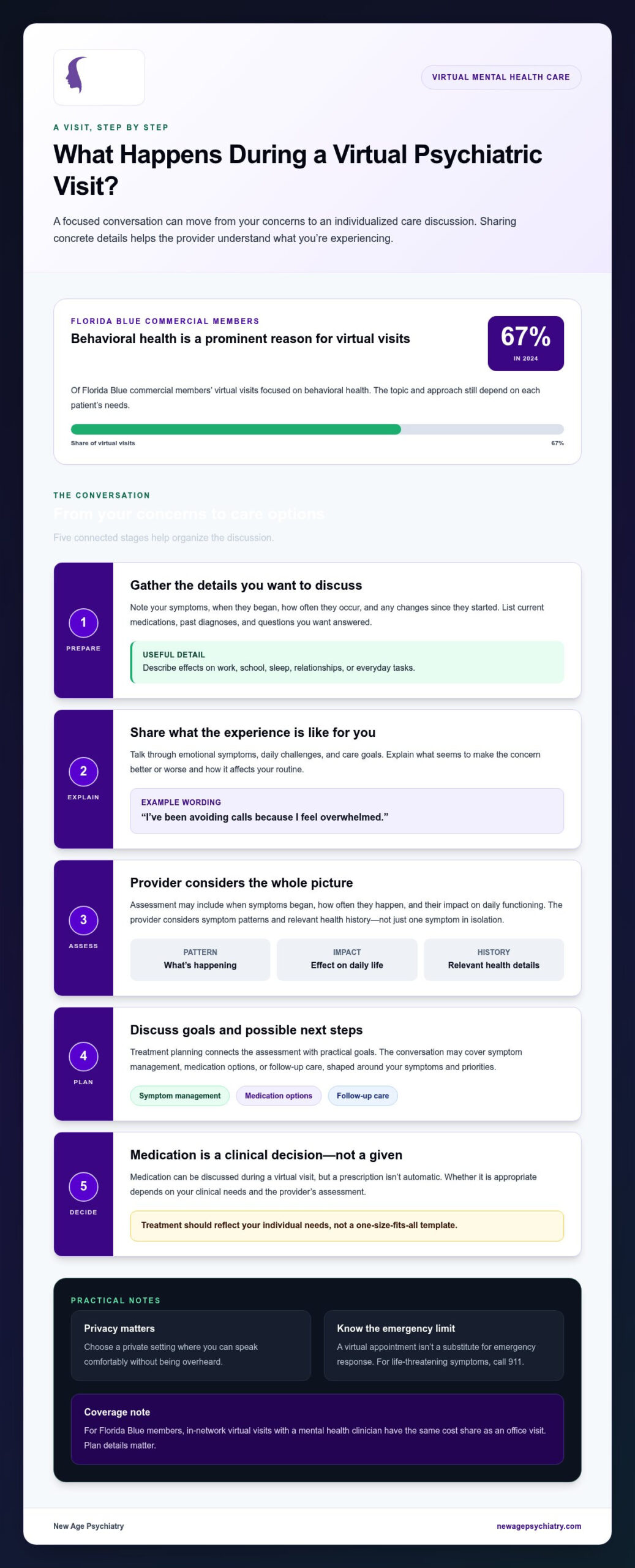
Behavioral health telepsychiatry connects a patient and mental health provider through interactive technology. The visit creates a space to discuss emotional symptoms, daily challenges, and care goals. In 2024, 67% of Florida Blue commercial members’ virtual visits focused on behavioral health. That figure shows how prominently mental health care features in virtual visits for those members. It doesn’t mean every concern or appointment is handled the same way. The discussion depends on what the patient needs to address.
A visit may focus on anxiety, depression, or changes affecting work, relationships, or sleep. Describe when a concern began, what makes it better or worse, and how it affects your daily routine. For example, someone experiencing persistent worry might explain how it interferes with concentration. Concrete examples help the provider understand your concern and guide the conversation. They also help you identify priorities, such as managing symptoms or exploring treatment options.
Telepsychiatry can make behavioral health conversations more accessible when travel, mobility, or scheduling creates obstacles. It can also help patients continue discussions with a provider without travelling to an office. The remote format has practical limits: the patient needs a way to communicate with the provider, and a private setting can support a more comfortable conversation. If a person faces an immediate, life-threatening emergency, a virtual appointment isn’t a substitute for emergency response. Call 911 for life-threatening symptoms.
Before a visit, note your symptoms, questions, and any changes since the concern began. A brief example can make a difficult experience easier to explain: “I’ve been avoiding calls because I feel overwhelmed.” You can also describe how often the issue arises and which parts of daily life it affects. These details help focus the appointment on your concerns, without requiring you to find perfect words during the conversation. The goal is a clear, individualized discussion with a mental health provider.
Florida Blue members who need help with mental health or substance use disorder benefits can contact the Florida Insurance Consumer Helpline at 1-877-693-5236 statewide and toll-free. Virtual health can help practices deliver more preventive care.
Diagnosis, treatment, and prescriptions during virtual visits
A virtual psychiatric assessment starts with your concerns and the details you share. The provider may ask when symptoms began, how often they occur, and how they affect work, school, sleep, or relationships. For example, if you have trouble concentrating, explain when it happens and whether it disrupts daily tasks. These details guide the clinical discussion and possible next steps.
Diagnosis involves more than matching one symptom to a condition. A provider considers the pattern of symptoms, their effect on daily functioning, and relevant health history. Prepare by listing current medications, past diagnoses, and questions you want answered. If a concern has several parts, such as low mood and disrupted sleep, describe each one rather than focusing on just one symptom.
Treatment planning connects the assessment with practical goals. The discussion may cover symptom management, medication options, or follow-up care. A plan should reflect your symptoms and priorities, not a one-size-fits-all template. For instance, if you’re seeking help with anxiety, explain which situations feel difficult and what you hope will change. That context helps keep the discussion focused on meaningful goals.
Medication can be discussed during a virtual visit, but a prescription isn’t automatic. The provider considers your symptoms, medical history, current medications, and other treatment factors before deciding whether to prescribe. Bring an up-to-date medication list and mention past side effects. If medication is prescribed, ask how to take it, what changes to watch for, and when to follow up. Clear instructions help you understand the plan after the appointment.
Virtual care can also support ongoing psychiatric management. Follow-up discussions give you space to report changes in symptoms and share any treatment concerns. A simple note, such as “I’m sleeping better, but still struggling to focus,” offers a concrete starting point. Diagnosis, treatment choices, and prescription decisions remain connected to the information you share and the clinician’s assessment.
Virtual care costs and insurance coverage
For Florida Blue members, an in-network virtual visit with a family doctor, mental health doctor, or therapist has the same cost share as an office visit. Cost share is the portion you pay under your plan, such as a copay or coinsurance. For Florida Blue Cross Blue Shield telepsychiatry, your specific benefits and the provider’s network status determine your share. A virtual appointment doesn’t automatically mean a lower out-of-pocket cost.
Treat this as a general reference, not a single rate for every member. Your plan’s benefit summary explains the applicable copay, deductible, and coinsurance. For example, a plan may require you to meet a deductible before certain services are covered. The service type and network status also affect your share.
To understand your likely expense, review your member account or plan documents for behavioral health benefits. Look for the provider’s network status, the virtual visit cost share, and any applicable deductible. Then compare those details with the appointment you’re considering. A mental health visit and a medication benefit may be listed separately, so review each one rather than assuming a single copay covers both. This helps when comparing Florida Blue Cross Blue Shield telepsychiatry coverage with your plan’s other behavioral health benefits.
Coverage and clinical care are related but distinct. Insurance determines how a covered visit is paid; the provider assesses symptoms and discusses appropriate care. If your plan covers an in-network virtual mental health visit, its cost share matches the office-visit cost share. That doesn’t mean every service or prescription has identical coverage. Prescription benefits follow the terms of your plan.
If you’re considering psychiatric support for anxiety or depression, explore virtual psychiatric care options and consider how ongoing treatment may fit your needs. Bring your plan’s behavioral health and pharmacy benefit details into the decision, so you can understand both the visit coverage and medication coverage separately.
New Age Psychiatry: ADHD Diagnosis and Treatment
New Age Psychiatry provides ADHD diagnosis and treatment through virtual psychiatric care for adults in Florida. Consider an assessment if ongoing attention or organization difficulties are affecting daily life and you want to discuss treatment options. The evaluation helps clarify your concerns and shape a plan suited to your needs.
New Age Psychiatry also provides treatment for insomnia, depression, and anxiety. If sleep problems, low mood, or persistent worry are affecting your routine, a virtual psychiatric visit offers space to discuss symptoms and possible treatment. These concerns can overlap, so sharing how they affect work, relationships, or daily responsibilities helps guide the conversation.
For support with ADHD or another of these concerns, visit New Age Psychiatry.
Take the Next Step Toward Support
Choosing care is a personal decision, and understanding Florida Blue Cross Blue Shield telepsychiatry can help separate insurance questions from the clinical conversation. Coverage concerns what your plan pays; an assessment focuses on your symptoms and goals. Before seeking care, write down what has changed, how it affects your routine, and what you hope to address. Those notes can help you explain your priorities.
New Age Psychiatry offers ADHD diagnosis and treatment, insomnia treatment, and depression treatment through virtual care for adults in Florida. If one of these concerns is affecting your daily life, a psychiatric assessment can be a practical next step. Reach out to New Age Psychiatry to discuss your concerns and arrange a virtual appointment.
Contact New Age Psychiatry today to explore your next step. Starting a conversation can help you move toward care with greater clarity and confidence.
Frequently Asked Questions
Can I get a diagnosis, treatment, and prescription(s) during a virtual visit?
Yes, a virtual psychiatric visit can include an assessment, discussion of a diagnosis, and a treatment plan; a prescription may be provided when clinically appropriate. Before the appointment, gather your current medication names, past diagnoses, and relevant health records. For example, noting when concentration problems began can help clarify an ADHD assessment. The clinician uses your history and reported symptoms to guide care decisions.