

A college student’s attention problems aren’t automatically ADHD. An ADHD diagnosis for college students in Florida considers whether symptoms were present before age 12, have lasted at least six months, and affect more than one setting, such as school, work, or home. A clinician also considers whether another factor could better explain the difficulties.
It can be hard to tell whether missed deadlines, disorganization, restlessness, or trouble focusing point to ADHD or the demands of college life. This article explains how adult diagnostic criteria relate to childhood symptoms, which challenges may become more noticeable in college, and what else can affect attention. Understanding the difference can help you decide whether a professional assessment is a useful next step.
Key Takeaways
- Notice how attention, organization, and impulse-control difficulties affect college life, and look for patterns that reach beyond a single class or deadline.
- Consider how sleep problems, anxiety, depression, and other factors may contribute to focus challenges before assuming ADHD is the cause.
- A professional assessment weighs your current concerns alongside your history and information about how symptoms affect different areas of life.
- Learn what to expect from an adult ADHD evaluation in Florida and how diagnosis and treatment can support your next steps.
Adult ADHD diagnostic criteria and childhood symptoms
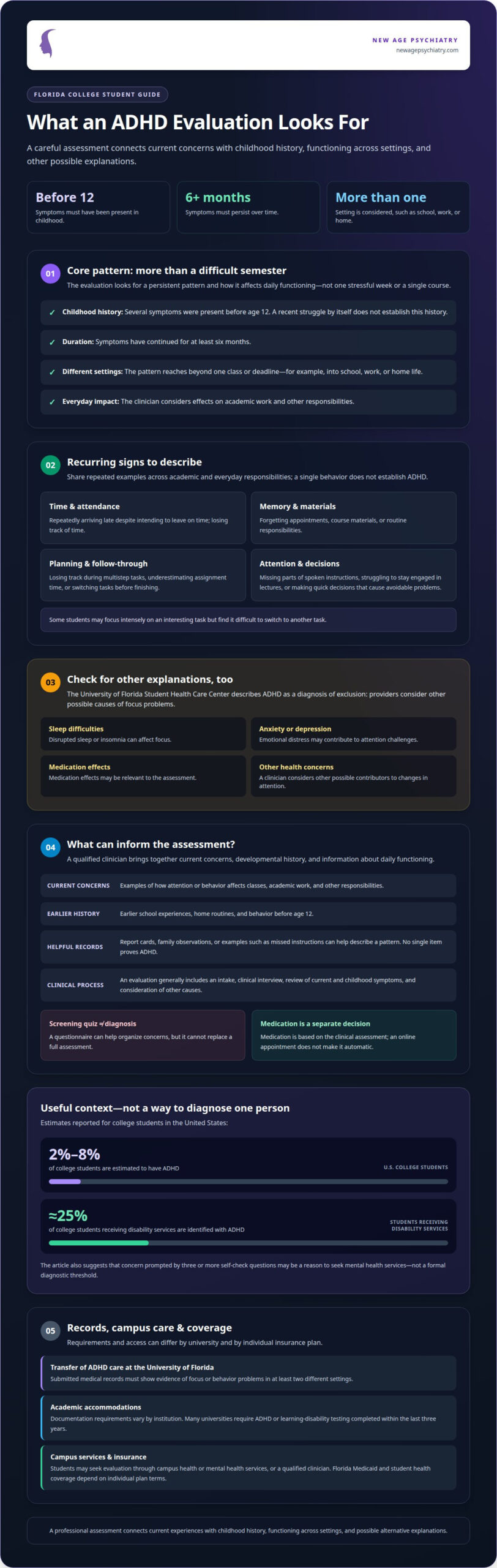
Adult ADHD criteria connect current difficulties with a pattern that began in childhood. Several symptoms must have been present before age 12, and symptoms must persist for at least six months. A college student’s recent struggle alone doesn’t establish that history.
ADHD is a chronic condition that can affect attention, organization, and impulse control. A student might repeatedly lose track of assignments, struggle to plan study time, or interrupt others. An evaluation considers whether symptoms form a persistent pattern, began during childhood, occur across settings such as school, work, or home, and affect daily functioning.
Childhood evidence can help clarify whether college demands exposed a longstanding pattern or created a newer challenge. A clinician may ask about earlier school experiences, home routines, and behavior before age 12. Report cards, family observations, or examples of missed instructions can help describe the pattern, though no single item proves ADHD.
Telehealth can support an ADHD evaluation when a qualified clinician reviews symptoms and history. Medication is a separate treatment decision based on the clinical assessment, not an automatic result of an online appointment.
The evaluation generally includes an intake, a clinical interview, review of current and childhood symptoms, and consideration of other causes. Appointment timing depends on scheduling and how promptly relevant history or records are available.
An online screening quiz can’t replace a full assessment. A rushed evaluation or stimulant prescription without reviewing symptoms, history, and other possible causes may lead to an inaccurate conclusion or unsuitable care. A careful assessment helps distinguish a persistent pattern from attention problems with another explanation.
In college, academic pressure can make existing ADHD symptoms more visible, while disrupted sleep or emotional strain can also affect focus. A professional assessment connects current experiences with childhood history and functioning across settings, rather than relying on one difficult semester.
Common ADHD signs in college students
College can bring attention challenges into sharper focus as students manage lectures, independent study, and changing schedules. Signs may include losing track of time, struggling with long readings, forgetting class materials, or switching tasks without finishing them. One difficult course or stressful week, however, doesn’t establish an ongoing pattern.
Look for recurring effects across academic and everyday responsibilities. A student might repeatedly underestimate how long assignments take, miss parts of spoken instructions, or act without considering consequences. Some students struggle to stay engaged during lectures; others focus intensely on an interesting task but find it hard to switch. An evaluation considers the broader pattern and its impact, not a single behavior.
- Repeatedly arriving late despite intending to leave on time.
- Forgetting appointments, course materials, or routine responsibilities.
- Having difficulty completing multistep academic tasks without losing track.
- Making quick decisions that create avoidable problems with coursework or daily routines.
Estimates suggest that 2% to 8% of college students in the United States have ADHD. ADHD is also identified in approximately 25% of college students receiving disability services. These figures offer context, not a way to diagnose an individual student. A useful self-check is whether three or more questions about persistent attention or organization difficulties prompt concern. That is a reason to seek mental health services, not a formal diagnostic threshold.
Sleep problems, anxiety, and depression can also affect attention. If concentration worsens alongside insomnia or emotional distress, those concerns are important to discuss during an assessment. The University of Florida Student Health Care Center describes ADHD as a diagnosis of exclusion, meaning providers consider other possible causes of focus problems.
College students can seek an ADHD evaluation through campus health or mental health services, or through a qualified clinician. The University of Florida Student Health Care Center is one campus resource; access and evaluation processes vary by institution.
Florida Medicaid and student health insurance coverage depends on the individual plan’s terms. Those terms determine whether ADHD testing and treatment are covered and what requirements apply.
How is ADHD diagnosed in college students in Florida?
An ADHD evaluation brings together current concerns, developmental history, and information about daily functioning. The clinician asks how attention or behavior affects academic work and other responsibilities. For example, repeated difficulty following lectures may be considered alongside trouble managing tasks at home or work. A screening questionnaire can help organize concerns, but it doesn’t replace a full clinical assessment.
The clinician also considers other explanations for attention changes. The University of Florida Student Health Care Center describes ADHD as a diagnosis of exclusion, with providers considering other possible causes of focus problems. Sleep difficulties, anxiety, depression, medication effects, or other health concerns may be relevant. This helps distinguish a longstanding pattern from difficulties linked to another issue.
Records can be especially important when a student is transferring ADHD care to the University of Florida. According to the University of Florida Student Health Care Center, medical records submitted for ADHD transfer of care must show evidence of focus or behavior problems in at least two different settings. Relevant records can help connect the student’s history with current care.
For academic accommodations, documentation requirements can differ by institution. Many universities require ADHD or learning-disability testing completed within the last three years. A student should review the institution’s process because accepted documentation and intake steps vary. A prior diagnosis may support the request, but the university’s accommodation review is separate from clinical diagnosis.
- Clinical interview: The clinician discusses current symptoms, history, and their impact on daily life.
- Supporting information: Past records or observations can help describe difficulties across settings.
- Clinical formulation: The clinician considers possible causes and determines whether the evidence supports ADHD.
The evaluation should explain how the evidence supports the clinical conclusion and what care may follow. For a Florida college student, keeping relevant records together can also help communicate their history when transferring care or discussing accommodations.
Start with a clinical interview about current symptoms, developmental history, and their effects across daily responsibilities. The clinician may review past records or observations, consider other possible causes, and then decide whether the evidence supports ADHD and what care may follow.
Who can diagnose ADHD in Florida, and what qualifications are required?
An adult ADHD assessment should be completed by a qualified healthcare professional trained to evaluate mental health conditions. It requires more than a brief symptom checklist. The professional considers current concerns, developmental history, and how difficulties affect daily functioning. Trouble finishing coursework, for example, has a different significance when it is persistent and affects responsibilities beyond one class.
For college students, the professional should be able to assess adult ADHD symptoms and consider other causes of attention problems. The University of Florida Student Health Care Center describes ADHD as a diagnosis of exclusion, so a careful evaluation considers whether another condition may better explain the difficulties. A useful assessment connects the student’s account with relevant history and records rather than relying on one test result.
Qualifications matter because diagnosis and treatment planning are related but distinct tasks. A professional evaluating ADHD should explain how the information supports the clinical conclusion and discuss appropriate next steps. If medication is considered, the prescriber evaluates whether it fits the student’s needs and monitors treatment. A diagnosis alone doesn’t mean medication is necessary.
Students transferring care can ask their current clinician for records describing previous assessment and treatment. At the University of Florida Student Health Care Center, transfer records must show focus or behavior problems in at least two different settings. This illustrates why a complete history can matter when care moves between clinicians.
For campus accommodations, an evaluator’s report may also need to meet the university’s documentation standards. Clinical diagnosis and academic accommodation decisions serve different purposes: a clinician assesses health, while a university reviews documentation for its services. Understand which evaluation you need for each goal.
Before an appointment, prepare questions about the clinician’s adult ADHD assessment process, how other causes are considered, and what the findings mean. Clear explanations can help you understand the diagnostic reasoning and possible care options.
New Age Psychiatry: ADHD Diagnosis and Treatment
New Age Psychiatry provides ADHD diagnosis and treatment for adults who want professional support understanding persistent attention difficulties. An assessment can connect your current concerns with your history and help clarify possible next steps. Treatment planning may include medication management when clinically appropriate.
Consider an evaluation if attention or organization challenges keep affecting your coursework or daily responsibilities, or if you’re unsure whether another concern may be involved. Insomnia, anxiety, and depression can also affect focus, so discussing the full picture can help guide care.
If you’re ready to discuss an ADHD evaluation, contact New Age Psychiatry.
Take the next step toward clearer support
A clearer understanding of attention challenges can help you decide what support to seek and what questions to bring to an evaluation. For a student, that may mean discussing how concentration, sleep, or mood affects everyday responsibilities. The goal is to understand the whole picture and identify care that fits your needs.
New Age Psychiatry offers ADHD diagnosis and treatment, as well as insomnia and depression treatment. If you’re ready to discuss your concerns and possible next steps, contact New Age Psychiatry. A professional conversation can help you move forward with a more informed perspective on ADHD diagnosis for college students in Florida.
Frequently Asked Questions
What is ADHD?
ADHD is a chronic condition that can affect attention, organization, and impulse control. For a college student, this might mean regularly losing track of course instructions, struggling to plan assignments, or acting impulsively in conversations. These challenges vary from person to person. A diagnosis considers the broader pattern and its effects, rather than treating one behavior as proof of ADHD.
How is ADHD different from normal college stress?
College stress often rises around a demanding exam, a heavy workload, or a change in routine. ADHD-related difficulties are assessed as a broader, ongoing pattern, not just a reaction to one stressful period. A student might struggle with planning and follow-through even after exams end. Sleep, anxiety, and depression can also affect concentration, so an evaluation considers the full context.
Should you tell your school’s disability office about ADHD?
If ADHD is affecting your access to coursework, you can contact your school’s disability office to ask about its accommodation process. College accommodations are handled under the Americans with Disabilities Act; a high school IEP or 504 Plan doesn’t automatically carry over, and colleges don’t create new versions of those plans. The school reviews documentation and determines appropriate accommodations through its own process.
When should a college student get evaluated for ADHD?
Consider an evaluation when attention or organization problems repeatedly interfere with coursework, work, or daily responsibilities. If you keep missing important deadlines despite trying different ways to manage assignments, a professional can help assess what may be contributing. An evaluation may be especially useful when difficulties persist or appear in more than one part of life, rather than only during a particularly busy week.
What medications and treatments are commonly offered after an ADHD diagnosis?
ADHD treatment may involve behavioral interventions, therapy, medication, or a combination, depending on the person’s needs. Medication isn’t automatic; the clinician considers the assessment and discusses suitable options. New Age Psychiatry provides ADHD diagnosis and treatment for adults in Florida, including virtual medication management. Discussing how symptoms affect academic and daily responsibilities can help clarify which treatment approaches may be appropriate.
Can telehealth providers diagnose ADHD and prescribe medication in Florida?
Telehealth can support an ADHD evaluation when a qualified clinician reviews symptoms and history. Medication is a separate decision based on the assessment, not an automatic result of an online appointment.