

An intrusive thought can feel alarming, but having one doesn’t mean you want it or will act on it. Managing OCD intrusive thoughts often means addressing compulsions that bring short-term relief, rather than trying to eliminate every anxious feeling. Exposure and Response Prevention (ERP) helps people face feared thoughts while gradually learning to resist the rituals linked to them.
It’s understandable to want certainty when a thought feels upsetting. This article explains how ERP and support from an OCD-informed professional can help, why accepting a thought without arguing with it may matter, and how obsessions and compulsions can affect daily life. You’ll also learn what other OCD symptoms can look like, helping you understand patterns behind the distress and consider what kind of care may fit.
Key Takeaways
- Learn how ERP addresses the compulsions that keep OCD cycles going, rather than focusing only on anxiety.
- Understand how an OCD-informed professional can tailor support and therapy exercises to a person’s needs and readiness.
- Explore how accepting intrusive thoughts without trying to suppress or debate them can change your response to uncertainty.
- Recognize how obsessions and compulsions may show up in daily life and when symptoms may call for professional support.
1. Exposure and Response Prevention (ERP)
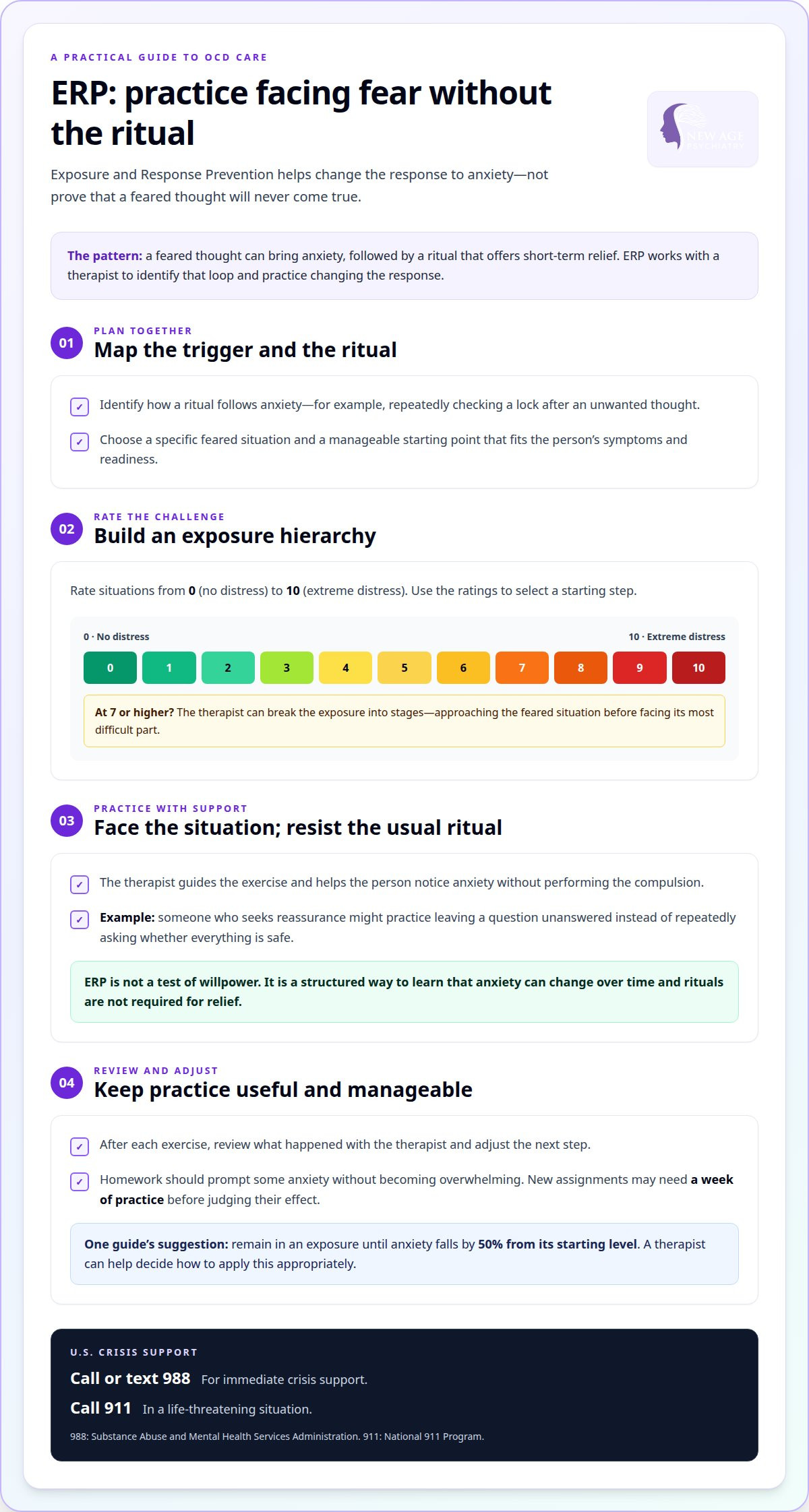
Exposure and Response Prevention, or ERP, helps people face feared thoughts while reducing compulsions that bring short-term relief. A therapist works with the patient to identify how a ritual follows anxiety, such as repeatedly checking a lock after an unwanted thought. The goal is to change the response, not prove the thought will never come true or that the person must prevent every possible outcome.
Planning begins with an exposure hierarchy: situations are rated from 0, meaning no distress, to 10, meaning extreme distress. The therapist and patient use those ratings to choose a manageable starting point. If an exposure feels like a 7 or higher, the therapist can break it into stages, such as approaching a feared situation before facing its most difficult part. This makes the plan specific to the person’s OCD symptoms and readiness.
During an exercise, the therapist guides the patient toward a feared situation and supports them in resisting the usual ritual. For example, someone who seeks reassurance might practice leaving a question unanswered rather than repeatedly asking whether everything is safe. The therapist helps the patient notice anxiety without performing the compulsion. Exposure isn’t a test of willpower. It’s a structured way to learn that anxiety can change over time and rituals aren’t required for relief.
A therapist also reviews what happened during each exercise and adjusts the next step. One guide suggests remaining in an exposure until anxiety falls by 50% from its starting level; the therapist can help apply this appropriately. Homework should prompt some anxiety without becoming overwhelming, and new assignments may need a week of practice before judging their effect. For immediate crisis support in the U.S., call or text 988, according to the Substance Abuse and Mental Health Services Administration. In a life-threatening situation, call 911, according to the National 911 Program.
2. Support from an OCD-informed therapist or coach
An OCD-informed therapist understands how obsessions, compulsions, and distress can reinforce one another. Early sessions can clarify which thoughts feel intrusive, what responses follow, and how symptoms affect work, relationships, or routines. This shared understanding helps the therapist choose relevant therapy skills instead of treating each concern as separate. A coach may help with practice and accountability, while clinical treatment should address mental health needs within the provider’s professional role.
Homework turns ideas from a session into planned practice between appointments. The therapist can agree on one specific task, such as noticing repeated mental review, then discuss what made it challenging at the next session. Progress doesn’t require perfect completion. The therapist helps review what happened, identify obstacles, and adjust the assignment so it stays useful instead of becoming another compulsive rule.
If an exercise feels beyond a person’s readiness, they can tell the therapist before proceeding. Together, they can make the task smaller, change its timing, or clarify its purpose. For example, a patient overwhelmed by a written exercise might first discuss the thought aloud in therapy. The therapist can also discourage perfectionism, such as repeating an assignment until it feels exactly right. Practice should follow the treatment plan and the patient’s pace, not comparisons with someone else.
Cognitive behavioral therapy (CBT) focuses on how thoughts, feelings, and responses interact. For OCD, CBT skills can help a person change patterns that keep symptoms disruptive. Acceptance and commitment therapy (ACT) offers another approach: notice an obsessive thought as a thought, then choose an action guided by personal values. Neither approach requires proving that a feared thought is true or false. If intrusive thoughts are affecting daily life, a psychiatric assessment can help clarify symptoms and discuss appropriate treatment options.
3. Accepting thoughts without controlling them
When an intrusive thought causes anxiety, a therapist can help you notice it without treating it as a command or warning. In Acceptance and Commitment Therapy (ACT), you can practice naming the thought, allowing the discomfort, and choosing what to do next based on your values. This approach changes your relationship with mental events rather than trying to control every instance of thinking.
Trying to suppress a thought can make it return more often. A therapist might explain this with the white-bear activity: try not to think about a white bear for 30 seconds, then notice what happens. The exercise illustrates why pushing thoughts away may keep attention fixed on them. In a session, the therapist can help you observe a thought without arguing with it, replacing it, or seeking certainty about what it means.
Accepting uncertainty doesn’t mean deciding that a feared outcome will happen. It means recognizing that complete certainty isn’t always available, then choosing not to let a gut feeling dictate a compulsion. A therapist may help a patient examine a belief such as “I must prevent every possible risk” and identify how reassurance-seeking or mental review temporarily reduces distress. The focus is on making room for uncertainty while returning attention to meaningful activities.
For a mindfulness exercise, a therapist may use “leaves on a stream,” inviting you to picture each thought resting on a leaf and moving along. This is an observation practice, not a way to force thoughts to disappear. If thoughts involve self-harm or harming someone else, discuss them with a mental health professional who can assess your needs and support next steps. People in the U.S. can call or text 988 for help, according to the Substance Abuse and Mental Health Services Administration. In a life-threatening situation, call 911, according to the National 911 Program.
4. Intrusive thoughts and other OCD symptoms
Intrusive thoughts can involve harm, contamination, relationships, mistakes, or taboo subjects. Their content alone doesn’t show what someone intends to do. With obsessive-compulsive disorder (OCD), thoughts can cause intense distress and lead to repeated actions or mental rituals. Everyone can experience unwanted thoughts, but having them alone doesn’t establish OCD. Managing OCD intrusive thoughts starts with understanding their impact, not judging their content.
Compulsions may be visible, such as repeatedly washing hands, or less obvious, such as silently reviewing a conversation. Other common patterns include seeking reassurance, searching online for certainty, and avoiding a person or place. For example, someone worried about offending a friend might reread old messages, ask others to interpret them, or avoid contacting the friend. These responses may briefly ease distress while keeping attention fixed on the obsession.
Focus on how symptoms affect daily life, not just the subject of a thought. Describe the pattern to a clinician: what triggers the obsession, what action or mental ritual follows, and what happens afterward. Note whether the behavior feels urgent, difficult to control, or relieving only briefly. OCD symptoms can disrupt routines and may intensify during stressful periods, such as a demanding work project or family change.
OCD doesn’t always follow one visible pattern. A person may experience obsessions with few observable compulsions, or compulsions that are difficult to connect to a specific thought. That’s why an assessment considers the full cycle and its impact, rather than judging someone by one intrusive thought. A clinician can help with managing OCD intrusive thoughts by examining these patterns and discussing treatment options. If recurring thoughts and rituals disrupt your routines, seek professional help for OCD symptoms.
New Age Psychiatry
New Age Psychiatry offers OCD treatment for adults in Florida whose intrusive thoughts or related symptoms disrupt daily life. A virtual psychiatric assessment can help clarify symptoms and inform a personalized treatment plan, including medication management when appropriate. OCD can also occur alongside concerns such as anxiety, depression, or insomnia, so discussing the broader picture can help guide care.
Consider professional support when rituals, reassurance seeking, or distress make everyday responsibilities harder to manage. New Age Psychiatry provides psychiatric care through telehealth, giving adults a way to discuss symptoms and treatment options with a professional. Treatment choices depend on your needs and the clinical assessment.
If you’re ready to discuss care for OCD symptoms, contact New Age Psychiatry.
Take the Next Step at Your Pace
Progress can begin with a clear conversation about what feels hardest right now. Managing OCD intrusive thoughts may involve understanding how symptoms affect your routines, relationships, or well-being, then discussing care that fits your needs. You don’t need to have every detail figured out before seeking support.
New Age Psychiatry provides virtual OCD treatment and psychiatric care for adults in Florida. If other concerns are part of your experience, the practice also offers ADHD Diagnosis and Treatment, Insomnia Treatment, and Depression Treatment. Sharing how these concerns overlap can help shape a fuller discussion of your mental health and possible next steps.
Choosing to ask for help is a meaningful step, even if you’re still unsure what kind of support you need. Contact New Age Psychiatry to discuss your concerns and explore a path forward that feels manageable.
Frequently Asked Questions
What Is Obsessive-Compulsive Disorder (OCD)?
OCD is a mental health condition involving obsessions, compulsions, or both. Obsessions are unwanted thoughts, images, or urges that cause distress; compulsions are repeated behaviors or mental acts intended to ease that distress. For example, someone might repeatedly check a door after locking it. A clinician considers the pattern and its effect on daily life when assessing whether symptoms may be OCD.
What are the symptoms of OCD?
OCD symptoms can include recurring unwanted thoughts and repetitive actions or mental rituals that feel difficult to resist. Examples include checking, washing, arranging, seeking reassurance, avoiding triggers, or silently replaying events. Symptoms may take up time or interfere with work, relationships, or routines. Notice what happens before and after a behavior, then describe those details to a mental health professional.
What are the treatment options for OCD?
OCD treatment may include Exposure and Response Prevention, a form of cognitive behavioral therapy, and medication. Selective serotonin reuptake inhibitors, including fluoxetine, fluvoxamine, paroxetine, and sertraline, are among the medication options. A prescriber considers symptoms, health history, other medications, and preferences when discussing medication. Treatment can combine approaches, and the right plan depends on the person’s needs and clinical assessment.
How can I find help?
Start by arranging an evaluation with a mental health professional and explaining how thoughts or rituals affect everyday activities. Bring examples, such as repeated checking before leaving home or reassurance-seeking that strains relationships. Adults in Florida can access virtual psychiatric evaluation and medication management through New Age Psychiatry. If you’re unsure what to share, briefly describing your main concern is a useful first step.
How is OCD different from anxiety?
OCD and anxiety can overlap, but OCD involves obsessions, compulsions, or both, while anxiety can occur without repetitive rituals. For example, a person may worry about an upcoming presentation without performing a ritual to reduce that worry. Someone with OCD may repeatedly review notes or seek reassurance to feel certain. A professional can assess the pattern, distress, and impact rather than relying on one symptom alone.
What if my self-care becomes compulsive?
Self-care may be turning into a compulsion if it feels urgent, rigid, or necessary to prevent a feared outcome. For example, a calming routine may become distressing if you must repeat it until it feels exactly right. Notice whether the practice supports your daily life or restricts it, and discuss the pattern with a clinician. They can help distinguish flexible wellness habits from rituals that maintain distress.