
It’s 1:40 a.m. in Orlando and you’ve been staring at a mole on your arm for twenty minutes. You’ve taken six photos of it. You’ve read three forums and one medical site, and now you’re fairly sure it’s melanoma, even though your dermatologist looked at it in March and said it was fine. If that’s a regular night for you, you may be dealing with health anxiety. It’s a real condition, and it responds well to the right care.
This post is educational, not a diagnosis. I’ll cover what health anxiety is (and what illness anxiety disorder means), why Googling symptoms makes it worse, which health anxiety treatment options have research behind them, and how telehealth care with New Age Psychiatry works anywhere in Florida.
Key Takeaways
- Health anxiety is fear of having or getting a serious illness that sticks around even after normal tests and reassurance.
- Symptom searching and health anxiety travel together. A 2019 meta-analysis found a strong link between health anxiety and cyberchondria.
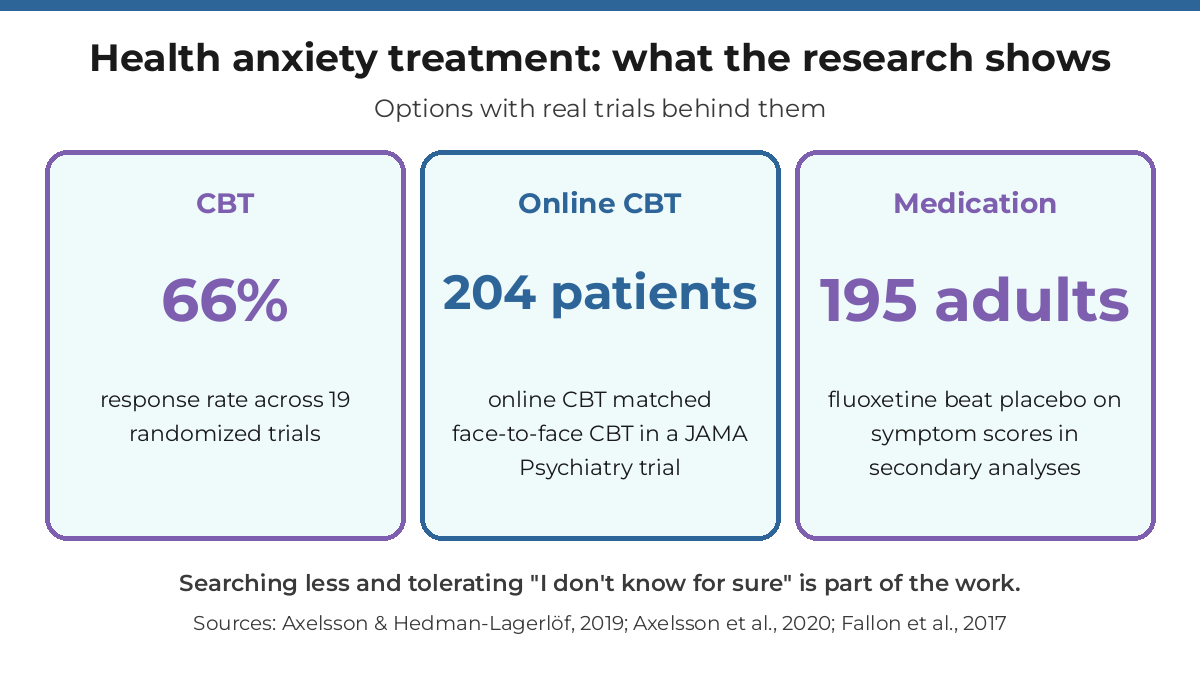
- CBT has the best evidence. Across 19 randomized trials, about two-thirds of people responded.
- Online CBT held up against in-person CBT in a randomized trial of 204 patients.
- Medication, usually an SSRI, is an option too, and some people do best with both.
What Is Health Anxiety?
Health anxiety is a fear of being seriously sick that doesn’t settle down when it should. A normal test result buys you a day of relief, maybe a week. Then a new twinge shows up and the cycle starts over. The old word for it was hypochondria, which most people hear as an insult. I don’t use it.
The official diagnosis has changed over the years. A 2023 review by Sauer, Witthöft, and Rief explains that DSM-5 replaced hypochondriasis with two diagnoses: people with pathological health anxiety are diagnosed with somatic symptom disorder or illness anxiety disorder, depending on how strong their physical symptoms are, and CBT has the best evidence for both (PubMed). Translation: if you’re mostly scared of a disease you might have, that leans illness anxiety disorder. If real physical symptoms are front and center and eat up your attention, that leans somatic symptom disorder.
It’s more common than people think. A 2018 review by Tyrer put lifetime prevalence of health anxiety at about 6% in the general population and as high as 20% in hospital outpatient clinics (PubMed). And COVID didn’t help. A 2024 meta-analysis of 12 studies by Plackett and Ferris found health anxiety scores during the pandemic were higher than in pre-pandemic studies, and higher in women, unmarried people, and people with existing health conditions (PubMed).
Signs of Health Anxiety
Caring about your health is a good thing. Health anxiety looks different. Here’s what I hear a lot:
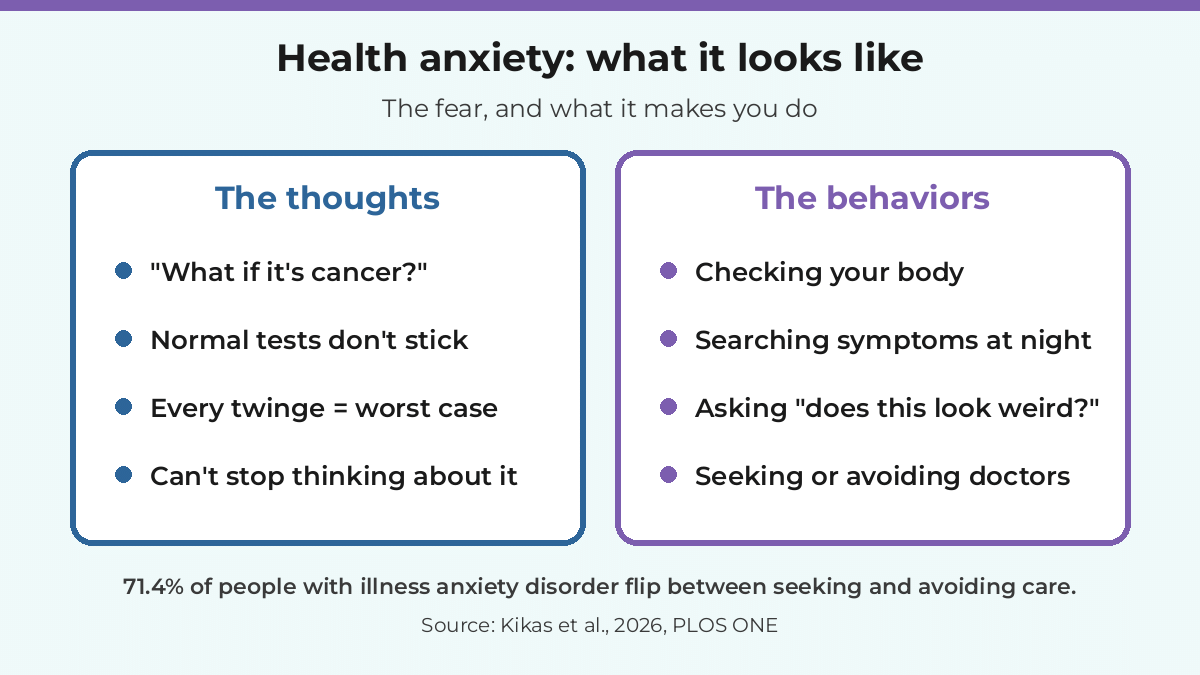
- You check your body a lot: pulse, lumps, moles, your throat in the bathroom mirror
- A normal result calms you down for a few days, then the doubt comes back
- You ask your partner “does this look weird to you?” more than they’d like
- You avoid doctors entirely, because what if they find something
- Every headache is a possible stroke, every chest flutter a possible heart attack
- You’ve lost hours to symptom searching and felt worse after
Yes, avoiding doctors and running to them can both be health anxiety. Same fear, two different exits. DSM-5 splits illness anxiety disorder into care-seeking and care-avoidant types, but real life is messier. In a 2026 study of health-anxious adults, Kikas and colleagues found most people with illness anxiety disorder (71.4%) flipped back and forth between seeking and avoiding medical care, while 25% were mainly care-seeking and 3.6% mainly care-avoidant (PubMed). Three urgent care visits in a month, then nothing for a year. That pattern is common.
Cyberchondria: Why Googling Symptoms Backfires
Cyberchondria is the name for repeated health searching online that leaves you more distressed instead of less. A 2019 meta-analysis by McMullan and colleagues pooled 20 studies with 7,373 participants and found a strong correlation between health anxiety and cyberchondria (r = 0.62) and a moderate one between health anxiety and online health information seeking in general (r = 0.34) (PubMed).
Why would searching make it worse? A 2021 review by Schenkel and colleagues described health-related internet use in health anxiety as a safety behavior maintained through intermittent reinforcement (PubMed). In plain English: sometimes a search reassures you, and sometimes it hands you a scarier diagnosis. That unpredictability is exactly what keeps people coming back. It’s the slot machine effect.
Your brain also isn’t reading those search results neutrally. A 2023 meta-analysis of 34 studies with 8,602 participants by Du and colleagues found health anxiety is consistently linked to reading ambiguous information in a negative way, with a medium effect size (PubMed). And a 2022 meta-analysis by Shi and colleagues found that people with health anxiety weren’t significantly quicker to notice health threats, but their attention stayed stuck on those threats longer than other people’s (PubMed). That matches what patients tell me. It isn’t noticing the symptom. It’s not being able to stop thinking about it.
Health Anxiety Treatment: What Actually Works
First, a fair point: health anxiety doesn’t mean nothing is wrong with your body. If you haven’t had a checkup in a while, get one with your primary care provider. The goal of treatment isn’t to ignore your body. It’s to stop the fear from running the show after you’ve been checked.
CBT for health anxiety
CBT has the strongest evidence. A 2019 meta-analysis of 19 randomized trials by Axelsson and Hedman-Lagerlöf found a moderate to large effect of CBT on health anxiety, a pooled response rate of 66% and remission rate of 48%, effects that largely lasted 12 to 18 months, and internet-delivered CBT working about as well as face-to-face (PubMed).
The online part matters if you live in Florida and the idea of fighting I-4 or the Palmetto every week for a therapy appointment makes you want to skip it. In a 2020 JAMA Psychiatry trial, Axelsson and colleagues randomized 204 patients to 12 weeks of internet-delivered or face-to-face CBT and found online CBT was noninferior to face-to-face CBT, with therapists spending about 10 minutes per patient per week online versus 45.6 minutes in person (PubMed).
What does CBT for health anxiety actually involve? Cutting back on checking and searching, slowly. Learning to sit with “I don’t know for sure” without running to Google. Testing your predictions. It’s uncomfortable at first. That discomfort is how it works.
Medication
Medication has a place too. In a 2017 trial in the American Journal of Psychiatry, Fallon and colleagues randomized 195 adults with hypochondriasis to placebo, CBT, fluoxetine, or both. response rates followed the expected pattern (47.2% with both, 41.8% with one active treatment, 29.6% with placebo), and in secondary analyses fluoxetine reduced health anxiety more than placebo at 24 weeks, with less anxiety and better quality of life; combining it with CBT gave a small extra benefit (PubMed). The authors were also upfront that no single treatment’s response rate clearly beat placebo on its own, and about half of patients didn’t respond. So anyone promising you a quick fix is overselling.
In my practice, an SSRI makes sense when the anxiety is constant, when depression or panic is also in the picture, or when someone has tried therapy and is still stuck. For a lot of people it’s both: medication to turn the volume down, and CBT skills to break the habit loop.
When to Get Evaluated
Get evaluated if health fears are eating hours of your day, costing you sleep, straining your relationship, or sending you to urgent care over and over with nothing found. Same if you’re avoiding medical care you actually need because you’re too scared. An evaluation also checks for what often comes along with health anxiety, like panic attacks, depression, or OCD. If your checking feels more like a ritual, our post on how to tell OCD from an anxiety disorder is a good next read.
If you’re having thoughts of suicide, don’t wait for an appointment. Call or text 988, chat at 988lifeline.org, or call 911.
Health Anxiety Care by Telehealth in Florida
At New Age Psychiatry, the first visit is a full psychiatric evaluation by secure video. We’ll go through what you fear, how much time it takes up, what you’ve already been checked for, sleep, mood, panic, and substance use. Then we build a plan. That might mean medication, a referral for CBT, or both. Follow-ups are where we adjust.
Telehealth has limits. As our FAQ explains, New Age Psychiatry doesn’t provide telehealth care for people with a history of psychosis, a recent suicide attempt or suicidal thoughts in the past six months, thought disorders, bipolar I disorder, or dementia. If that’s where things are, we’ll tell you plainly that a higher level of care is the safer fit.
Frequently Asked Questions
Is health anxiety the same as hypochondria?
Mostly, yes. Hypochondriasis was the older diagnosis. Today, health anxiety is usually diagnosed as illness anxiety disorder or somatic symptom disorder, depending on how much physical symptoms are part of it.
Should I stop Googling my symptoms?
Cutting back usually helps, and the research on cyberchondria backs that up. Going cold turkey is hard, so most people do better reducing it step by step as part of CBT.
Can I get treated for health anxiety online in Florida?
Yes. New Age Psychiatry sees adults located in Florida by secure video, from Miami and Fort Lauderdale to Tampa, Orlando, and Jacksonville, within the limits in our FAQ.
Anxiety Care by Telehealth Across Florida
New Age Psychiatry is a telehealth-only psychiatry practice for adults across Florida, led by Hilary Ortega, PMHNP-BC. Whether you’re in a Brickell high-rise, a Jacksonville suburb, or a quiet street in Tampa, the visit happens from wherever you have privacy and a decent connection.
If you read the opening and thought “that’s me at 1:40 a.m.,” that’s reason enough to book. You can keep reading on the New Age Psychiatry blog, including our generalized anxiety disorder telehealth guide, or visit our online psychiatrist in Florida page for more on telehealth psychiatry Florida options.
References
Axelsson, E., Andersson, E., Ljótsson, B., Björkander, D., Hedman-Lagerlöf, M., & Hedman-Lagerlöf, E. (2020). Effect of internet vs face-to-face cognitive behavior therapy for health anxiety: A randomized noninferiority clinical trial. JAMA Psychiatry, 77(9), 915–924. https://doi.org/10.1001/jamapsychiatry.2020.0940
Axelsson, E., & Hedman-Lagerlöf, E. (2019). Cognitive behavior therapy for health anxiety: Systematic review and meta-analysis of clinical efficacy and health economic outcomes. Expert Review of Pharmacoeconomics & Outcomes Research, 19(6), 663–676. https://doi.org/10.1080/14737167.2019.1703182
Du, X., Witthöft, M., Zhang, T., Shi, C., & Ren, Z. (2023). Interpretation bias in health anxiety: A systematic review and meta-analysis. Psychological Medicine, 53(1), 34–45. https://doi.org/10.1017/S0033291722003427
Fallon, B. A., Ahern, D. K., Pavlicova, M., Slavov, I., Skritskya, N., & Barsky, A. J. (2017). A randomized controlled trial of medication and cognitive-behavioral therapy for hypochondriasis. The American Journal of Psychiatry, 174(8), 756–764. https://doi.org/10.1176/appi.ajp.2017.16020189
Kikas, K., Upton, E., Corkish, B., Werner-Seidler, A., & Newby, J. M. (2026). Illness anxiety disorder and somatic symptom disorder: Similarities and differences in health-anxious individuals. PLOS ONE, 21(3), Article e0342493. https://doi.org/10.1371/journal.pone.0342493
McMullan, R. D., Berle, D., Arnáez, S., & Starcevic, V. (2019). The relationships between health anxiety, online health information seeking, and cyberchondria: Systematic review and meta-analysis. Journal of Affective Disorders, 245, 270–278. https://doi.org/10.1016/j.jad.2018.11.037
Plackett, R., & Ferris, E. (2024). The prevalence and determinants of health anxiety during the COVID-19 pandemic: A systematic review and meta-analysis. PLOS Mental Health, 1(7), Article e0000120. https://doi.org/10.1371/journal.pmen.0000120
Sauer, K. S., Witthöft, M., & Rief, W. (2023). Somatic symptom disorder and health anxiety: Assessment and management. Neurologic Clinics, 41(4), 745–758. https://doi.org/10.1016/j.ncl.2023.02.009
Schenkel, S. K., Jungmann, S. M., Gropalis, M., & Witthöft, M. (2021). Conceptualizations of cyberchondria and relations to the anxiety spectrum: Systematic review and meta-analysis. Journal of Medical Internet Research, 23(11), Article e27835. https://doi.org/10.2196/27835
Shi, C., Taylor, S., Witthöft, M., Du, X., Zhang, T., Lu, S., & Ren, Z. (2022). Attentional bias toward health-threat in health anxiety: A systematic review and three-level meta-analysis. Psychological Medicine, 52(4), 604–613. https://doi.org/10.1017/S0033291721005432
Tyrer, P. (2018). Recent advances in the understanding and treatment of health anxiety. Current Psychiatry Reports, 20(7), Article 49. https://doi.org/10.1007/s11920-018-0912-0