

In Florida, ketamine therapy for anxiety disorders may be prescribed off-label by a physician for a valid medical purpose. Ketamine is FDA-approved as an anesthetic, not specifically for psychiatric disorders. Some clinics use ketamine for anxiety and other mood symptoms, but its strongest evidence base is for treatment-resistant depression. Understanding what treatment involves and where evidence is limited can help you weigh your options.
If anxiety has been difficult to manage, it’s reasonable to want clear answers about what ketamine therapy involves and what claims about fast relief mean. This guide explains how infusions are used, what a treatment course may look like, how long relief is claimed to last, and how anxiety care differs from FDA-approved uses of esketamine. For anxiety, ketamine may be considered alongside psychotherapy. You’ll also learn what clinical screening considers and where psychiatric care for anxiety may fit into your next steps.
Key Takeaways
- Learn how ketamine’s effects on brain signaling are thought to support treatment, and why its use for anxiety differs from its established anesthetic use.
- Understand why some clinics report relief within hours, while the timing and duration of effects can vary from person to person.
- See what an infusion course may involve, including the treatment schedule, recovery needs, and factors considered during clinical screening.
- Explore how ketamine may fit into anxiety care alongside other forms of support, and when a psychiatric assessment can help clarify treatment options.
Clinic claims about ketamine’s speed and duration of relief
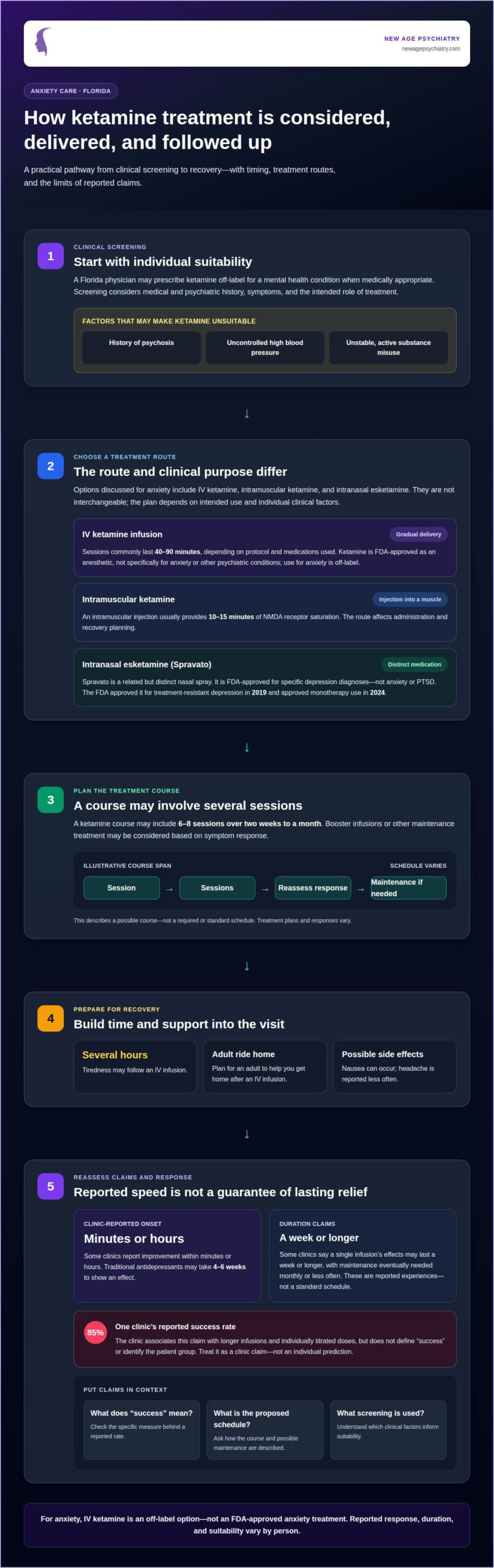
Some Florida clinics report that people feel relief within hours of an intravenous ketamine infusion. One clinic reports an 85% success rate with longer infusions and individually titrated doses, but doesn’t define “success” or identify the patient group. Treat that percentage as a clinic claim, not a prediction for an individual. Traditional antidepressants typically take weeks to have an effect, while ketamine’s reported onset can be faster.
Some clinics claim that the effects of a single infusion may last a week or longer, and that maintenance treatment may eventually be needed once per month or less often. These are reported experiences, not a standard schedule. Treatment plans and responses vary, so an initial response does not establish how long relief will continue.
Florida physicians may prescribe ketamine off-label for mental health conditions when it is medically appropriate. Screening considers medical and psychiatric history. Ketamine may not be suitable for people with a history of psychosis, uncontrolled high blood pressure, or unstable, active substance misuse. These factors can affect whether it is an appropriate option.
For practical planning, distinguish a clinic’s physical location from where it provides care. People comparing options around Pompano Beach, Fort Myers, and Tampa should check which locations a service covers. A Fort Myers clinic offers IV ketamine for symptoms associated with anxiety and other mood disorders. Tampa treatment pricing and insurance contributions depend on the proposed course and individual plan benefits, so coverage cannot be assumed from a clinic’s location.
When weighing any clinic’s claims, look at the specific measure behind a reported success rate, the proposed treatment schedule, and the screening criteria. These details put claims about rapid relief in context and help you understand what treatment involves before deciding whether to proceed.
What is Ketamine Therapy?
Ketamine therapy uses ketamine in a clinical treatment setting, including intravenous (IV) infusions for mental health symptoms. Ketamine was approved in the United States as an anesthetic, not specifically as a psychiatric treatment. For anxiety, an IV infusion is therefore different from a medication with FDA approval for that condition.
Ketamine affects glutamate signaling by blocking the NMDA receptor, a mechanism associated with neuroplasticity. This is one reason clinicians study its effects on mood and mental health. A personalized treatment plan considers symptoms, medical history, and the intended role of ketamine rather than treating every diagnosis alike.
Is ketamine therapy FDA-approved for anxiety disorders? No. Ketamine is FDA-approved as an anesthetic, but not specifically for anxiety disorders or other psychiatric conditions. In Florida, a physician may prescribe it off-label for a mental health condition when medically appropriate.
Some clinics use IV ketamine for psychiatric conditions such as depression, post-traumatic stress disorder (PTSD), suicidal ideation, and obsessive-compulsive disorder (OCD), as well as anxiety symptoms. These uses do not mean ketamine is FDA-approved for each condition. That distinction matters when weighing treatment claims.
Spravato is esketamine, a related but distinct medication administered as a nasal spray. The FDA approved Spravato for treatment-resistant depression in 2019 and, in 2024, approved it for use as monotherapy. Its approved uses include adults with treatment-resistant depression and adults with major depressive disorder accompanied by acute suicidal ideation or behavior. Spravato is not FDA-approved for anxiety or PTSD.
For people exploring care, separating the medication’s mechanism, approved indications, and clinic-specific uses can make discussions more focused. A conversation about anxiety treatment options can help connect symptoms with an appropriate psychiatric care plan.
Ketamine infusion therapy for anxiety and other mood disorders
Treatment options discussed for anxiety in Florida include intravenous (IV) ketamine, intramuscular injections, and intranasal esketamine. The route, schedule, and clinical purpose differ.
Infusion and Injection Options
An IV infusion delivers ketamine gradually, while an intramuscular injection places it into a muscle. IV sessions commonly last 40 to 90 minutes, depending on the protocol and medications used. An intramuscular injection usually provides 10 to 15 minutes of NMDA receptor saturation. The route matters because it affects administration and recovery planning, not just convenience.
Some clinics use intranasal esketamine, sold as Spravato. It has FDA-approved uses for specific depression diagnoses, not anxiety. After an initial course, booster infusions or other maintenance treatment may be considered based on symptom response. These treatment routes are not interchangeable; the plan depends on the intended use and individual clinical factors.
Comparison with Standard Anxiety Treatments
Standard anxiety care can include psychotherapy and medication. Antidepressant treatment may take 4 to 6 weeks to show an effect, while clinics report that ketamine symptoms can improve within minutes or hours. Faster reported onset does not make ketamine a substitute for every established treatment. The comparison is most useful when discussing prior response, current symptoms, and treatment goals with a psychiatric clinician.
A ketamine course may include 6 to 8 sessions over two weeks to a month, followed by maintenance sessions as needed. These visits require planning. After an IV infusion, people can feel tired for several hours and need an adult to help them get home. Nausea can occur, and headache is reported less often.
Ketamine is a Schedule 3 controlled substance. For anxiety, IV ketamine use is distinct from FDA-approved esketamine treatment for specified depression conditions. This difference helps clarify what the treatment is intended to address and how its use relates to other mental health care.
Anxiety disorders and ketamine
Ketamine’s strongest evidence base is for treatment-resistant depression, not anxiety disorders. Evidence for anxiety is less established, and ketamine infusion therapy is not an FDA-approved anxiety treatment. Some clinics use ketamine for anxiety symptoms, often alongside psychotherapy, but a clinic’s offering does not establish FDA approval or equivalent evidence across diagnoses. This distinction matters when considering ketamine therapy for anxiety disorders in Florida.
What evidence supports ketamine treatment for anxiety disorders? Available information suggests potential use for anxiety symptoms, often alongside psychotherapy, while the strongest evidence remains for treatment-resistant depression. Weigh claims about relief against the evidence for the treatment and its approved uses.
Anxiety can involve different experiences, from persistent worry to sudden episodes of intense fear. A psychiatric assessment considers symptoms, their effects on daily life, medical history, and other mental health conditions. These details can help distinguish anxiety as the main concern from symptoms linked to depression or PTSD. Evidence for one condition does not establish effectiveness for another. In Florida, discussing these factors helps put ketamine therapy for anxiety disorders in the context of your broader care.
Esketamine, marketed as Spravato, is distinct from ketamine infusion therapy. It is FDA-approved for specific depression indications, including treatment-resistant depression in adults, but not for anxiety disorders or PTSD. Ask which medication and diagnosis a treatment claim refers to: approval for depression does not extend to anxiety.
A useful next step is to discuss symptom patterns, previous treatments, and recovery goals in a psychiatric evaluation. For example, someone with persistent anxiety and treatment-resistant depression needs a plan that considers both diagnoses rather than assuming one intervention addresses each. Ketamine may be considered within a broader care plan, but it does not replace careful assessment or other appropriate support. Clear expectations start with understanding what the evidence supports for the condition being treated.
New Age Psychiatry: Anxiety Treatment
New Age Psychiatry provides anxiety treatment and low-dose ketamine therapy through completely virtual psychiatric care for adults in Florida. Ketamine may be discussed as part of care when clinically appropriate, with its potential role considered in light of the diagnosis, medical history, and evidence. It is not FDA-approved specifically for anxiety.
A psychiatric evaluation can help clarify whether anxiety, depression, insomnia, or another concern should guide treatment. If you’re considering ketamine, a clinician can discuss its potential role alongside other options without presenting reported outcomes as guarantees. This can help connect your symptoms and treatment goals with appropriate care.
Contact New Age Psychiatry to discuss anxiety treatment and your care options.
Take the Next Step Toward Personalized Care
Choosing care starts with a useful conversation about what’s affecting daily life and what you hope will change. If you’re considering ketamine therapy for anxiety disorders in Florida, bring questions about treatment goals, previous care, and concerns to a psychiatric evaluation. That discussion can help shape a plan around your needs rather than assumptions.
New Age Psychiatry provides anxiety treatment and care for adults with depression, insomnia, and ADHD. When concerns overlap, a broader psychiatric perspective can help clarify which symptoms need attention and how care can be coordinated. You can ask direct questions and get a clear explanation of the options being considered.
Contact New Age Psychiatry to discuss your care needs and explore a thoughtful next step. Reaching out can be a steady beginning toward support that fits your situation.
Frequently Asked Questions
What are the benefits?
Some clinics report that mood symptoms may improve rapidly with ketamine, which may be relevant when conventional care hasn’t helped enough. The clearest evidence is for treatment-resistant depression, not anxiety. If you’re considering treatment for persistent worry, weigh possible symptom relief against the limited evidence for anxiety and discuss how progress would be assessed.
What are the side effects?
Reported side effects of IV ketamine include nausea and, less commonly, headache. Clinics describe these effects as short-lived, often lasting one to two hours. Because tiredness after treatment can affect safe travel, plan transportation rather than driving yourself. Screening also considers your medical history and other medications when assessing whether ketamine is appropriate.
What is the experience like?
An IV visit includes administration and recovery time, so plan for more than the infusion itself. Some patients feel tired for several hours afterward and need an adult to help them get home. Arrange a ride before the appointment and avoid scheduling activities that require alertness immediately afterward. The treatment team can explain the visit plan.
Will it help me?
A diagnosis name alone cannot determine whether ketamine is suitable. The decision depends on your symptoms, medical and psychiatric history, previous treatment response, and screening for factors that may make ketamine inappropriate. For instance, a history of psychosis or uncontrolled high blood pressure can affect whether it is considered. A psychiatric assessment can help clarify whether ketamine belongs in your care plan.
How much does ketamine therapy for anxiety cost in Florida, and does insurance cover it?
Insurance does not cover services. It may be used for medication purchases at a pharmacy, but that does not mean it covers ketamine care. Check your pharmacy benefit with your plan before relying on it for medication costs.
Which Florida clinics offer ketamine therapy for anxiety, and how can their credentials be checked?
New Age Psychiatry provides anxiety treatment and low-dose ketamine therapy through completely virtual psychiatric care for adults in Florida. To check a clinician’s credentials, use their name and professional license information to search Florida’s state licensing records. Confirm that the listed license matches the clinician’s role in your care; a clinic’s treatment offering alone does not establish a particular clinician’s qualifications.