

Better sleep habits can support severe insomnia, but they may not resolve it on their own. A practical approach to sleep hygiene for severe insomnia starts with a bedroom that’s dark, quiet, and cool, around 65°F if that feels comfortable, plus a consistent wake time and a calming routine before bed. These steps can make sleep more supportive, but persistent insomnia may need treatment beyond habit changes.
If you’ve already adjusted your bedtime or cut back on screens but still lie awake, it doesn’t mean you’re doing something wrong. Insomnia can persist even when you’ve made thoughtful changes to your sleep environment and routine.
This article explains how bedroom conditions, caffeine and alcohol, daytime habits, exercise, and wind-down routines can affect sleep. You’ll also learn why sleep hygiene is only one part of insomnia care, and when ongoing symptoms may call for professional support.
Key Takeaways
- Make the bedroom a calm, comfortable place for sleep, and reduce light, noise, and distractions that may keep you alert.
- Review the timing of caffeine, alcohol, nicotine, and evening meals to spot habits that could interfere with rest.
- Keep sleep and wake times consistent, and use daytime naps thoughtfully so they’re less likely to disrupt nighttime sleep.
- Build a gentle wind-down routine and time exercise to help your body transition toward rest.
- Think of home habits as one part of care: persistent or severe insomnia may need treatment beyond sleep hygiene alone.
1. Bedroom temperature, light, and noise
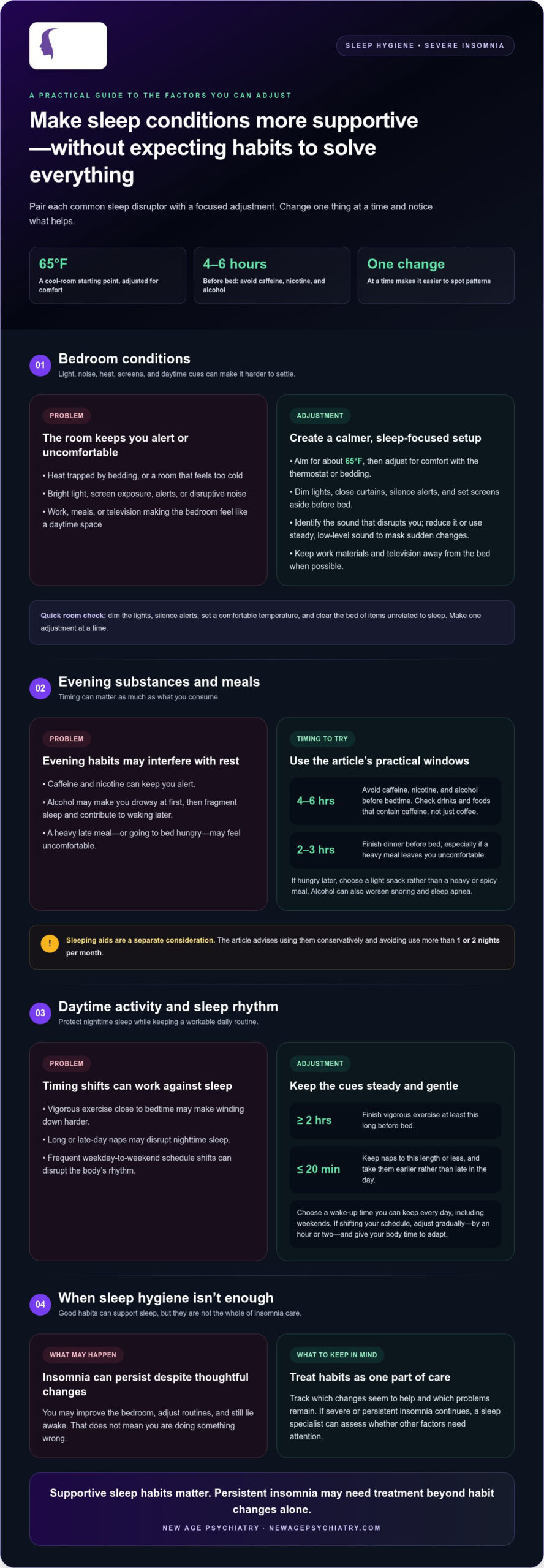
A dark, quiet, comfortably cool bedroom supports better sleep conditions. Aim for about 65 degrees Fahrenheit, then adjust for comfort rather than treating that number as a strict rule. Reduce light, limit noise, and put away screens before bed. These conditions answer the practical question: a cool, dark, quiet room with less screen exposure can make it easier to settle and fall asleep.
Start with room temperature. If you wake overheated, lower the thermostat or switch to lighter bedding; if you feel cold, add a layer. An uncomfortable room can make it harder to stay asleep. Notice whether the problem starts at bedtime or later, when bedding may trap heat. Make one change at a time, such as adjusting the thermostat before replacing a mattress or changing several conditions at once.
Bright light can make a bedroom feel like daytime. Close curtains or blinds, cover small indicator lights, and turn off overhead lamps when you’re ready to sleep. Tablets, smartphones, and LED screens emit light that can suppress melatonin production. Set your phone aside instead of checking it in bed, and use a dim light if you need to move around at night. This reduces bright-light exposure without requiring a complicated routine.
Noise matters, too. Identify the specific sound that disrupts your rest, such as traffic, a television in another room, or a barking pet. Close the window, move the television farther from the bedroom, or arrange for pets to sleep elsewhere if they disturb you. If noise persists, consider a steady, low-level sound to mask sudden changes. The aim is a quieter space, not perfect silence.
Comfort depends on your mattress, pillows, bedding, and how you use the room. An uncomfortable mattress can make it difficult to settle, while clutter or a work setup may keep the bedroom associated with daytime tasks. When possible, keep work materials, meals, and television away from the bed. Reserve the bedroom for sleep and intimacy; for example, answer emails at a desk rather than under the covers.
Try a simple evening check: dim the lights, silence alerts, set a comfortable temperature, and clear the bed of anything unrelated to sleep. Keep the setup practical, especially if you share the room or need a light for safety. Track which changes seem to help and which problems remain. If severe insomnia continues despite improving bedroom conditions, a sleep specialist can assess whether other factors need attention. Sleep hygiene for severe insomnia can support care, but room changes alone may not address every cause.
2. Caffeine, alcohol, nicotine, and late meals
Caffeine, alcohol, and nicotine can affect how easily you fall asleep and stay asleep. As a practical starting point, avoid caffeine and nicotine for four to six hours before bedtime, and avoid alcohol during the same period. Also finish dinner two to three hours before bed, especially if a heavy meal leaves you uncomfortable.
Caffeine can keep you alert when you’re trying to rest, and its effects vary depending on the amount and timing. Check coffee, tea, energy drinks, soda, and chocolate rather than tracking coffee alone. If sleep is difficult, have your last caffeinated drink earlier and note whether it changes how long it takes to fall asleep or how often you wake. Avoid changing several habits at once so you can identify which adjustment helps.
Alcohol may initially make you feel drowsy, but it can fragment sleep and contribute to waking later in the night. Try avoiding it in the four to six hours before bedtime and observe whether your sleep is less interrupted. Alcohol can also worsen snoring and sleep apnea. If you drink in the evening, consider how the timing overlaps with your usual bedtime, not just whether you feel sleepy afterward.
Nicotine is stimulating, so smoking or using nicotine close to bedtime may interfere with settling down. Avoid it in the four to six hours before bed, and pay particular attention to evening use. Late meals can cause a different problem: going to bed hungry or very full may be uncomfortable. Finish a regular meal two to three hours before sleep; if you’re still hungry, choose a light snack instead of a heavy or spicy meal.
Exercise and naps also affect sleep. Vigorous exercise close to bedtime may make it harder to wind down, so finish it at least two hours before bed. Keep daytime naps to 20 minutes or less, and take them earlier rather than late in the day. These adjustments can help protect your circadian rhythm without requiring you to avoid daytime activity altogether.
Sleeping aids are a separate consideration from caffeine or nicotine. Use them conservatively, and avoid taking them more than 1 or 2 nights per month. Keep a brief record of evening substances, meal timing, and nighttime waking; this can reveal patterns to discuss during care for chronic insomnia. If insomnia continues despite changes, insomnia treatment may help address factors that daily habit adjustments don’t resolve.
3. Why Is Sleep Hygiene Important?
A steady sleep schedule gives your body a predictable cue for rest. Choose a wake-up time you can keep every day, including weekends, then plan bedtime around when you feel sleepy. Your internal brain clock follows a 24-hour physiological cycle, so frequent shifts between weekdays and weekends can disrupt its rhythm. A consistent pattern may make it easier to fall asleep when you go to bed.
If your current schedule differs from your goal, adjust it gradually rather than shifting bedtime and wake time dramatically all at once. Move the schedule by an hour or two, then give your body time to adapt before shifting again. For example, if you sleep late on weekends, move your weekend wake-up time closer to your weekday routine. A gradual approach can help avoid adding pressure around sleep.
Daytime light also helps anchor the sleep-wake rhythm. Aim for at least 20 minutes of sunlight during the day, especially in the morning. A short outdoor walk after waking can combine light exposure with a repeatable daily cue. The timing matters: morning light supports circadian rhythms, while bright light late at night can make it harder to wind down and fall asleep.
Naps can relieve daytime sleepiness, but long or late naps may reduce the drive to sleep at night. According to New Age Psychiatry, adults should nap for no more than 20 minutes. Keep a nap early in the afternoon when possible, and avoid using it to compensate for a changing bedtime. If you track naps alongside nighttime waking, you can see whether they affect your own sleep pattern.
Sleep hygiene also includes practical daytime choices. Keep meals and eating times reasonably predictable, and notice whether late or irregular eating affects your comfort at bedtime. Use a brief sleep diary to record wake time, naps, caffeine timing, and how long it takes to fall asleep. A few consistent notes can reveal patterns more clearly than judging your sleep by one difficult night.
These habits can support sleep, but chronic insomnia is not a personal failure. Persistent sleep problems can interact with mental health, stress, and other factors, so routine changes may not be enough on their own. Melatonin is part of the body’s sleep-wake system, but changing your schedule is not the same as taking a supplement. Focus on steady cues, then consider your habits as a whole when assessing ongoing insomnia.
4. Exercise and bedtime wind-down
Daytime exercise can support a more settled sleep rhythm, especially when it becomes part of a regular routine. Try moderate activity such as walking, cycling, or light strength work during the day. A practical target from the research is 20 minutes of exercise three times a week. Choose activities you can repeat comfortably, rather than making an intense workout another source of pressure.
If exercise leaves you feeling alert, timing may matter. Finish vigorous activity at least two hours before bedtime, and avoid vigorous exercise within three hours of bed. Notice how different activities affect you: an evening walk may feel calming, while a hard workout may make it harder to fall asleep. If you feel unsettled at bedtime after exercise, move it earlier and compare how your evening goes.
Build a wind-down routine that starts before you feel exhausted. Set aside 20 minutes for a few quiet activities, such as reading a paper book, gentle stretching, soft music, or relaxation exercises. Repeat the same sequence in the same order when possible. For example, dim the lights, stretch, then read in a chair. A predictable routine gives the transition from daytime activity to rest a clear rhythm.
Screens can compete with that transition. Tablets, smartphones, and LED screens emit blue light, which can suppress melatonin production. Set a device-free period of 20 to 50 minutes before bed; if the full period feels difficult, begin with a smaller step and extend it. Charge the phone outside the bed area, silence nonessential alerts, and choose an offline activity for the final part of the evening.
Worry can also keep the mind active after lights-out. Schedule 15 to 20 minutes to write a to-do list or worry list before bed, then close the notebook when the time ends. For recurring bedtime worry, set this period well before bedtime rather than using it as the final activity. This practical boundary can help separate planning from the time reserved for winding down.
Keep your routine simple enough to follow on demanding days. A warm bath two hours before bedtime, followed by light stretching and reading, is one possible sequence. If a step feels stimulating or frustrating, replace it with a quieter activity. Sleep hygiene can provide a foundation, while therapy may address persistent patterns that home routines don’t change. Consistency matters more than an elaborate bedtime checklist.
5. Sleep hygiene as part of insomnia treatment
For adults with insomnia, useful sleep habits include keeping a steady wake time, limiting late caffeine and alcohol, and making the bedroom comfortable. If you’re awake after about 20 minutes in bed, get up and do something calming in low light, then return when sleepy. These steps support better sleep, but they aren’t a complete treatment plan for everyone.
Persistent insomnia can have several contributing factors. Sleep apnea may need assessment, and anxiety or depression can occur alongside chronic insomnia. Medication effects and side effects also deserve attention during a clinical assessment. A sleep diary that notes symptoms, medications, and nighttime waking can help clarify patterns.
Sleep hygiene matters because daily habits and the sleep environment can support sleep quality and daytime alertness. Still, the American Academy of Sleep Medicine concluded that evidence is insufficient to recommend sleep hygiene as a stand-alone therapy for chronic insomnia. In practical terms, habits can complement treatment, but relying on them alone may leave ongoing difficulty falling or staying asleep unaddressed.
Cognitive behavioral therapy for insomnia, or CBT-I, is considered the gold standard for chronic insomnia treatment and typically involves six to eight sessions. It uses structured strategies to address thoughts and behaviors linked to sleep difficulties. A clinician may also assess other possible sleep disorders and recommend tests, such as sleep apnea testing or actigraphy, when appropriate.
Keep the next step manageable. Track bedtime, wake time, nighttime awakenings, daytime sleepiness, and changes in routine. Bring your notes to a healthcare appointment, along with a list of medications and supplements. If symptoms worsen, treatment isn’t helping, or you experience medication side effects, contact your healthcare provider. These details can support a fuller assessment than a list of habits alone.
Sleep hygiene for severe insomnia works best as part of a broader plan, not as a test of willpower. If consistent routines and bedroom adjustments haven’t eased persistent sleep problems, explore support for ongoing insomnia as a next step.
New Age Psychiatry: ADHD Diagnosis and Treatment
New Age Psychiatry provides insomnia treatment for adults whose sleep problems persist despite changes to their home routines. A virtual psychiatric evaluation can consider insomnia alongside medication use, anxiety, depression, and other mental health concerns that may affect sleep. Treatment may include medication management as part of an individualized care plan.
Consider seeking support when insomnia repeatedly interferes with daytime functioning or poor sleep continues despite a consistent routine. You don’t have to manage persistent sleep difficulties alone. Seeking care doesn’t mean you’ve failed to make the right changes at home.
Visit New Age Psychiatry to learn about insomnia care.
Take the Next Step Toward Better Rest
Ongoing sleep difficulties can affect how you feel, think, and manage daily responsibilities. You don’t have to treat every difficult night as a problem to solve alone. Using sleep hygiene for severe insomnia as one part of a broader care plan can help you approach persistent symptoms with more support and a clearer understanding of what may be affecting your sleep.
New Age Psychiatry provides insomnia treatment, ADHD diagnosis and treatment, and depression treatment through virtual psychiatric care for adults in Florida. An evaluation can consider how sleep concerns relate to your symptoms and mental health, then inform an appropriate care plan. If sleep problems interfere with daily life, seeking support is a practical next step, not a sign that you haven’t tried hard enough.
Bring your concerns and the changes you’ve already tried into the conversation. Contact New Age Psychiatry to explore support. A more supported path forward can start with one conversation.
Frequently Asked Questions
What Is Insomnia?
Insomnia is persistent difficulty falling asleep, staying asleep, or getting restorative sleep despite having an opportunity to rest. It can affect daytime alertness and everyday functioning, rather than being just one restless night. Chronic insomnia symptoms occur at least three times per week for three months. Keeping notes about sleep difficulties and their daytime effects can help distinguish an ongoing pattern from occasional disrupted sleep.
How is it treated?
Chronic insomnia is commonly treated with cognitive behavioral therapy for insomnia, or CBT-I, which typically involves six to eight sessions. An assessment can also consider sleep habits, medications, mental health, and possible sleep disorders. When symptoms suggest another condition, a healthcare provider may recommend testing, such as sleep apnea testing or actigraphy. The right approach depends on the pattern of symptoms and what may be contributing to them.
What can I expect if I have this condition?
Insomnia can make it difficult to fall asleep or stay asleep, and poor sleep may affect daytime alertness. The experience varies: one person may struggle to fall asleep, while another wakes repeatedly and has trouble getting back to sleep. A sleep diary can help capture these differences. Record bedtime, awakenings, wake time, and daytime effects, then share the pattern during a clinical assessment.
When should I see my healthcare provider?
Contact your healthcare provider if insomnia symptoms worsen, treatment isn’t helping, or you experience medication side effects. Bring a brief record of your sleep pattern, along with a current list of medications and supplements. Include when symptoms began and whether they affect daytime activities. These details can help a provider assess possible contributing factors and whether further evaluation, such as testing for sleep apnea, is appropriate.
Why Is Sleep Hygiene Important?
Sleep hygiene offers practical ways to support nighttime sleep and daytime alertness. Consistent habits can create clearer cues for rest, while a sleep diary can show whether a routine coincides with better or worse nights. That information is useful even if insomnia continues, because it helps describe your experience during an assessment. Treat these habits as supportive tools, not a measure of effort or personal discipline.
What is sleep hygiene, and what can it realistically do for severe insomnia?
Sleep hygiene refers to the daily habits and bedroom conditions that support sleep. Sleep hygiene for severe insomnia can help address factors such as an irregular schedule or a disruptive environment, but it may not resolve serious or persistent symptoms on its own. If changing routines hasn’t helped, that doesn’t mean you’ve failed. It may be a sign that a broader assessment and treatment approach would be useful.
What is CBT-I, and why is it recommended over sleep hygiene alone for chronic insomnia?
CBT-I is cognitive behavioral therapy designed for insomnia. It addresses thoughts and behaviors connected with sleep difficulties, rather than focusing only on bedroom conditions or general habits. It’s recommended because sleep hygiene education alone is not considered sufficient as a stand-alone treatment for chronic insomnia. CBT-I typically involves six to eight sessions, with strategies that can be applied to the patterns affecting your sleep.
What medical conditions, medications, or mental health issues can cause severe insomnia?
Insomnia can interact with stress and mental health; anxiety or depression may occur alongside chronic insomnia. Substances, medications, other sleep disorders, and physical or mental health conditions may also need to be considered.