

An adult ADHD re-evaluation isn’t just a repeat questionnaire. Getting an ADHD re-evaluation as an adult in Florida means having a clinician assess your current symptoms, their impact across different settings, and whether signs were present in childhood. Standardized tools can support the assessment, but they don’t replace clinical judgment.
If you weren’t diagnosed as a child, you can still seek an adult evaluation. The process can also help distinguish ADHD from concerns such as anxiety, depression, sleep difficulties, or other conditions that may affect focus and organization.
This guide explains who can assess adult ADHD and how a clinical evaluation differs from neuropsychological testing. You’ll also learn what information a clinician may review, whether you need a referral, and what to consider about insurance coverage in Florida. Understanding these steps can help you choose an assessment that fits your needs and know what to expect.
Key Takeaways
- A qualified clinician can assess adult ADHD by reviewing symptoms, history, and their impact on daily life.
- Learn when a clinical psychiatric evaluation may address your needs and when neuropsychological testing may add detail.
- Find out what background information can help the assessment and how referrals may affect your next steps.
- Understand what to consider about telehealth coverage and insurance before arranging an evaluation.
Adult ADHD evaluation tools and clinical assessment
An adult evaluation reviews current symptoms, childhood history, and their effects on daily life. Choose a Florida clinic that uses clinical interviews and diagnostic criteria, not a screening questionnaire alone.
Child and Adult Assessment Differences
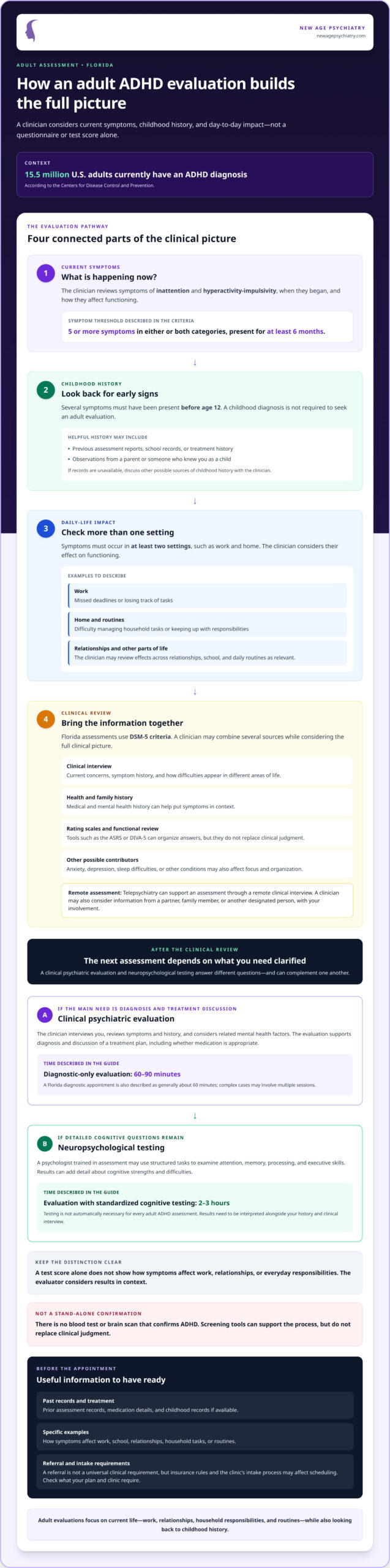
Children’s assessments often draw on observations from parents and teachers, alongside school behavior and performance. Adult evaluations focus more on work, relationships, household responsibilities, and daily routines. They also look back to childhood, because several symptoms must have been present before age 12. An estimated 15.5 million U.S. adults currently have an ADHD diagnosis, according to the Centers for Disease Control and Prevention.
Symptoms and Functional Impairment
A clinician reviews symptoms of inattention and hyperactivity-impulsivity, when they began, and how they affect functioning. Adults need five or more symptoms in either or both categories, present for at least six months, to meet the symptom threshold described in the criteria. The American Psychiatric Association states that symptoms must occur in at least two settings, such as work and home. Examples might include missed deadlines at work and difficulty managing household tasks.
How Florida clinicians help move a childhood ADHD diagnosis into adult care
A past diagnosis gives the clinician useful context, but adult care still considers present-day symptoms and their effects. Previous assessment reports, school records, or treatment history can help clarify childhood onset and what has changed over time. If those records aren’t available, the clinician can discuss other sources of history, including observations from a parent or someone who knew you as a child.
Florida assessments use DSM-5 criteria and may include a clinical interview, medical and family history, rating scales, and functional review. Tools such as the ASRS or DIVA-5 can organize answers, but they don’t replace clinical judgment. Telepsychiatry can support an assessment through a remote clinical interview. A clinician may also consider information from a partner, family member, or another designated person, with your involvement. There’s no blood test or brain scan that confirms ADHD; diagnosis depends on the full clinical picture.
Clinical psychiatric evaluation versus neuropsychological testing
A diagnostic-only adult ADHD evaluation typically takes 60-90 minutes; one with standardized cognitive testing typically takes 2-3 hours. During a clinical psychiatric evaluation, the clinician interviews you, reviews symptoms and history, and considers how ADHD may relate to anxiety, sleep problems, or another mental health disorder. That assessment supports diagnosis and discussion of a treatment plan, including whether medication is appropriate.
Neuropsychological testing takes a different approach. A psychologist trained in assessment may use structured tasks to examine attention, memory, processing, and executive skills. Results can describe cognitive strengths and difficulties, but they need to be interpreted alongside your history and clinical interview. Testing can add detail when questions involve learning, memory, or other cognitive concerns. It isn’t automatically necessary for every adult ADHD assessment.
The key difference is the purpose. A psychiatric evaluation focuses on diagnosis, relevant mental health factors, and treatment options. Neuropsychological testing offers a more detailed profile of cognitive performance. A test score alone doesn’t show how symptoms affect work, relationships, or everyday responsibilities, so the evaluator considers results in context.
In Florida, adults can start with a diagnostic clinical appointment and discuss whether further testing would answer an important question. The interview may cover when difficulties began, how they appear in different parts of life, and whether anxiety or depression could also affect concentration. Be ready to share specific examples, such as losing track of tasks or struggling to follow multistep instructions. The clinician can explain the findings and possible next steps.
When choosing between assessment types, consider what you need clarified. If your main goal is an ADHD diagnosis and a treatment discussion, a clinical evaluation may be the relevant starting point. If detailed cognitive questions remain, neuropsychological testing may provide additional information. These approaches can complement one another, but they answer different questions.
Do I need a referral to get evaluated for ADHD in Tampa?
A referral isn’t a universal clinical requirement, though insurance rules may affect scheduling. Getting an ADHD re-evaluation as an adult in Florida starts with arranging an assessment with a clinician.
Referral Requirements and Appointment Preparation
Whether you need a referral can depend on your insurance plan and the clinic’s intake process. Before booking, review your plan’s referral requirements and ask the clinic what information it needs for an adult ADHD appointment. Bring prior assessment records, medication details, and examples of how symptoms affect work, school, relationships, or household tasks. Childhood records or observations can help clarify earlier symptoms.
Getting a clinician-led adult ADHD re-evaluation in Florida
For adults getting an ADHD re-evaluation in Florida, a clinician reviews current concerns, relevant medical and mental health history, and the effects of symptoms on daily life. Be prepared to describe specific patterns, such as missed work deadlines or difficulty keeping up with household responsibilities. The clinician may also consider conditions such as depression that can affect concentration, then explain the findings and possible next steps.
A Florida diagnostic appointment generally takes about 60 minutes, though complex cases may involve multiple sessions. Some Tampa-area practices report waits of 4 to 8 weeks for new psychiatric evaluations. Some telehealth-forward practices see new patients within 1 to 3 business days to two weeks. Appointment availability and evaluation length are separate parts of the timeline.
For a Tampa telehealth appointment, use the time shown in your scheduling confirmation and plan to join from a private, quiet space. Tampa follows Eastern Time, so confirm the appointment time if you’re joining from another time zone. Keep any forms, prior records, and medication information nearby so you can answer questions accurately during the clinical interview.
Will insurance cover my ADHD evaluation?
Coverage depends on your insurance plan, the type of assessment, and whether telehealth care is included. A clinical interview and neuropsychological testing may be handled differently for benefits and billing, so identify which evaluation you’re considering before reviewing coverage.
Ask your insurer whether adult ADHD assessment is covered, whether a referral is required, and whether the clinician must be in-network. Clarify how your plan treats telehealth appointments and any follow-up visits. These details can affect your out-of-pocket costs. The price also depends on the evaluation’s scope and whether cognitive testing is included, so there isn’t one price for every assessment.
There is no universal three-visit schedule for an adult ADHD evaluation. If an assessment is arranged across three telehealth visits, they might allow time for an initial interview and history, follow-up questions or records, and a review of findings. The clinician determines the appropriate steps based on the available evidence and the questions that need answers. Ask how the assessment process is structured before scheduling.
Florida telehealth providers may assess and treat ADHD under Florida Statute § 456.47. Through December 31, 2026, no in-person exam is required for Florida ADHD telehealth. This permits a remote assessment, but it doesn’t determine what your insurance plan will cover. Insurance benefits and telehealth rules are separate considerations.
For a telehealth appointment, plan to join from a private place where you can speak openly and discuss your mental health history. Share your physical location with the clinician during the appointment, especially if you’re traveling or joining from outside Florida. This helps the clinician understand where you’re receiving care and address any location-related requirements.
Before booking, gather your insurance details and ask about coverage for the clinical assessment, follow-up, and any recommended testing. If you’re comparing a clinical evaluation with neuropsychological testing, ask how each option fits your diagnostic needs and plan benefits. A clear breakdown can help you understand the process and likely costs before care begins.
New Age Psychiatry: ADHD Diagnosis and Treatment
New Age Psychiatry provides adult ADHD diagnosis and treatment through telehealth for Florida residents. If you’re seeking a re-evaluation or want to discuss ongoing symptoms and care options, this can be a practical next step. A clinician can consider your history and current concerns as part of the diagnostic process and discuss medication management when appropriate.
Focus, sleep, anxiety, and mood can overlap in ways that complicate daily life. New Age Psychiatry also offers treatment for insomnia, anxiety, and depression, which may be relevant when these concerns affect your mental health alongside attention difficulties.
If you’d like to explore adult ADHD care, contact New Age Psychiatry to take the next step.
Choose a next step that fits your life now
Getting an ADHD re-evaluation as an adult in Florida can help you understand what support fits your current priorities, rather than simply revisiting past experiences. Think about what you want to change in daily life, such as staying organized at work, managing responsibilities at home, or improving sleep. Those priorities can guide a focused conversation about care.
New Age Psychiatry offers ADHD diagnosis and treatment, along with treatment for insomnia and depression. These services may be relevant when attention concerns overlap with sleep or mood challenges. Your next step can be a conversation about your concerns and the kind of support you’re seeking.
Start a conversation with New Age Psychiatry about adult ADHD care. You can move forward at a pace that feels right for you.
Frequently Asked Questions
Who Can Diagnose ADHD in Adults?
A qualified clinician trained in ADHD assessment can diagnose ADHD in adults. Psychiatrists and other physicians can evaluate symptoms and discuss medical factors, while psychologists can conduct diagnostic assessments and psychological testing. The right professional depends partly on whether you need a diagnosis, cognitive testing, or medication management. Before scheduling, clarify that the appointment is for adult ADHD assessment, not screening alone.
Is There a Single Test for ADHD?
No single questionnaire, scan, or laboratory result establishes an ADHD diagnosis. An assessment draws on several kinds of evidence, including your account of symptoms, history, and effects on daily activities. A rating scale can help organize information, but it can’t stand alone as a diagnosis. For example, concentration difficulties may have more than one explanation, so the clinician considers the wider clinical picture.
What should I bring to my first appointment?
Bring a photo ID, your medication list, relevant health records, and any previous ADHD assessment paperwork you can access. A short written note with examples can help you explain concerns clearly, such as repeatedly forgetting bills or losing track of conversations. If you have questions about insurance, bring your plan details too. These materials support the conversation, but you can still attend if some records aren’t available.
How to find Florida clinics offering adult ADHD testing near me
Look for a Florida clinic that assesses ADHD through clinical interviews and diagnostic criteria, rather than relying on a screening questionnaire alone. Ask about the clinic’s intake process and whether it offers neuropsychological testing if you need a detailed cognitive assessment.
How much does an adult ADHD evaluation cost in Florida without insurance