

Executive dysfunction and ADHD can overlap, but they are not the same thing. Executive dysfunction can make it difficult to plan, start, organize, or switch tasks, and it can occur with conditions other than ADHD. If you’re seeking ADHD and executive dysfunction help online, a professional assessment can look at the broader pattern when these challenges disrupt daily life, rather than focusing on one symptom alone.
Missing deadlines, losing track of tasks, or struggling to get started can leave you unsure what’s behind the problem. These challenges are real, and they don’t mean you’re lazy or not trying hard enough. Similar difficulties can have different causes, so recognizing familiar traits isn’t enough to determine whether ADHD is responsible.
This article explains executive dysfunction, how its symptoms can resemble ADHD, and what may help distinguish them. You’ll also learn why self-tests can’t diagnose ADHD and how a professional evaluation can clarify what you’re experiencing and guide care.
Key Takeaways
- Executive dysfunction can affect planning, focus, and task completion, but it isn’t the same as ADHD or a personal failing.
- Timers, calendars, written task lists, and other external supports can help make everyday demands easier to manage.
- A professional assessment considers symptom patterns and history to help clarify whether ADHD or another concern may be involved.
- Understanding the source of your difficulties can guide a more relevant approach to care and support.
What Is Executive Dysfunction?
Executive function refers to mental skills that help you manage tasks and choices. Its three main components are working memory, cognitive flexibility, and inhibitory control. Working memory helps you hold information in mind while reading instructions or following a conversation. Cognitive flexibility helps you adjust when plans change, while inhibitory control helps you pause before acting. Difficulties in these areas can make starting, organizing, or finishing everyday tasks unusually hard. That isn’t laziness or a lack of care.
Executive-function challenges can occur with ADHD, but also with depression, autism spectrum disorder, obsessive-compulsive disorder, and other conditions. Brain injury and neurological conditions, including stroke and dementia, can affect these skills too. If executive difficulties occur alongside anxiety or depression, those concerns also matter in an assessment. Understanding the cause helps guide appropriate care.
For adults with ADHD, challenges may involve attention, planning, impulse control, and managing emotions. ADHD treatment may ease executive-function difficulties for some people, but medication focused on attention may not resolve planning or organization problems. Cognitive behavioral therapy can help build time-management, planning, and organizational skills. A therapist can tailor strategies to practical situations, such as breaking a large work assignment into smaller tasks or practicing a transition between activities.
Choosing an online ADHD provider means looking for a professional who evaluates adults and explains how assessment informs care. Therapy, coaching, and evaluation are different services; coaches support practical skills, while a psychiatric evaluation addresses diagnosis and treatment. Insurance coverage for online ADHD evaluation, therapy, or coaching varies by plan and service. The price depends on the case and is given after a quote request; service type, assessment scope, and insurance benefits affect costs. To find online care in the United States, focus on a psychiatrist or therapist whose stated services include adult ADHD assessment and treatment.
Online ADHD coaching can help translate goals into manageable steps for planning, organization, and time management. A coach may help structure a calendar or break a project into smaller milestones. To build broader skills, therapy can address patterns behind task difficulties, including emotional responses and avoidance. If you’re in crisis in the United States, the National 911 Program advises calling 911, and the Substance Abuse and Mental Health Services Administration advises calling the 988 Suicide & Crisis Lifeline.
Do EF issues sound a lot like ADHD?
Yes. Trouble sustaining attention, remembering instructions, or starting tasks can appear in both ADHD and executive dysfunction. An adult might open a work document, forget the next step, then shift to unrelated tasks. That experience alone doesn’t explain its cause. ADHD involves a persistent pattern of symptoms, while executive-function difficulties can arise alongside several conditions. For ADHD diagnosis, DSM-5-TR criteria include five symptoms for people aged 17 and older, with symptoms present before age 12. A professional considers symptom history and impact, not just one missed appointment or deadline.
External supports can make tasks less dependent on memory and attention. A written list makes next steps visible, while a calendar can hold deadlines and reminders. Time blocking reserves specific periods for work, and a visual timer can help you track time. Break a large project into smaller goals, such as outlining a report before drafting each section. These tools don’t diagnose ADHD, but they can show which supports make daily tasks easier and where difficulties remain.
Support groups and accountability partners can add structure while leaving decisions in your hands. For example, you might ask a friend to check in before you begin a task, then share your progress at an agreed time. A group can offer practical ideas and a place to discuss common barriers. Keep the arrangement specific: set one goal, decide how you’ll share progress, and review whether it helps. If attention or memory problems repeatedly disrupt work, relationships, or daily responsibilities, bring those examples to a healthcare appointment.
At home, try one support at a time, such as putting a calendar somewhere visible or writing down your next action. Reassess when a strategy stops helping, your demands change, or new symptoms affect sleep or mood. If executive-function difficulties interfere with your usual activities, talk with a healthcare professional instead of relying on a self-test for answers. An assessment can consider your symptom history, daily impact, and other mental health concerns to clarify whether ADHD or another factor may be involved.
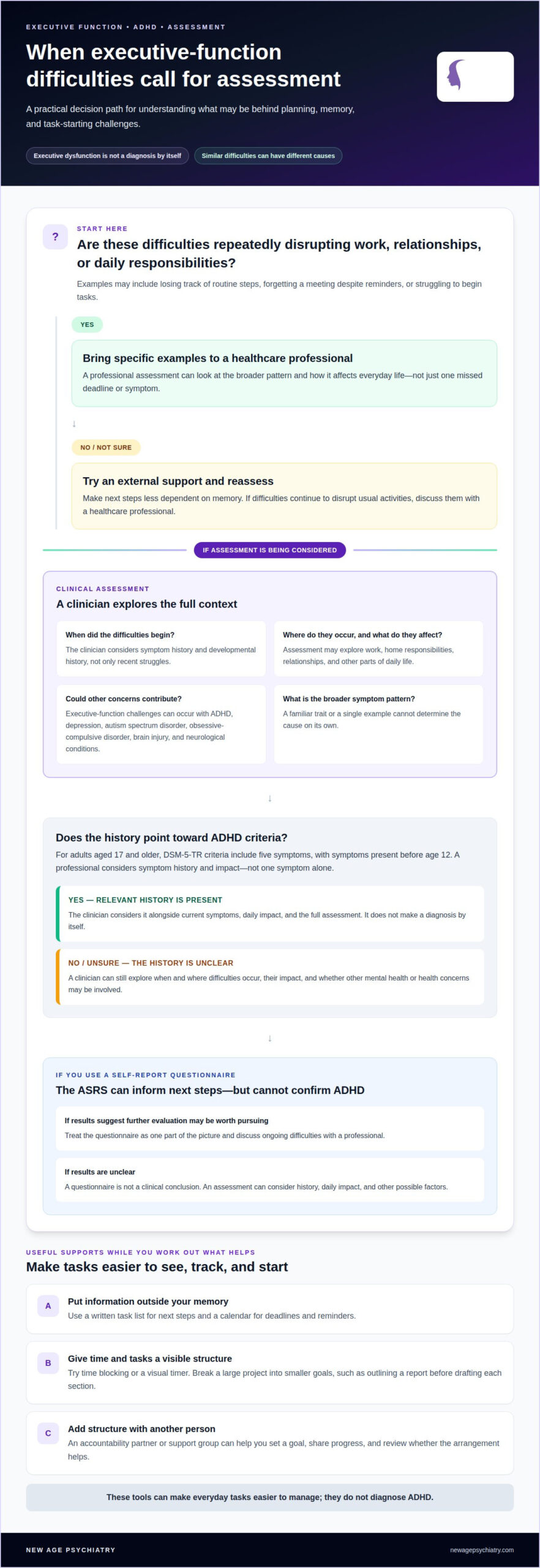
Professional assessment for adult executive dysfunction
For adults seeking ADHD and executive dysfunction help online, a clinical assessment can explore how difficulties affect work, home responsibilities, and relationships. A clinician may ask for specific examples, such as forgetting a meeting despite reminders or losing track of steps in a routine task. They’ll consider when the difficulties began, where they occur, and whether mental health symptoms or other concerns may contribute. Executive dysfunction describes challenges with skills such as working memory; it is not a standalone diagnosis.
For an ADHD diagnosis, DSM-5-TR criteria require five symptoms for people aged 17 and older, with symptoms present before age 12. An adult evaluation examines current symptoms and developmental history, rather than relying only on recent struggles. The Adult ADHD Self-Report Scale (ASRS) can suggest whether further evaluation may be worth pursuing, but it can’t confirm ADHD. A questionnaire provides one part of the picture, not a clinical conclusion.
Adults can seek an assessment when ongoing difficulties interfere with daily functioning, even if they weren’t identified earlier. The clinician may discuss school, work, relationships, and strategies you’ve already tried. Self-report questionnaires such as the BRIEF-A can measure aspects of executive function, and neuropsychological tasks may also be used. Neither a questionnaire nor a task alone establishes a diagnosis. A professional considers the results alongside your personal history and other possible explanations.
Effective ADHD and executive dysfunction help online involves more than filling out a form. Remote assessment can make it harder to review information that isn’t visible or easy to describe during a video appointment. A private setting can support a clearer conversation, while records or examples can help explain patterns over time. Telehealth prescribing depends on applicable requirements and clinical circumstances; an online appointment doesn’t automatically mean medication is appropriate or will be prescribed. The assessment helps determine whether treatment, further evaluation, or another kind of support best fits your concerns.
Executive dysfunction and ADHD symptom overlap
Executive dysfunction can be part of ADHD, but the terms don’t mean the same thing. ADHD is a recognized disorder with diagnostic criteria; executive dysfunction describes difficulties with mental processes such as planning, working memory, and inhibition. This distinction matters because similar symptoms can have different explanations. Trouble organizing a workday, for example, may reflect ADHD, another mental health concern, or a combination of factors.
The overlap is measurable in adults assessed for ADHD. In a study of 1,090 adults referred for ADHD, 44% met the cutoff for executive-function deficits. That finding shows the difficulties often occur together in this group, but it doesn’t mean everyone with ADHD has the same challenges. One person may struggle to begin tasks, while another can start readily but lose track of steps or shift between activities.
Emotional regulation can also be part of this picture. Among adults referred for ADHD who had executive-function deficits, 69% showed emotional dysregulation, compared with 23% of those without these deficits. A small setback may therefore trigger frustration that makes it harder to return to a task. The percentages describe groups, not an individual diagnosis; a clinician considers the person’s symptoms, history, and daily impact.
The practical takeaway is to look beyond a single behavior. Note whether difficulties recur across settings, how long they’ve been present, and how they affect work, relationships, or everyday routines. One missed deadline can’t explain the cause. A broader pattern, such as recurring difficulty planning, managing attention, and regulating emotions, gives a professional more useful context for assessment. This can guide care toward the underlying concern rather than treating each challenge as a lack of effort.
If these overlapping symptoms are affecting daily life, explore online ADHD assessment and treatment as a possible next step.
New Age Psychiatry: ADHD Diagnosis and Treatment
New Age Psychiatry provides ADHD diagnosis and treatment for adults seeking clarity about attention, organization, or task-management difficulties. A psychiatric assessment can help distinguish ADHD symptoms from executive-function challenges linked to other mental health concerns, then inform an individualized treatment plan.
If sleep problems, depression, or anxiety also affect your focus and daily routines, discuss them as part of your care. New Age Psychiatry provides virtual treatment for insomnia, depression, and anxiety for adults in Florida. Bringing these concerns into the conversation can help guide a more appropriate path forward.
If ongoing difficulties are affecting your everyday life, contact New Age Psychiatry to discuss ADHD diagnosis and treatment through virtual care in Florida.
Take the Next Step Toward Clarity
You don’t need to have every answer before seeking professional guidance. It’s enough to notice that a recurring difficulty is affecting your life and that you want to understand it better. Seeking ADHD and executive dysfunction help online can give you space to discuss your concerns and consider what support may fit. Start with what feels most pressing, whether that’s keeping up at work, managing daily responsibilities, or understanding changes in your attention.
Progress can begin with a clear conversation, not a perfect explanation. Share what you’ve noticed and what you hope will feel different; a professional can help shape the next steps around your needs. Contact New Age Psychiatry to discuss care. Taking that first step can help you move toward a clearer understanding of what you’re experiencing.
Frequently Asked Questions
What Are Executive Functions?
Executive functions are mental skills that help you manage behavior and work toward goals. Preparing for a meeting, for example, may mean remembering its purpose, gathering notes, and shifting attention when priorities change. These skills also help you pause before reacting to a frustrating email. Difficulties can look different from person to person, so one challenging task alone doesn’t reveal the broader pattern.
What is the difference between ADHD and executive dysfunction?
ADHD is a diagnosable disorder; executive dysfunction describes difficulty using skills such as planning, self-monitoring, or impulse control. The distinction matters because executive-function challenges can occur with conditions other than ADHD. For example, trouble organizing tasks alongside low mood may call for a broader mental health assessment. A clinician considers symptom history and daily impact to understand whether ADHD or another concern better explains the difficulties.
What online therapy options help adults with ADHD and executive dysfunction?
Adults may consider virtual psychotherapy, psychiatric evaluation, or medication management, depending on their needs. Therapy can address how task difficulties affect stress, relationships, and routines, while a psychiatric evaluation considers symptoms and possible treatment. New Age Psychiatry provides virtual psychiatric evaluations and medication management for adults in Florida, including ADHD care. It also offers virtual therapy and combined medication-management and therapy services. The right approach depends on the concern being addressed.
What are evidence-based treatments for ADHD executive dysfunction, including medication and CBT?
Treatment may include ADHD medication, psychotherapy, or both, based on clinical assessment. Cognitive behavioral therapy (CBT) can help build planning and organizational skills, while mindfulness techniques may support emotional regulation. For example, therapy can explore how frustration after an interruption affects your ability to return to a task. A qualified prescriber considers symptoms, mental health history, and treatment goals when making medication decisions.
What professional treatments and practical supports, including apps, can help adults manage executive dysfunction at home or work?
Professional care may combine psychiatric treatment with practical supports suited to your routines. Digital calendars can display appointments and deadlines; task apps can organize project steps, while timers can make work periods easier to see. These tools support follow-through, but they don’t identify the cause of your difficulties. A clinician can help determine whether treatment or additional strategies may address problems that persist at home and work.
Are there free online ADHD support groups and resources in the United States?
Free online peer groups and educational resources may be available in the United States, though their access and format vary. A support group can offer shared experiences and practical perspectives, while educational materials can help explain common ADHD concerns. Neither provides an individual diagnosis or replaces clinical care. If a resource’s advice conflicts with your treatment plan, discuss the concern with your healthcare professional.