

Stimulants aren’t the only ADHD treatment option. Adults looking for non-stimulant ADHD medication online in Florida can discuss options such as atomoxetine, viloxazine (Qelbree), guanfacine ER (Intuniv), and clonidine ER (Kapvay) with a psychiatric provider. These medications aren’t scheduled controlled substances, but a clinical evaluation is needed to determine whether treatment is appropriate.
It’s understandable to want clear information before considering medication. Non-stimulants work differently and may take time to have an effect. The right option depends on your symptoms, health history, and treatment goals.
This guide explains non-stimulant ADHD medications, compares atomoxetine and Qelbree, and describes options that may be considered through Florida telehealth. It also covers how an ADHD evaluation and medication management can inform a treatment plan.
Key Takeaways
- See how atomoxetine and Qelbree differ, including why their onset and treatment history may matter when considering options.
- Learn what an online ADHD evaluation in Florida involves and how telehealth rules affect medication decisions.
- Understand how guanfacine and clonidine fit among non-stimulant choices, along with their potential side effects and time to benefit.
- Explore how an ADHD diagnosis and medication management can help shape a treatment plan around your needs.
What’s the difference between atomoxetine (Strattera) and Qelbree (viloxazine)?
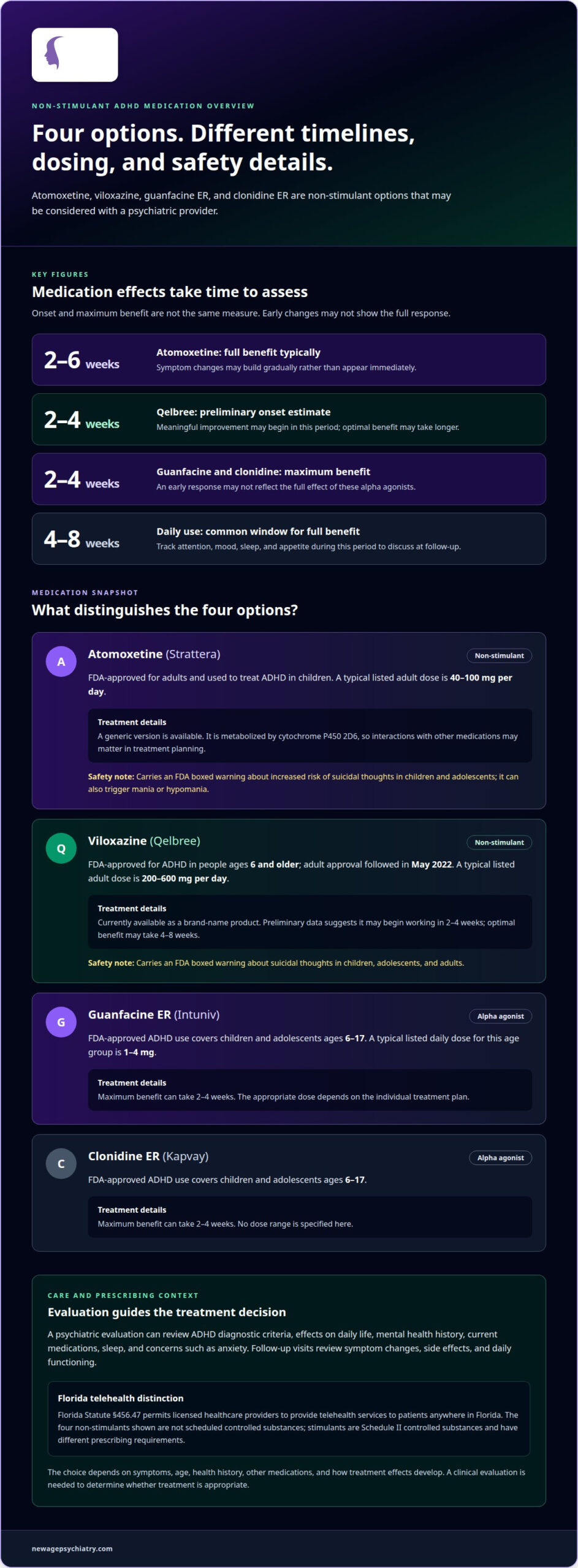
Atomoxetine (Strattera) and viloxazine (Qelbree) are non-stimulants; guanfacine and clonidine are alpha agonists. All four may be considered for ADHD, but they differ in medication class, approval details, and how soon benefits may appear.
Atomoxetine is a non-stimulant medication used to treat ADHD in children. It is also FDA-approved for adults and is not a stimulant like Vyvanse. For adults, a typical listed dose is 40-100 mg per day. Its full benefit typically takes 2-6 weeks, so changes in symptoms may build gradually rather than appear immediately.
Qelbree received FDA approval for ADHD in 2021 for people ages 6 and older; the FDA approved it for adults in May 2022. A typical listed adult dose is 200-600 mg per day. Preliminary data suggests viloxazine may begin working in 2-4 weeks. Qelbree is currently available as a brand-name product, while atomoxetine has a generic version.
Side effects and safety considerations also differ. Atomoxetine can trigger mania or hypomania, and it carries an FDA boxed warning about increased risk of suicidal thoughts in children and adolescents. Viloxazine carries a boxed warning about suicidal thoughts for children, adolescents, and adults. Atomoxetine is metabolized by cytochrome P450 2D6, so interactions with other medications may matter during treatment planning.
Guanfacine ER (Intuniv) and clonidine ER (Kapvay) offer another non-stimulant approach as alpha agonists; their FDA-approved ADHD use covers children and adolescents ages 6-17. Clonidine and guanfacine take 2 to 4 weeks to provide maximum benefit. The choice among these medicines depends on symptoms, age, other medications, and how treatment effects develop over time.
Can you treat ADHD without stimulants?
Yes. Non-stimulants are an option for treating ADHD, and Florida telehealth can provide psychiatric evaluations and medication management. Medication type matters because prescribing requirements differ for non-stimulants and controlled stimulants.
Online Treatment Availability and State Restrictions
Online ADHD care uses telehealth for psychiatric evaluation and follow-up, with Florida rules applying to patients located in the state. Florida Statute §456.47 permits licensed healthcare providers to provide telehealth services to patients anywhere in Florida, according to the Florida Legislature. This gives Florida residents a remote route to care while keeping treatment within state requirements.
Non-stimulants such as atomoxetine and clonidine aren’t scheduled controlled substances. Stimulants are Schedule II controlled substances. DEA rules for controlled-substance prescribing require a valid registration and an initial evaluation using real-time audio-visual technology. This distinction affects the evaluation process and what can be prescribed remotely.
Physician Supervision and Treatment Decisions
A psychiatric evaluation considers whether symptoms meet ADHD diagnostic criteria and how they affect daily life. The clinician reviews your mental health history, current medications, sleep, and concerns such as anxiety. This information can help distinguish ADHD symptoms from other challenges and guide treatment planning.
Follow-up visits allow the clinician to review symptom changes, side effects, and daily functioning during medication management. For example, changes in sleep or mood after starting treatment are useful to discuss. Telehealth makes these visits remote, while medication decisions continue to depend on assessment and ongoing care.
Medication Onset and Treatment Duration
Non-stimulants need consistent daily use before their full effect becomes clear. Most take 4-8 weeks of daily use to show full therapeutic benefit. Qelbree can show meaningful improvement in 2-4 weeks, while optimal benefit may take 4-8 weeks. Early changes don’t necessarily reflect the full response.
During the first 4-8 weeks, track attention, mood, sleep, and appetite. These observations give the clinician practical information for follow-up and treatment decisions. For guidance on ADHD treatment options, an evaluation can connect symptoms with a considered plan.
What Counts as ADHD Medication?
ADHD medications include stimulants such as Adderall and non-stimulants such as guanfacine and clonidine. They differ in medication class, approval, and safety considerations, so diagnosis and health history are important when considering treatment.
Alpha Agonist Side Effects and Effectiveness
Guanfacine and clonidine are alpha agonists used as non-stimulant ADHD medications. Their maximum benefit can take 2 to 4 weeks, so an early response may not reflect the full effect.
Side effects are part of the treatment discussion, and their type and impact vary. At follow-up, describe any symptom changes or unwanted effects. This helps the prescriber assess how the medication is working and whether the plan needs adjustment.
Guanfacine ER Uses and Side Effects
Guanfacine ER, sold as Intuniv, is FDA-approved for ADHD in children and adolescents ages 6-17. A typical listed daily dose for this age group is 1-4 mg. The appropriate dose depends on the treatment plan, rather than a dose being selected from a general range.
Patients and prescribers can review side effects and symptom changes together at follow-up. This is useful when the treatment plan includes another medication, since the combination can affect how care is assessed. Guanfacine and clonidine aren’t scheduled controlled substances.
Medication Warnings and Appetite Changes
Boxed warnings provide important safety information; they aren’t a diagnosis or a prediction about an individual patient. Atomoxetine carries an FDA boxed warning about increased suicidal thoughts in children and adolescents; viloxazine carries one for children, adolescents, and adults.
Appetite is another change to track during treatment. For the first 4-8 weeks of non-stimulant ADHD medication, monitoring appetite alongside attention, mood, and sleep can give the prescriber useful context. If Adderall or another medication is also being considered, discuss the full medication list and any combination during the prescribing conversation.
Non-stimulant ADHD medications available through Florida telehealth
Florida residents can discuss non-stimulant ADHD medication through telehealth with a provider licensed to treat patients in the state. For adults exploring non-stimulant ADHD medication online in Florida, an evaluation can help connect symptoms, health history, and treatment priorities with appropriate options.
Options include atomoxetine, viloxazine (Qelbree), guanfacine ER, and clonidine ER. These medicines aren’t scheduled controlled substances. Atomoxetine and viloxazine affect norepinephrine pathways, while guanfacine and clonidine are alpha agonists. Their different medication classes mean they aren’t interchangeable, though each may be considered for ADHD.
Atomoxetine and Qelbree are FDA-approved for adults and children ages 6 and older. Intuniv (guanfacine ER) and Kapvay (clonidine ER) are FDA-approved for ADHD in children and adolescents ages 6-17. For adults seeking non-stimulant ADHD medication online in Florida, the evaluation should account for age-specific approvals and individual clinical needs. A prescriber weighs symptoms, current medications, and possible side effects when discussing a treatment plan.
Which online ADHD providers serve patients in Florida and prescribe non-stimulants? New Age Psychiatry provides completely virtual psychiatric evaluations and medication management for adults in Florida. A clinician can assess ADHD and consider medication options based on clinical findings, rather than a request for a specific medicine.
Does insurance cover non-stimulant ADHD medications and telehealth visits in Florida? Florida’s telehealth parity law requires commercial insurers to cover telehealth services when they would cover the same service in person. This applies to telehealth service coverage; prescription coverage depends on the terms of the patient’s plan.
Telehealth provides a remote way to access evaluation and medication management, while clinical assessment guides treatment choices. Describing how ADHD affects work, home routines, or relationships gives the clinician useful context for discussing options.
New Age Psychiatry: ADHD Diagnosis and Treatment
New Age Psychiatry provides completely virtual ADHD diagnosis and medication management for adults in Florida, including evaluation of non-stimulant options. An assessment can consider ADHD symptoms, mental health history, current medications, and how attention difficulties affect daily life. This helps shape a treatment discussion around your needs, not just a medication name.
Insomnia, depression, or anxiety can also affect concentration and may be relevant to a broader psychiatric assessment. Discussing these concerns alongside ADHD symptoms can help clarify treatment priorities and support coordinated care.
If you’re ready to discuss ADHD evaluation and treatment, contact New Age Psychiatry.
Choose a Next Step That Fits Your Needs
Searching for non-stimulant ADHD medication online in Florida can begin a broader conversation about attention, daily routines, and mental health. Bring your concerns to an evaluation so treatment decisions can reflect your experiences and priorities.
New Age Psychiatry offers ADHD Diagnosis and Treatment, along with Insomnia Treatment and Depression Treatment. These concerns can overlap and affect concentration and wellbeing, so sharing the full picture can help guide care. You don’t need to choose a medication before your evaluation.
Contact New Age Psychiatry today to discuss ADHD evaluation and treatment. Taking that first step can help you move toward a plan that feels informed and manageable.
Frequently Asked Questions
What is Qelbree and how does it work?
Qelbree is the brand name for viloxazine, a prescription non-stimulant medication for ADHD. It affects brain signaling involved in attention and is not a scheduled controlled substance. Qelbree is FDA-approved for ADHD in people ages 6 and older, including adults. Medication selection and monitoring take into account symptoms, other medicines, and changes in mood or daily functioning.
What is a non-stimulant medication?
A non-stimulant medication treats ADHD without being classified as a stimulant. Options include atomoxetine, viloxazine, guanfacine ER, and clonidine ER. These medicines aren’t scheduled controlled substances. They may require consistent use before their full effects become clear, rather than having an immediate effect. The medication and follow-up plan depend on clinical evaluation.
Who Can Prescribe ADHD Meds via Telehealth in Florida?
A provider licensed to deliver telehealth care in Florida may evaluate patients and prescribe medication within their professional authority. Prescribing follows clinical assessment, not simply a request for a specific medicine. An evaluation considers symptoms, health history, and current medications. Controlled medications have additional prescribing requirements, so medication type matters to the telehealth process.
Which non-stimulant medications are FDA-approved for ADHD in adults and children?
Atomoxetine and Qelbree (viloxazine) are FDA-approved for ADHD in adults and children ages 6 and older. Intuniv (guanfacine ER) and Kapvay (clonidine ER) are FDA-approved for ADHD in children and adolescents ages 6-17. Approval depends on the specific medicine and age group; these options aren’t interchangeable. A prescriber considers the person’s symptoms and health factors when discussing them.
Can Florida providers prescribe ADHD medication through online telehealth visits?
Yes. Florida providers may prescribe ADHD medication through telehealth after an appropriate clinical evaluation. Requirements differ by medication type: non-stimulants such as atomoxetine aren’t scheduled controlled substances, while stimulants are Schedule II controlled substances. This distinction affects prescribing requirements. An online visit supports evaluation and treatment planning, but medication decisions are based on the patient’s clinical needs.
What Florida rules apply to prescribing non-stimulant ADHD medications online?
Florida Statute §456.47 permits licensed healthcare providers to provide telehealth services to patients located anywhere in Florida, according to the Florida Legislature. Non-stimulant ADHD medications listed here aren’t scheduled controlled substances. Requirements involving controlled-substance prescribing, such as checking E-FORCSE, concern controlled medications rather than these non-stimulants. The provider still conducts an evaluation and makes prescribing decisions within applicable professional standards.