If you’re wondering how to get diagnosed with OCD online, start by separating an online screening from a clinical assessment. A screening can highlight symptoms, but Mental Health America says its online screening tools aren’t diagnostic instruments. A mental health professional can evaluate your symptoms and determine whether they meet the criteria for OCD.
It’s understandable to want a clear answer when intrusive thoughts or repeated behaviors affect your day. An online test can be a useful starting point, but its score can’t capture the full context of what you’re experiencing.
This article explains what OCD screening results can and can’t tell you, what kinds of symptoms may warrant support, and how to share your results with a mental health professional. You’ll also learn what to expect from a clinical assessment, so you can take the next step with more clarity and less uncertainty.
Key Takeaways
- Use an online screening score as a starting point, and look at which symptom themes contribute to it.
- Notice whether symptoms cause distress or interfere with your time and daily functioning; those details add important context.
- When discussing results, bring examples of what you experience and how it affects you, rather than relying on the score alone.
- A clinician can assess symptoms in an interview and may use the Yale-Brown Obsessive Compulsive Scale to evaluate severity.
How accurate is an online OCD test?
An online OCD assessment can help you recognize patterns and decide whether to seek support, but it cannot confirm a diagnosis. Mental Health America says online screening tools are not diagnostic instruments. A clinician evaluates your symptoms, their impact, and other possible explanations before diagnosing OCD. Unwanted thoughts or repeated habits alone don’t establish the condition.
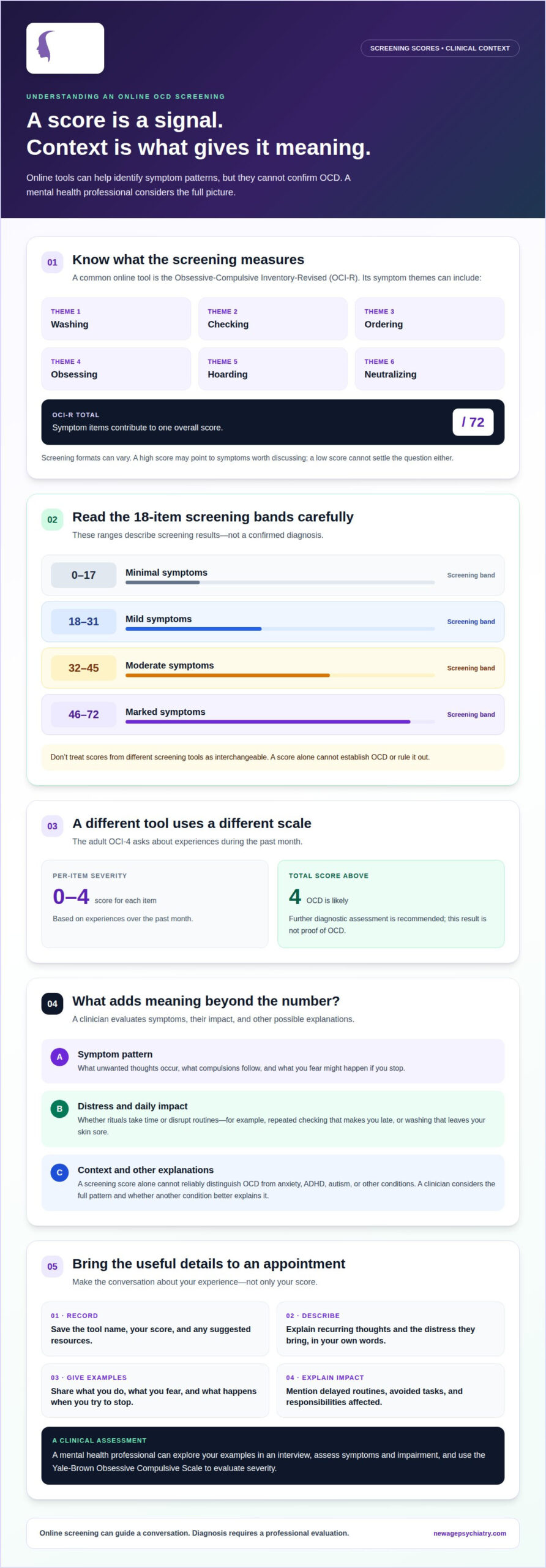
A common online screening uses the Obsessive-Compulsive Inventory-Revised, or OCI-R. An online screening may ask about different symptom patterns, but its format can vary. The themes are washing, checking, ordering, obsessing, hoarding, and neutralizing. The symptom items contribute to a total score out of 72. A high score can point toward symptoms worth discussing, but a low score can’t settle the question either.
OCD warning signs can involve a cycle: an unwanted thought creates distress, and a compulsive action briefly eases it. For example, someone may repeatedly check a locked door to reduce fear that a break-in could harm a relationship. A test may identify patterns such as checking or washing, but it can’t show what the thoughts mean to you, how much time rituals take, or what else may explain them.
OCD can look different across adults and children. A child might repeatedly seek reassurance, avoid certain objects, or feel compelled to arrange toys in a particular order. OCD often first develops in children between six and nine years old, though children as young as five can develop it. A child’s online symptom checker may help a parent prepare examples for a professional, but it cannot diagnose OCD.
So, how does an online OCD assessment and diagnosis work? You answer screening questions, review the result as a symptom guide, then discuss your experiences with a mental health professional. A clinical interview provides the evaluation needed for diagnosis and helps guide treatment, such as therapy or medication. If you have thoughts of harming yourself, call or text 988 for immediate support, according to the Substance Abuse and Mental Health Services Administration.
Distress and interference with daily life
A screening score gains meaning when you connect it to distress and daily functioning. Consider a washing ritual that delays leaving home, or unwanted thoughts that disrupt sleep and concentration. The obsessive-compulsive disorder criteria in the DSM-5-TR consider the symptom pattern and its impact, not a score alone. Note what happens, how you respond, and what activities become harder.
Scores depend on the screening tool, so don’t treat different scales as interchangeable. On the 18-item symptom screening, scores range from 0-17 for minimal symptoms, 18-31 for mild, 32-45 for moderate, and 46-72 for marked symptoms. These bands describe screening results, not a confirmed diagnosis. A person’s distress and impairment still need discussion in context.
The adult OCI-4 uses a different scoring approach. Each item receives a severity score from 0 to 4, based on experiences during the past month. A total score greater than 4 means OCD is likely and further diagnostic assessment is recommended. That result signals a reason to explore symptoms, not proof of having the disorder.
How is OCD distinguished from anxiety, ADHD, autism, or other conditions in an online evaluation? A screening score alone can’t reliably separate them. A clinician considers the content of unwanted thoughts, compulsions, distress, effects on daily life, and whether another condition better explains the pattern.
What questions and screening tools are used to diagnose OCD? Screenings ask about symptom experiences and their frequency or severity; the OCI-4 asks adults about distress during the past month. A structured clinical interview then explores examples, context, and impairment alongside DSM-5-TR criteria.
Use results to guide a focused conversation. Bring the tool’s name, your score, and examples, such as repeated checking that makes you late or washing that leaves your skin sore. Describe what you avoid and which responsibilities are affected. These details help a professional interpret the score and decide what assessment should follow.
Sharing screening results with a healthcare provider
After receiving an online OCD “diagnosis,” treat the result as a screening signal, not a confirmed diagnosis. Arrange an assessment with a mental health professional and bring the test name, score, and examples of how your experiences affect daily life.
- Save the result and tool name. Record the score and any suggested resources, so your provider can understand what the online OCD test measured.
- Describe recurring thoughts in your own words. For example, explain whether an unwanted thought returns, what distress it brings, and what you do afterward.
- Give specific examples of compulsions. Describe what you perform, such as checking an appliance repeatedly, and what you fear might happen if you stop.
- Explain the effect on daily routines. Mention concrete experiences, such as arriving late after repeated checks or avoiding a task because it triggers distress.
- Bring questions about the result. Ask which answers influenced the screening score and whether another condition could help explain those experiences.
The Mental Health America OCD screening asks how much certain experiences distressed or bothered you during the past month. If you complete it, note which answers felt difficult to explain or didn’t reflect your experience. A score can’t show the context behind each response. During an appointment, those details help move the conversation beyond the number to your symptoms, history, and daily functioning.
Screening results may point you toward educational articles or other resources. Use them to prepare questions, not as a treatment plan or proof of obsessive-compulsive disorder. If a resource describes a symptom you recognize, write down a recent example and how it affected you. That gives a provider something specific to explore during an assessment.
Share the full picture, including answers that seem inconsistent or uncertain. A professional can ask follow-up questions and assess whether your symptoms fit OCD or another explanation. This turns an online result into a more informed discussion about diagnosis and possible next steps.
Clinical diagnosis by a mental health professional
Seek an evaluation when intrusive thoughts or rituals cause distress or disrupt work, relationships, or daily routines. A mental health professional reviews your symptoms, their impact, and whether another condition could better explain them. For adults wondering how to get diagnosed with OCD online, a screening result can help organize concerns, but an evaluation needs to consider your full experience.
A clinical diagnosis involves a comprehensive interview and symptom evaluation. The clinician asks about unwanted thoughts, compulsive behaviors, distress, and effects on everyday activities. The DSM-5-TR provides diagnostic criteria, while the Yale-Brown Obsessive Compulsive Scale can help assess severity. A clinician administers that scale during an interview, rather than using it as an independent online screening questionnaire.
OCD can be diagnosed through an online appointment when a mental health professional conducts a thorough clinical interview and evaluates symptoms. Knowing how to get diagnosed with OCD online means understanding that the professional assessment happens during the appointment, not through a self-test. The clinician considers symptom patterns, distress, daily functioning, and other possible explanations.
A telehealth provider may discuss medication after an OCD diagnosis, but a diagnosis doesn’t automatically mean medication will be prescribed. The clinician considers the evaluation and whether medication fits your care needs.
Psychiatrists, psychologists, and social workers can assess mental health symptoms. For an online OCD evaluation, the professional should explore your symptoms, distress, and daily functioning rather than rely on a screening score alone. This helps distinguish OCD from anxiety or other possible explanations. A useful appointment also leaves room to discuss questions about the assessment and what the findings mean.
Before your appointment, think through an intrusive thought, a related ritual, and how each affects your day. These examples can make the clinical conversation more specific. If you’re ready to discuss an evaluation and possible next steps, schedule an online mental health appointment.
New Age Psychiatry
New Age Psychiatry can help you explore mental health concerns that may accompany questions about OCD. If attention difficulties, sleep problems, depression, or anxiety are also affecting daily life, its offerings include ADHD diagnosis and treatment, insomnia treatment, depression treatment, and anxiety treatment. Sharing your screening result and specific examples can help guide a conversation about which concerns need attention. An online screening score alone can’t establish a diagnosis, so use it as context for discussing your experiences with a mental health professional. If you’d like support with the concerns listed here, contact New Age Psychiatry to discuss your next step.
Take the next step with confidence
Seeking an answer matters, even if your thoughts or symptoms feel difficult to explain. You don’t need perfect words or a complete record to start a conversation. A few notes about what concerns you and what support you’re hoping for can help you begin. Understanding how to get diagnosed with OCD online can start with discussing those concerns with a professional.
If you’re considering how to get diagnosed with OCD online, focus on arranging a professional assessment rather than relying on a screening result alone. New Age Psychiatry provides adult psychiatric care in Florida, including ADHD diagnosis and treatment, insomnia treatment, and depression treatment. Discuss your concerns and possible next steps in a conversation focused on your needs.
Taking this step doesn’t commit you to a particular decision. It gives you space to ask questions and explain what kind of support you’re seeking. When you feel ready to discuss how to get diagnosed with OCD online, contact New Age Psychiatry for support. You deserve thoughtful care and a clear path forward.
Frequently Asked Questions
How do doctors test for OCD?
Doctors assess OCD through a clinical interview, not a single test. They ask about recurring thoughts, rituals, distress, and effects on everyday activities. An OCI-R screening can help organize symptom information, while the Yale-Brown Obsessive Compulsive Scale helps a clinician assess severity during an interview. Bring examples of what happens before and after a ritual, such as what prompts repeated checking.
What are the symptoms of OCD?
OCD involves obsessions, compulsions, or both. Obsessions are recurring, unwanted thoughts or urges that cause distress; compulsions are actions or mental rituals performed to reduce that distress. Examples include repeated washing, checking, arranging, or seeking reassurance. Themes vary between people, so focus on how the thoughts and behaviors affect your choices, routines, or relationships.
Can this screening provide a formal OCD diagnosis?
No. Mental Health America states that its online screening tools are not diagnostic instruments. A screening result can help you identify experiences to discuss, but it cannot establish whether you have obsessive-compulsive disorder. A score, for example, may reflect reported symptoms without explaining their context. Use your answers to prepare for a clinical conversation, not as a diagnosis.
How do doctors usually diagnose OCD?
Doctors usually diagnose OCD by evaluating symptoms through a comprehensive clinical interview. They ask how recurring thoughts and behaviors present in your life, the distress they cause, and how they affect daily functioning. They also consider whether another condition better explains the experiences. The DSM-5-TR provides diagnostic criteria, and a clinician may use the Yale-Brown scale to assess symptom severity.
What type of licensed clinician can diagnose OCD online?
A qualified mental health professional, such as a psychiatrist, psychologist, or social worker, can conduct an OCD evaluation. In an online appointment, the clinician needs to discuss your symptoms and their effects rather than rely on a questionnaire alone. Adults in Florida seeking psychiatric evaluation can discuss OCD concerns through New Age Psychiatry’s completely virtual care, which focuses on adult psychiatric diagnosis and treatment.
What are the limitations or risks of getting an OCD diagnosis online?
An online questionnaire cannot confirm OCD, and a score alone can miss important context. Brief answers may not capture how symptoms affect work, relationships, or daily responsibilities, and similar experiences can have different explanations. A useful online evaluation gives you time to describe examples and answer follow-up questions. If an appointment focuses only on a test result, explain what the score leaves out.