

What if the right online psychiatrist isn’t the one with the fastest sign-up, but the one whose expertise and follow-up fit your needs? If you’re wondering how to find the right online psychiatrist for you, look beyond convenience. Comparing clinicians and services can feel complicated, especially when you’re weighing privacy, medication management, and whether virtual visits will feel personal and consistent.
You deserve clear answers before taking the next step. This guide offers a practical way to assess a psychiatrist’s qualifications and experience, the concerns they address, how they communicate, and what ongoing care may involve. You’ll also learn why state eligibility and treatment scope matter, so you can compare options with more confidence.
We’ll cover the details that shape a good fit, from the initial evaluation to follow-up care. New Age Psychiatry provides virtual psychiatric evaluations and medication management for adults in Florida, including care for ADHD, insomnia, depression, anxiety, OCD, and PTSD. Use the steps ahead to identify your priorities and make an informed choice.
Key Takeaways
- To understand how to find the right online psychiatrist for you, start with your care needs and compare them with each clinician’s expertise and scope.
- Check the clinician’s professional role, relevant experience, and eligibility to provide care where you’ll be during appointments.
- Compare communication, privacy, continuity, and practical access, not just how easy it is to book a visit.
- Prepare for an initial conversation by noting your goals, symptoms, health history, medications, and questions about follow-up.
- New Age Psychiatry provides virtual evaluations and medication management for adults in Florida.
How to Find the Right Online Psychiatrist: Start With the Care You Need
Comparing clinicians can feel like a project of its own, especially if you haven’t sought psychiatric care before. Online psychiatry is psychiatric evaluation and care delivered remotely by a qualified clinician. Virtual appointments can be easier to fit into your routine, but convenience alone doesn’t determine whether a clinician is right for you. Your needs, the clinician’s scope, communication style, and follow-up plan all matter.
Psychiatrists assess mental health concerns and may provide medication management. Psychotherapy, sometimes called talk therapy, focuses on working through thoughts, feelings, and behavior with a therapist. These approaches address different needs and may complement each other. For more on the virtual-care format, see Telepsychiatry on Wikipedia. As you consider how to find the right online psychiatrist for you, begin by getting clear on the kind of support you want.
Clarify what you want help with
You don’t need to arrive with a diagnosis or a polished explanation. Note what you’ve noticed, when it started, how it affects daily life, and what you hope could change. Include previous care, current medications, and questions you want to raise. These details give a clinician useful context without requiring you to decide what your symptoms mean.
More than one concern may shape an evaluation. For example, difficulty sleeping can occur alongside anxiety or low mood. A clinician can consider the full picture rather than focusing on one symptom in isolation. You might write, “I’m struggling to concentrate and my sleep has changed,” instead of trying to label the cause. Your notes are a starting point for discussion, not a self-diagnosis.
Decide whether virtual psychiatric care matches your situation
Remote appointments let you speak with a clinician without traveling to an office, which may make care easier to fit into your routine. Virtual care may be appropriate when your needs can be assessed and supported remotely. Suitability depends on your circumstances and the clinician’s scope, so consider whether the service addresses the concerns you want to discuss.
Think about what would help you communicate comfortably: a private place to speak, a stable internet connection, and notes nearby. Also consider the kind of care you’re seeking. Psychiatric evaluation and medication management differ from psychotherapy, even though both can support mental health. Knowing the distinction helps you choose a service that matches your goals rather than assuming every online mental health service offers the same care.
Virtual psychiatry is not emergency care. If you’re in immediate danger, may harm yourself or someone else, or need urgent help, contact local emergency services or a crisis support service now rather than waiting for a scheduled appointment. For non-urgent concerns, identifying what you want help with is a useful first step toward a focused conversation with a clinician.
Check an Online Psychiatrist’s Credentials, Specialty, and Scope
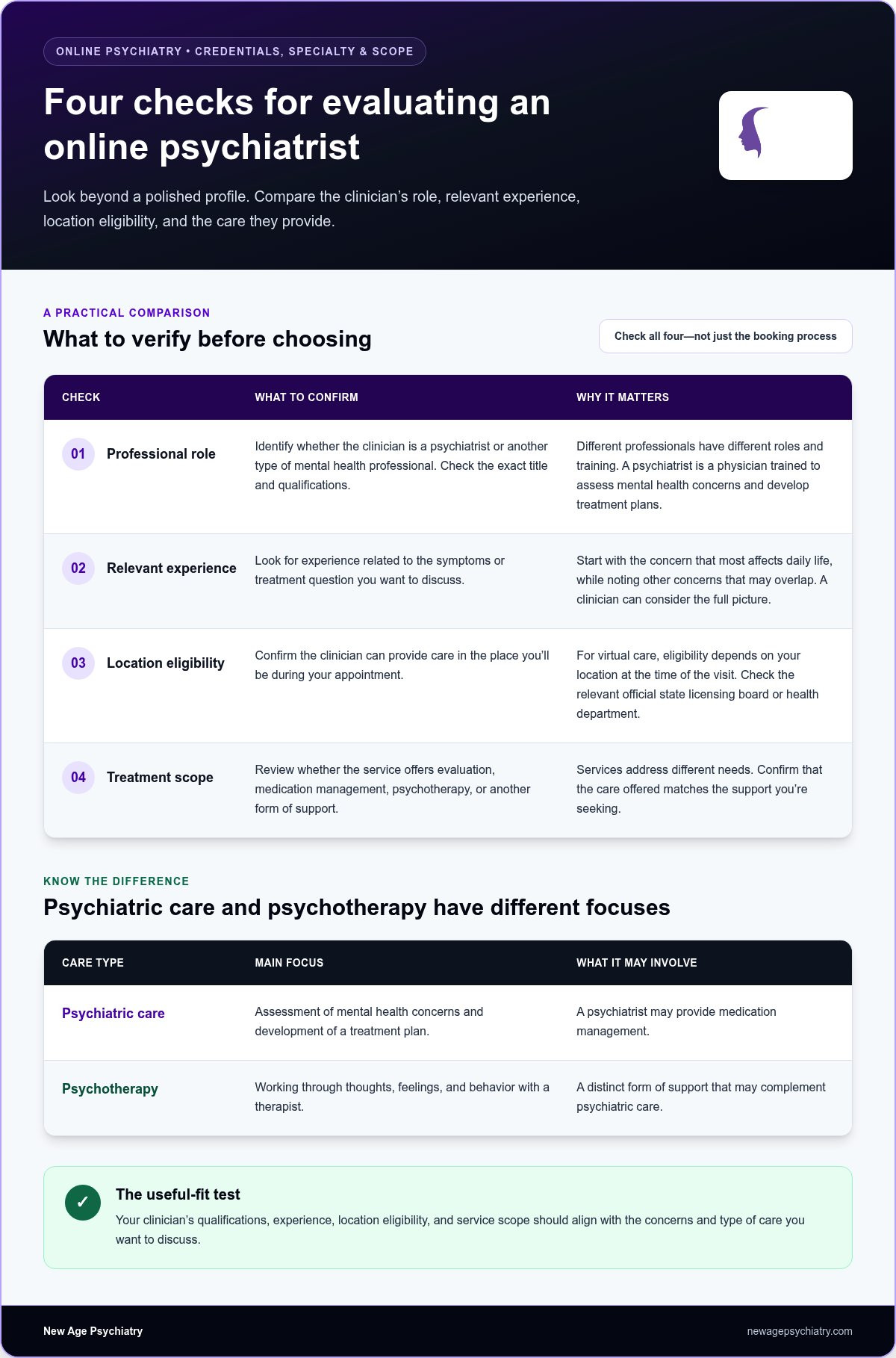
A polished profile doesn’t tell you everything you need to know. Compare clinicians by looking at four things: professional role, experience related to your concern, eligibility to provide care where you’ll be during appointments, and the services they provide. This gives you a clearer picture than broad claims about treating many conditions.
A psychiatrist is a physician trained to assess mental health concerns and develop treatment plans, which may include medication management. Other mental health professionals have different roles and training, so check the clinician’s exact title and qualifications. Verify their license through the relevant official state licensing board or health department. For virtual care, confirm that the clinician can see patients in your location.
- Confirm the professional role. Identify whether the clinician is a psychiatrist or another type of mental health professional.
- Look for relevant experience. Find information related to the symptoms or treatment question you want to discuss.
- Check location eligibility. Make sure the clinician can provide care where you’ll be at the time of the appointment.
- Understand the scope. Review whether the service focuses on evaluation, medication management, psychotherapy, or another form of support.
Match clinical experience to your main concern
Start with the concern that most affects your daily life, but don’t assume it’s the only relevant one. Look for experience connected to your primary symptoms or treatment question. If concentration problems, sleep changes, or anxiety overlap, mention the full picture. A clinician can consider how concerns relate rather than treating each in isolation.
For instance, if attention difficulties are prompting you to seek an assessment, it may help to understand what an evaluation can involve. New Age Psychiatry’s adult ADHD diagnosis and treatment guide offers background for adults exploring this concern. Specialty relevance is about finding care aligned with your needs, not choosing the profile with the longest list of conditions.
Understand the clinician’s role and treatment scope
Psychiatric evaluation and medication management are distinct from ongoing psychotherapy. An evaluation helps a clinician understand symptoms, history, and possible treatment needs. Medication management involves assessing and monitoring medication as part of care. Psychotherapy focuses on therapeutic conversations and strategies. These forms of support serve different purposes, and one doesn’t make the other less valuable.
Read the service description to understand the type of care it provides, then consider whether it matches what you want help with. If OCD is your main concern, for example, New Age Psychiatry’s online OCD medication management guide explains one part of psychiatric care. Questions about the evaluation process and follow-up can help you understand how the service fits your needs.
New Age Psychiatry provides remote psychiatric evaluation and medication management for adults in Florida. Explore New Age Psychiatry’s virtual psychiatric care and consider how its services relate to your concerns and goals.
Compare Online Psychiatry Options Beyond Convenience
A convenient appointment is a useful starting point, but it won’t tell you what care looks like after the first visit. Compare clinical fit, communication, continuity, privacy, and practical access together. A useful comparison considers both clinical scope and continuity. A service may address your main concern, yet its follow-up approach may not match the support you’re looking for.
| What to compare | What to look for |
|---|---|
| Clinical fit | Does the service address your concern and explain the kind of psychiatric care it provides? |
| Communication | Can you ask questions, understand the responses, and discuss care choices respectfully? |
| Continuity | Is there a clear plan for follow-up, medication monitoring, and prescription refill requests? |
| Privacy | Are privacy practices explained, and can you attend visits in a setting where you feel comfortable speaking? |
| Practical access | Do appointment options, location eligibility, insurance details, and payment arrangements work for your circumstances? |
Use the same questions for each option, and note where you have clear answers or need more information. Insurance participation, payment arrangements, appointment availability, and refill processes vary. Review the service’s stated policies and applicable plan details rather than assuming a visit is covered or that prescriptions are handled in a particular way.
Assess communication and shared decision-making
Notice whether the clinician explains options in plain language and makes room for your questions. A collaborative conversation should help you understand the reasoning behind a care plan and share your preferences, without promising a particular medication or outcome. Respect matters, too. You should feel able to describe your concerns without being dismissed or judged.
Compare continuity, privacy, and practical access
Ask how follow-up visits are arranged, how medication monitoring works, and how to submit refill requests. Clarify what communication is available between visits and what response times or boundaries apply. Knowing these details helps you understand what to expect and whether the care can feel consistent over time.
Review the service’s privacy practices and choose a private place for appointments where you can speak openly. For a condition-specific example, the telehealth depression care guide explores virtual psychiatric support for depression. You can also explore New Age Psychiatry’s virtual psychiatric care for adults in Florida.
This comparison can make how to find the right online psychiatrist for you feel more manageable: focus on the care offered, how communication works, and whether follow-up and access fit your needs.
Questions to Ask Before Starting Online Care
A first conversation can help you understand whether the clinician’s approach and service scope fit your needs. It’s also a chance to share concerns and ask for clearer explanations. You don’t need to know exactly what care you need before speaking with a clinician, and an initial discussion doesn’t guarantee a diagnosis, prescription, or particular treatment. Treat it as an opportunity to exchange information and understand possible next steps.
Bring useful information without over-preparing
A few notes can help you explain what’s been happening, but they don’t need to be complete. Write down when your concerns began, how they affect daily life, and what you hope to get help with. Include current medications and supplements, prior diagnoses, and relevant treatment history. If you don’t remember a detail, say so. A clinician can guide the discussion and ask follow-up questions.
Before the appointment, consider saving these prompts in a note:
- Goals: What would you like support with, or understand better?
- Symptoms: What have you noticed, when did it begin, and how does it affect your routine?
- History: What previous care, diagnoses, or treatments might be relevant?
- Medications: What prescriptions, over-the-counter medicines, or supplements do you currently take?
- Questions: What do you want to know about the evaluation, treatment options, follow-up, or the clinician’s scope?
Recognize signs of a supportive care relationship
Pay attention to how the clinician responds. Supportive communication includes listening carefully, explaining information in understandable language, and taking your questions seriously. You should be able to raise a concern respectfully, even if you’re unsure how to phrase it. Treatment decisions should reflect clinical judgment and your individual circumstances, not a promise of a specific medication or result.
Use the conversation to clarify practical details, too. You might ask:
- What does the evaluation involve, and what information will help you understand my concerns?
- What might follow-up look like, and how are medication questions or refill requests handled?
- How can I communicate between appointments, and what should I expect about response times?
- What privacy practices apply to virtual appointments?
- Which concerns does your psychiatric care address, and what falls outside its scope?
Clear answers can help you decide whether to continue, take time to consider, or seek a different kind of support. If the conversation feels rushed or you leave uncertain about the next steps, note what remains unclear and raise it. Finding a good fit is part of how to find the right online psychiatrist for you, not a test you need to pass.
Routine telepsychiatric care isn’t emergency support. If you or someone else is in immediate danger, contact local emergency services or a crisis support service now. For adults in Florida exploring remote psychiatric evaluation and medication management, explore adult telehealth psychiatric care.
Find the Right Online Psychiatrist for You in Florida
Bring your search into focus by weighing five factors together: clinical fit, qualifications, communication, continuity, and practical access. Start with the concerns you want help addressing, then consider whether the clinician’s experience and care scope match those needs. Clear explanations, respectful communication, and an understandable follow-up plan can help you make a more informed decision.
Location matters for virtual care, too. Choose a service that provides care to adults in Florida, and consider whether its appointment format and ongoing communication suit your circumstances. The goal isn’t to find a clinician who promises a particular result. It’s to identify care that aligns with your needs and helps you understand what the process involves. That’s a practical way to approach how to find the right online psychiatrist for you.
When New Age Psychiatry may fit your priorities
New Age Psychiatry provides virtual psychiatric evaluations and medication management for adults in Florida. Its condition-specific care includes ADHD, insomnia, depression, anxiety, OCD, and PTSD. Low-dose ketamine therapy is also available for eligible adults. These services are not a promise that a particular treatment is right for everyone; individual needs and clinical circumstances matter.
The practice focuses on remote psychiatric services for adults. Consider whether that format and scope match what you’re seeking. For example, an adult looking for a psychiatric evaluation or medication management may find the services relevant, while someone needing immediate crisis support needs a different kind of care.
As you review the fit, return to the questions that matter most to you: Does the service address your concern? Is the care delivered in a format that works for you? Do you understand what follow-up and communication involve? Clear answers can make your next step feel more grounded.
Take a calm, informed next step
You don’t need to resolve every question before exploring care. Revisit your notes, identify your main goal, and consider which parts of the care approach matter most to you. Asking about clinical scope, communication, and follow-up is a normal part of seeking psychiatric care. It helps you understand what to expect without assuming an evaluation will lead to a specific diagnosis, prescription, or treatment.
If adult telehealth psychiatric evaluation and medication management in Florida fit what you’re looking for, explore care with New Age Psychiatry. Take the time you need to consider how its services align with your priorities.
Take the Next Step at Your Own Pace
Choosing care doesn’t require perfect certainty. A useful next step can be as simple as writing down what you want help with and what would make you feel heard. As you consider how to find the right online psychiatrist for you, remember that asking questions and taking time to understand your options are part of making an informed choice.
For adults in Florida, New Age Psychiatry provides virtual psychiatric evaluations and medication management, with care for ADHD, insomnia, depression, anxiety, OCD, and PTSD. Low-dose ketamine therapy is available for eligible adults. Consider whether the practice’s services and remote format suit your needs.
Explore adult telehealth psychiatric care with New Age Psychiatry and prepare the questions you’d like to bring to a first conversation. You can take this one step at a time, with your needs guiding the way.
Frequently Asked Questions
Is online psychiatry as effective as in-person psychiatric care?
For many mental health concerns, research indicates that telepsychiatry can be as effective as in-person psychiatric care, but the right format depends on your needs and circumstances. Virtual appointments can support evaluation and ongoing care, while some situations may call for a different level or type of support. Share any concerns about meeting remotely with the clinician so you can discuss whether virtual care is appropriate for you.
Can an online psychiatrist prescribe medication?
An online psychiatrist may prescribe medication when it’s clinically appropriate and permitted under the rules that apply to the clinician and patient. A prescription isn’t automatic: the clinician first needs to understand your health history, symptoms, and treatment needs. If medication is part of your care, ask how monitoring and refill requests work. Don’t start, stop, or change medication without guidance from a qualified clinician.
How do I know if an online psychiatrist is licensed to treat me in Florida?
Check the clinician’s license through the relevant Florida state licensing board or the Florida Department of Health, using their name or license details. Confirm that the license is current and matches the clinician’s professional role. Because online care depends on where you’re physically located for the appointment, make sure the clinician can provide care to you in Florida. This verification is one practical step in how to find the right online psychiatrist for you.
Is online psychiatry private and confidential?
Psychiatric care is handled with attention to confidentiality, but privacy also depends on the service’s practices and your surroundings. Before an appointment, review the practice’s privacy information and understand how it handles health information and visit communications. Choose a quiet, private place, use a device you trust, and avoid public Wi-Fi if possible. If you’re unsure who can access your records, ask the practice directly.
What should I do if I need urgent mental health help?
Online psychiatry appointments aren’t a substitute for emergency or crisis support. If you may harm yourself or someone else, feel unable to stay safe, or face immediate danger, call local emergency services or go to an emergency department. In the United States, you can call or text 988 for crisis support. If possible, tell someone you trust what’s happening and ask them to stay with you while you seek help.
Can I switch online psychiatrists if the fit does not feel right?
Yes, you can seek care with a different clinician if the relationship or approach doesn’t feel suitable. If you decide to switch, request that relevant records be shared with your new clinician and clarify how current prescriptions will be managed during the transition. Don’t stop medication or leave a treatment plan unclear on your own. A change in clinician can be handled thoughtfully, with continuity and safety in mind.
Does insurance cover online psychiatric appointments?
Coverage varies by insurance plan, clinician, and type of appointment, so don’t assume a virtual visit is covered. Review your plan’s mental health and telehealth benefits, including whether the clinician is in network and what cost-sharing may apply. You can also ask your insurer how it classifies psychiatric evaluations versus follow-up medication management. Keep a record of the answer and any reference number in case you need it later.